


The requestStorageAccess() method of the Document interface allows content loaded in a third-party context (i.e., embedded in an <iframe>) to request access to third-party cookies and unpartitioned state. This is relevant to user agents that, by default, block access to third-party, unpartitioned cookies to improve privacy (e.g., to prevent tracking), and is part of the Storage Access API.
User-Agent header - HTTP | MDN
The HTTP User-Agent request header is a characteristic string that lets servers and network peers identify the application, operating system, vendor, and/or version of the requesting user agent.
Window: open() method - Web APIs | MDN
The open() method of the Window interface loads a specified resource into a new or existing browsing context (that is, a tab, a window, or an iframe) under a specified name.
Agentic Browser Security: Indirect Prompt Injection in Perplexity Comet | Brave
The attack we developed shows that traditional Web security assumptions don't hold for agentic AI, and that we need new security and privacy architectures for agentic browsing.

HTTP Semantics
The Hypertext Transfer Protocol (HTTP) is a stateless application-level protocol for distributed, collaborative, hypertext information systems. This document describes the overall architecture of HTTP, establishes common terminology, and defines aspects of the protocol that are shared by all versions. In this definition are core protocol elements, extensibility mechanisms, and the "http" and "https" Uniform Resource Identifier (URI) schemes. This document updates RFC 3864 and obsoletes RFCs 2818, 7231, 7232, 7233, 7235, 7538, 7615, 7694, and portions of 7230.
taken.
A web page that tells you what your browser gave away the moment you arrived. No login, no form, no permission. Most pages do this. None of them tell you.
Protocol Handler Registration via Browser Extensions – make everything intensely
Custom URL schemes have traditionally served as an integration bridge between the browser and external capabilities. Schemes such as mailto: and tel: allow navigation to trigger actions beyond ordinary HTTP resource retrieval. The HTML Standard formalizes this mechanism through the Custom Scheme Handlers API, which enables websites to register themselves as handlers for specific URL schemes.
AT Protocol Handler - Chrome Web Store
AT Protocol utilities: handle tools, post filtering, PDS info.

New Custom Handlers component for Chrome – make everything intensely
The HTML Standard section on Custom Handlers describes the procedure to register custom protocol handlers for URLs with specific schemes. When a URL is followed, the protocol dictates which part of the system handles it by consulting registries. In some cases, handlers may fall to the OS level and and launch a desktop application (eg. mailto:// may launch a native application) or, the browser may redirect the request to a different HTTP(S) URL (eg. mailto:// can go to gmail).
Some Secret Management Belongs in Your HTTP Proxy - exe.dev blog
do third-party integrations via HTTP header management

Group Note Draft: Web User Agents
Web user agents include both web browsers and other intermediaries between end-users and the web.

Anubis: Web AI Firewall Utility | Anubis
Weigh the soul of incoming HTTP requests to protect your website!

Elicitation - Model Context Protocol
Use this file to discover all available pages before exploring further.

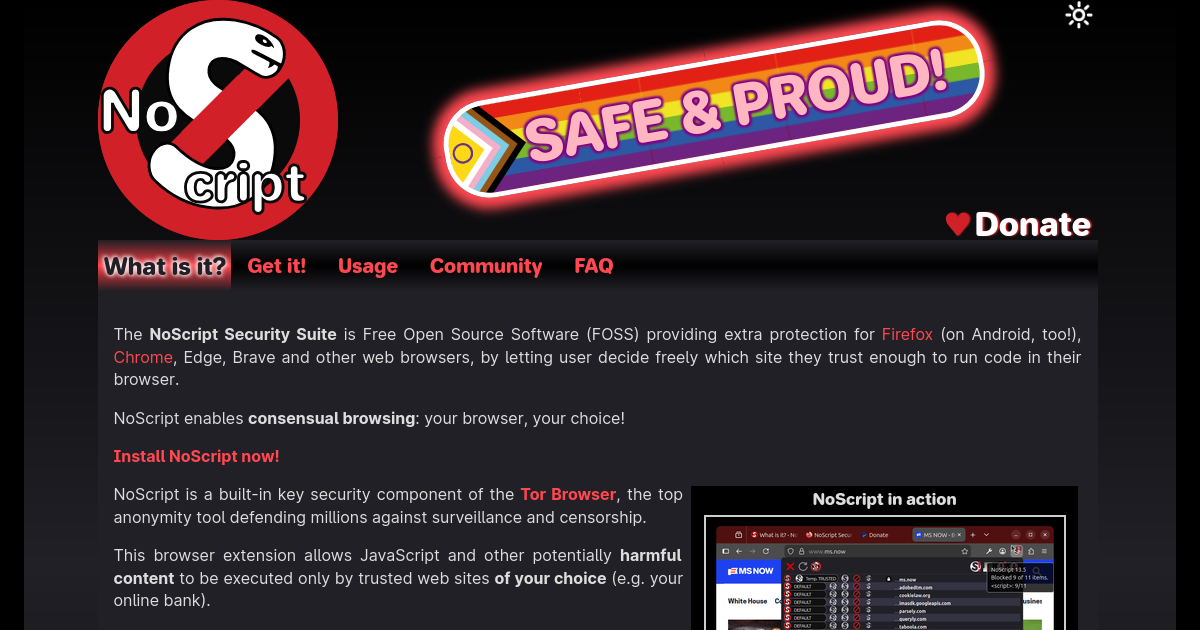
What is it? - NoScript: consensual browsing!
The NoScript Security Suite is Free Software protecting Firefox (on Android, too!), Chrome, Edge, Brave and other web browsers. Install NoScript now!
README
This is a browser extension that provides “wormhole” navigation between different AT Protocol/Bluesky services inspired by Dame’s Shortcut. The extension transforms URLs and identifiers from one service to equivalent URLs on other services.
