


Compression Dictionary Transport is a way of using a shared compression dictionary to dramatically reduce the transport size of HTTP responses.
Dictionary Compression is finally here, and it's ridiculously good
Dictionary compression could completely change how applications send data over the web. It's recently gained broad support, and offers absurd real-world...

HTTP Semantics
The Hypertext Transfer Protocol (HTTP) is a stateless application-level protocol for distributed, collaborative, hypertext information systems. This document describes the overall architecture of HTTP, establishes common terminology, and defines aspects of the protocol that are shared by all versions. In this definition are core protocol elements, extensibility mechanisms, and the "http" and "https" Uniform Resource Identifier (URI) schemes. This document updates RFC 3864 and obsoletes RFCs 2818, 7231, 7232, 7233, 7235, 7538, 7615, 7694, and portions of 7230.
Transferable objects - Web APIs | MDN
Transferable objects are objects that own resources that can be transferred from one context to another, ensuring that the resources are only available in one context at a time. Following a transfer, the original object is no longer usable; it no longer points to the transferred resource, and any attempt to read or write the object will throw an exception.
Secure coding technique: Default behavior of Zip libraries can lead to Remote Code Execution - Blog
This week we are going to talk about the default behavior of Zip libraries. If you are an application developer, it is very likely that you have used this before. Most resources that are downloaded over the internet are in zip format, this makes sense; compressed data is smaller, so it downloads faster and consumes less bandwidth.


Semantic Compression
An introduction to the idea that code should be approached with a mindset towards compressing it semantically, rather than orienting it around objects.

Compression is prediction | ngrok blog
Compression and LLMs are trying to solve the exact same problem: predicting what comes next. Learn the fundamentals of compression and how better prediction leads to better shrinkage.


rfcs/atproto/001-private-content.md at main · knasher/rfcs
Technical RFCs and design proposals for protocols and systems - knasher/rfcs
Streaming Data - AT Protocol Docs - AT Protocol
Synchronizing and streaming data from the AT Protocol.
Concise Binary Object Representation (CBOR)
The Concise Binary Object Representation (CBOR) is a data format whose design goals include the possibility of extremely small code size, fairly small message size, and extensibility without the need for version negotiation. These design goals make it different from earlier binary serializations such as ASN.1 and MessagePack. This document obsoletes RFC 7049, providing editorial improvements, new details, and errata fixes while keeping full compatibility with the interchange format of RFC 7049. It does not create a new version of the format.
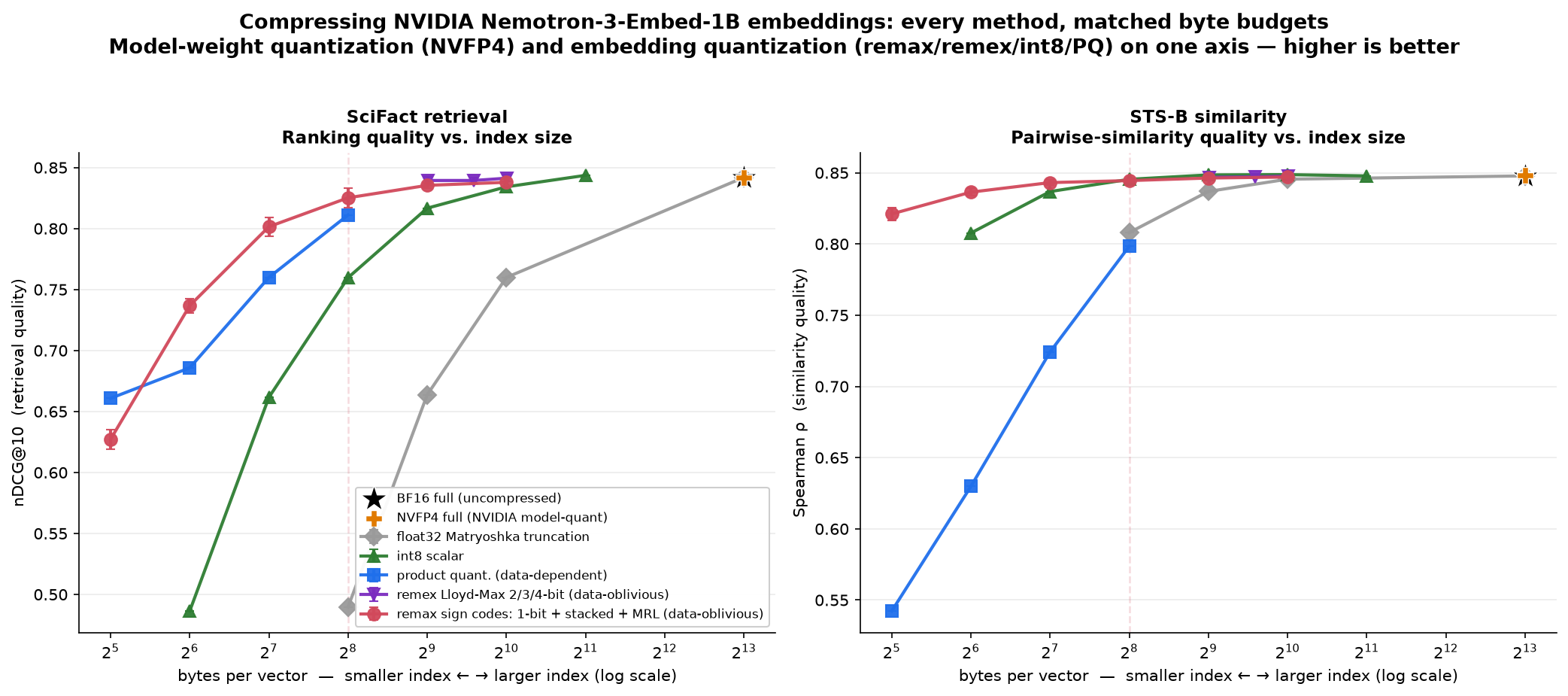
A 4-Bit Model and a 1-Bit Index
Running NVFP4 Nemotron on a CPU, then mapping every embedding-compression method at matched byte budgets. The two quantizations compose.
Stanford Seminar - IPFS and the Permanent Web
MessagePack: It's like JSON. but fast and small.
MessagePack is an efficient binary serialization format. It lets you exchange data among multiple languages like JSON. But it's faster and smaller. Small integers are encoded into a single byte, and typical short strings require only one extra byte in addition to the strings themselves.
[RFC] Replace HTTP+SSE with new "Streamable HTTP" transport by jspahrsummers · Pull Request #206 · modelcontextprotocol/modelcontextprotocol
This PR introduces the Streamable HTTP transport for MCP, addressing key limitations of the current HTTP+SSE transport while maintaining its advantages. Our deep appreciation to @atesgoral and @top...
interesting: reference pds hard-codes express' compression middleware, so bluesky must be explicitly stripping `Accept-Encoding` request header in HAProxy? ...costing them >2x egress bandwidth, but potentially saving CPU. many indie hosts really struggle with it. cc @calabro.io any insight?

fig (aka:[phil])
a few million straggler repos left but rougly: ~4.5TB as uncompressed CARs, also what has to be sent over the wire. hosts that apply *any* negotiated compression (`Accept-Encoding`) find great effect: >50% reduction in bytes transferred. Bluesky doesn't so it's moot. @bsky.app you should do this.