EmbeddingGemma 2 is a compact, open-source multimodal embedding model that maps text, code, images, video, and audio into a unified 768-dimensional space. Developers can use the sentence-transformers library to selectively load modular modality encoders—ranging from 270M to 740M parameters—to optimize memory usage. Additionally, Matryoshka Representation Learning enables dynamic dimension truncation down to 128d, significantly reducing vector database storage requirements while maintaining high retrieval performance.
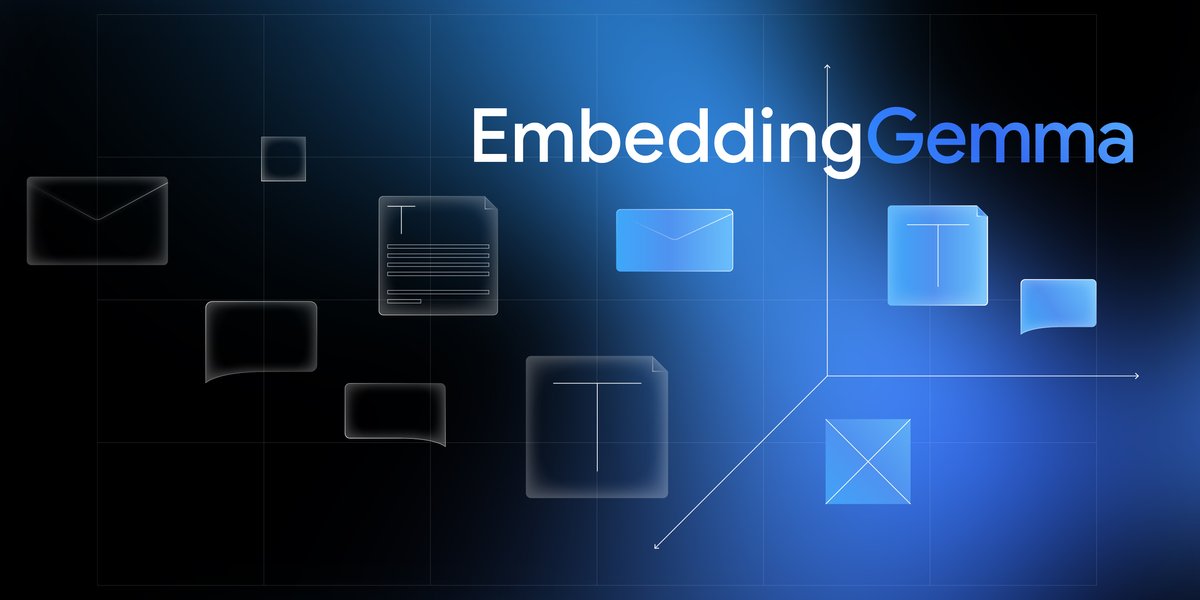
EmbeddingGemma: Powerful and Lightweight Text Representations
We introduce EmbeddingGemma, a new lightweight, open text embedding model based on the Gemma 3 language model family. Our innovative training recipe strategically captures knowledge from larger models via encoder-decoder initialization and geometric embedding distillation. We improve model robustness and expressiveness with a spread-out regularizer, and ensure generalizability by merging checkpoints from varied, optimized mixtures. Evaluated on the Massive Text Embedding Benchmark (MTEB) across multilingual, English, and code domains, EmbeddingGemma (300M) achieves state-of-the-art results. Notably, it outperforms prior top models, both proprietary and open, with fewer than 500M parameters, and provides performance comparable to models double its size, offering an exceptional performance-to-cost ratio. Remarkably, this lead persists when quantizing model weights or truncating embedding outputs. This makes EmbeddingGemma particularly well-suited for low-latency and high-throughput use cases such as on-device applications. We provide ablation studies exploring our key design choices. We release EmbeddingGemma to the community to promote further research.

EmbeddingGemma 2: an open, lightweight multimodal embedding model
Introducing EmbeddingGemma 2, an open multimodal embedding model optimized for privacy-first use cases
Google for Developers Blog - News about Web, Mobile, AI and Cloud
Discover EmbeddingGemma, Google's new on-device embedding model designed for efficient on-device AI, enabling features like RAG and semantic search.
The Beginner’s Guide to Text Embeddings & Techniques | deepset Blog
Text embeddings represent human language to computers, enabling tasks like semantic search. Here, we introduce sparse and dense vectors in a non-technical way.

Fast Embeddings on GPUs
Fast and accurate search is vital to all of Perplexity, from Search and Computer to our API Platform. Behind the scenes, the heavy lifting is done by embedding

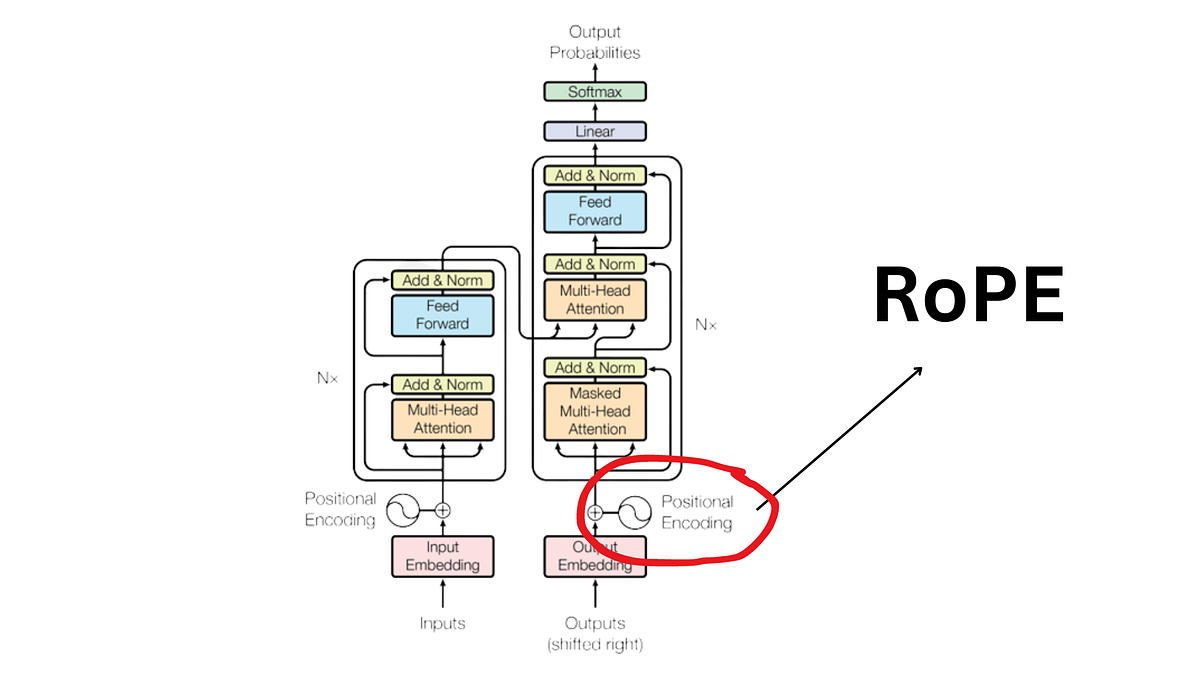
Rotary Positional Embeddings: A Detailed Look and Comprehensive Understanding
Since the “Attention Is All You Need” paper in 2017, the Transformer architecture has been a cornerstone in the realm of Natural Language…
MCIF: Multimodal Crosslingual Instruction-Following Benchmark from Scientific Talks
Recent advances in large language models have laid the foundation for multimodal LLMs (MLLMs), which unify text, speech, and vision within a single framework. As these models are rapidly evolving toward general-purpose instruction following across diverse and complex tasks, a key frontier is evaluating their crosslingual and multimodal capabilities over both short- and long-form inputs. However, existing benchmarks fall short in evaluating these dimensions jointly: they are often limited to English, mostly focus on a single modality at a time, rely on short-form inputs, or lack human annotations--hindering comprehensive assessment of model performance across languages, modalities, and task complexity. To address these gaps, we introduce MCIF (Multimodal Crosslingual Instruction Following), the first crosslingual human-annotated benchmark based on scientific talks on NLP and beyond. MCIF evaluates instruction following in crosslingual, multimodal settings over different input lengths and spans four macro-tasks: recognition, translation, question answering, and summarization. It covers three core modalities (speech, vision, and text) and four diverse languages (English, German, Italian, and Chinese), fully aligned across all dimensions. This parallel design enables a systematic evaluation of MLLMs' abilities to interpret instructions across languages and effectively integrate multimodal contextual information. Our benchmarking and analysis of 23 models highlight universal challenges across modalities and tasks, indicating substantial room for improvement in future MLLMs development. MCIF is released under CC-BY 4.0 license to promote open research.
Precise Zero-Shot Dense Retrieval without Relevance Labels
While dense retrieval has been shown effective and efficient across tasks and languages, it remains difficult to create effective fully zero-shot dense retrieval systems when no relevance label is available. In this paper, we recognize the difficulty of zero-shot learning and encoding relevance. Instead, we propose to pivot through Hypothetical Document Embeddings~(HyDE). Given a query, HyDE first zero-shot instructs an instruction-following language model (e.g. InstructGPT) to generate a hypothetical document. The document captures relevance patterns but is unreal and may contain false details. Then, an unsupervised contrastively learned encoder~(e.g. Contriever) encodes the document into an embedding vector. This vector identifies a neighborhood in the corpus embedding space, where similar real documents are retrieved based on vector similarity. This second step ground the generated document to the actual corpus, with the encoder's dense bottleneck filtering out the incorrect details. Our experiments show that HyDE significantly outperforms the state-of-the-art unsupervised dense retriever Contriever and shows strong performance comparable to fine-tuned retrievers, across various tasks (e.g. web search, QA, fact verification) and languages~(e.g. sw, ko, ja).
Gökdeniz Gülmez on Twitter / X
🚀 introducing mlx-embeddings-lora v1.0.5!„pip install -U mlx-embeddings-lora“Train your own text embedding models locally on Apple Silicon 🍏 using contrastive learning + LoRA fine-tuning — no GPUs, no cloud, just pure MLX speed.💡 Built on mlx-embeddings🧠 Supports LoRA…— Gökdeniz Gülmez (@ActuallyIsaak) November 13, 2025
Overcoming Vocabulary Constraints with Pixel-level Fallback
Subword tokenization requires balancing computational efficiency and vocabulary coverage, which often leads to suboptimal performance on languages and scripts not prioritized during training. We propose to augment pretrained language models with a vocabulary-free encoder that generates input embeddings from text rendered as pixels. Through experiments on English-centric language models, we demonstrate that our approach substantially improves machine translation performance and facilitates effective cross-lingual transfer, outperforming tokenizer-based methods. Furthermore, we find that pixel-based representations outperform byte-level approaches and standard vocabulary expansion. Our approach enhances the multilingual capabilities of monolingual language models without extensive retraining and reduces decoding latency via input compression.
transformers/src/transformers/models/auto/tokenization_auto.py at 1d5296f2de31ecee4fdd789dc2b2fe068b320284 · huggingface/transformers
🤗 Transformers: the model-definition framework for state-of-the-art machine learning models in text, vision, audio, and multimodal models, for both inference and training. - huggingface/transformers
Scaling Monosemanticity: Extracting Interpretable Features from Claude 3 Sonnet
We demonstrate that sparse autoencoders can extract interpretable features from Claude 3 Sonnet, a production-scale language model, addressing the open question of whether dictionary learning methods scale beyond small transformers. We trained sparse autoencoders with up to 34 million features on the model's middle layer residual stream, using scaling laws to guide hyperparameter selection. The resulting features are multilingual and multimodal (generalizing to images despite text-only training), respond to both concrete instances and abstract discussions of concepts, and can be used to steer model behavior in ways consistent with their interpretations. We find features corresponding to famous entities and locations, as well as more abstract concepts like sarcasm or errors in code. We also identify features relevant to ways in which language models might cause harm--including features representing deception, power-seeking, sycophancy, and bias--and show that these causally influence model outputs when manipulated. Additionally, we conduct analyses of feature interpretability, geometry, and computational function. However, significant limitations remain: our suite of features is incomplete, and we lack rigorous methods for evaluating whether our features faithfully capture model computations.
Scaling Monosemanticity: Extracting Interpretable Features from Claude 3 Sonnet
We demonstrate that sparse autoencoders can extract interpretable features from Claude 3 Sonnet, a production-scale language model, addressing the open question of whether dictionary learning methods scale beyond small transformers. We trained sparse autoencoders with up to 34 million features on the model's middle layer residual stream, using scaling laws to guide hyperparameter selection. The resulting features are multilingual and multimodal (generalizing to images despite text-only training), respond to both concrete instances and abstract discussions of concepts, and can be used to steer model behavior in ways consistent with their interpretations. We find features corresponding to famous entities and locations, as well as more abstract concepts like sarcasm or errors in code. We also identify features relevant to ways in which language models might cause harm--including features representing deception, power-seeking, sycophancy, and bias--and show that these causally influence model outputs when manipulated. Additionally, we conduct analyses of feature interpretability, geometry, and computational function. However, significant limitations remain: our suite of features is incomplete, and we lack rigorous methods for evaluating whether our features faithfully capture model computations.
LAION-5B: An open large-scale dataset for training next generation image-text models
Groundbreaking language-vision architectures like CLIP and DALL-E proved the utility of training on large amounts of noisy image-text data, without relying on expensive accurate labels used in standard vision unimodal supervised learning. The resulting models showed capabilities of strong text-guided image generation and transfer to downstream tasks, while performing remarkably at zero-shot classification with noteworthy out-of-distribution robustness. Since then, large-scale language-vision models like ALIGN, BASIC, GLIDE, Flamingo and Imagen made further improvements. Studying the training and capabilities of such models requires datasets containing billions of image-text pairs. Until now, no datasets of this size have been made openly available for the broader research community. To address this problem and democratize research on large-scale multi-modal models, we present LAION-5B - a dataset consisting of 5.85 billion CLIP-filtered image-text pairs, of which 2.32B contain English language. We show successful replication and fine-tuning of foundational models like CLIP, GLIDE and Stable Diffusion using the dataset, and discuss further experiments enabled with an openly available dataset of this scale. Additionally we provide several nearest neighbor indices, an improved web-interface for dataset exploration and subset generation, and detection scores for watermark, NSFW, and toxic content detection.
Linkup - SPARSEUP: Linkup's Open-Source Sparse Embedding Model
Linkup Research releases SPARSEUP, an open-source sparse embedding model under 150M parameters. SOTA on BEIR-13, sub-millisecond retrieval, Apache 2.0 license.