

Diátaxis is a widely-adopted, pragmatic and systematic approach to thinking about and creating documentation.
Documentation is more than you think
Everything that is involved in making great documentation everywhere and all at once.
Why good non-techie user documentation is vital for a wider embrace of the ATmosphere - Debbie's Blatherings - by Debbie Ridpath Ohi
Plus tips on writing good user documentation
Making Documentation Simpler and Practical: Our Docs-as-Code Journey — Squarespace Engineering Blog
In the fast-paced world of software development, documentation often gets a bad rap. It's perceived as a chore, a necessary evil, and sometimes, unfortunately, an afterthought. But what if writing documentation could be as dynamic and collaborative as writing the code itself? What if it could be si

Docs as Code: The Best Guide for Technical Writers
Recently, my work has involved writing a lot of documentation and. Doing this has introduced me to...

The Good Docs Project · GitLab
The Good Docs Project educates and empowers people to create high-quality documentation by providing them with templates, resources, best practices, and tools to enhance their documentation in open...

Full featured documentation deployment platform
Read the Docs is a documentation building and hosting platform aimed at helping developers creating documentation from code with versioned documentation, integrated search, pull request previews and more.

The Lore Version Control System - Lore Developer Documentation
A reference document explaining the rationale, goals, and theoretical design of Lore. This is not a peer-reviewed paper; it is a public-facing standalone description of the system, intended to make the why of Lore - the problems it was built to solve and the design choices that follow from those problems - as legible as a reader can make it without reading the source code.
OASIS Darwin Information Typing Architecture (DITA) TC — Subcommittee | OASIS
Advancing a document creation and management specification that builds content reuse into the authoring process
Getting started - Docs
Discourse Graphs are a tool and ecosystem for collaborative knowledge synthesis, enabling researchers to map ideas and arguments in a modular, composable graph format.
Docs-as-code: A Brief Introduction
Docs-as-code means “documentation as code.” It is an approach where documentation teams create and manage documentation using the same…
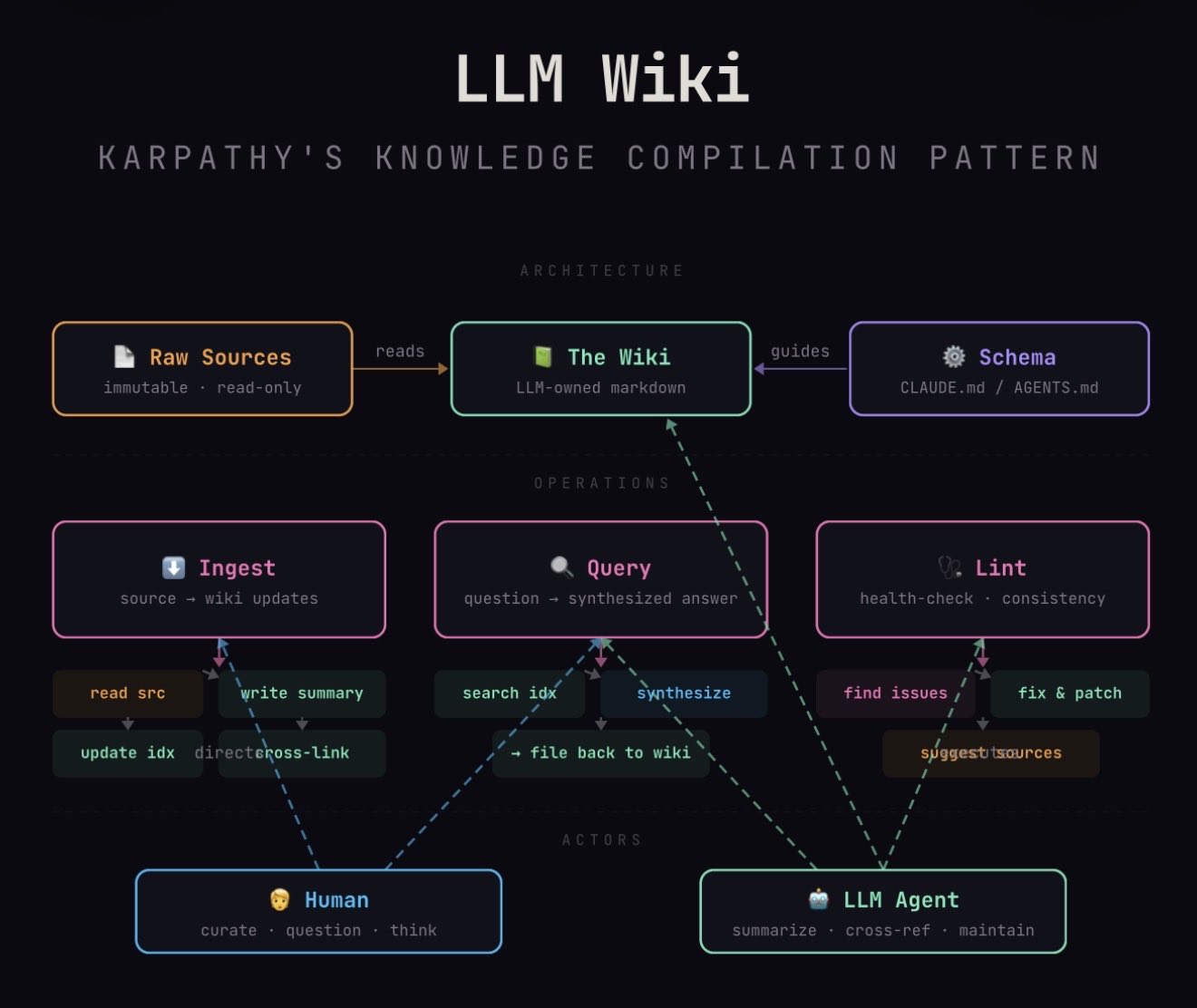
Yuchen Jin on Twitter / X
Karpathy’s “LLM Wiki” pattern: stop using LLMs as search engines over your docs. Use them as tireless knowledge engineers who compile, cross-reference, and maintain a living wiki. Humans curate and think.Diagram generated by my Claude agent knowledge worker. https://t.co/5u5i1GeFK8 pic.twitter.com/NIaq3KlAok— Yuchen Jin (@Yuchenj_UW) April 4, 2026
Steps Towards an Infrastructure for Scholarly Synthesis
Sharing, reusing, and synthesizing knowledge is central to the research process, both individually, and with others. These core functions are not supported by our formal scholarly publishing infrastructure: instead of the smooth functioning of functional infrastructure, researchers resort to laborious ”hacks” and workarounds to ”mine” publications for what they need, and struggle to efficiently share the resulting information with others. Information scientists have proposed an alternative infrastructure based on the more appropriately granular model of a discourse graph of claims, and evidence, along with key rhetorical relationships between them. However, despite significant technical progress on standards and platforms, the predominant infrastructure remains steadfastly document-based. Drawing from infrastructure studies, we locate the current infrastructural bottlenecks in the lack of local systems that integrate discourse-centric models to augment synthesis work, from which an infrastructure for synthesis can be grown. Through 3 years of research through design and field deployment in a distributed community of hypertext notebook users, we elaborate a design vision of what can and should be built in order to grow a discourse-centric synthesis infrastructure: a thriving “installed base” of researchers authoring local, shareable discourse graphs to improve synthesis work, enhance primary research and research training, and augment collaborative research. We discuss how this design vision — and our empirical work — contributes steps towards a new infrastructure for synthesis, and increases HCI’s capacity to advance collective intelligence and solve infrastructure-level problems.
Steps Towards an Infrastructure for Scholarly Synthesis
Sharing, reusing, and synthesizing knowledge is central to the research process, both individually, and with others. These core functions are not supported by our formal scholarly publishing infrastructure: instead of the smooth functioning of functional infrastructure, researchers resort to laborious "hacks" and workarounds to "mine" publications for what they need, and struggle to efficiently share the resulting information with others. Information scientists have proposed an alternative infrastructure based on the more appropriately granular model of a discourse graph of claims, and evidence, along with key rhetorical relationships between them. However, despite significant technical progress on standards and platforms, the predominant infrastructure remains steadfastly document-based. Drawing from infrastructure studies, we locate the current infrastructural bottlenecks in the lack of local systems that integrate discourse-centric models to augment synthesis work, from which an infrastructure for synthesis can be grown. Through 3 years of research through design and field deployment in a distributed community of hypertext notebook users, we elaborate a design vision of what can and should be built in order to grow a discourse-centric synthesis infrastructure: a thriving "installed base" of researchers authoring local, shareable discourse graphs to improve synthesis work, enhance primary research and research training, and augment collaborative research. We discuss how this design vision -- and our empirical work -- contributes steps towards a new infrastructure for synthesis, and increases HCI's capacity to advance collective intelligence and solve infrastructure-level problems.

AT Docs

Documentações e tutoriais úteis relacionados com ATProto

Putting my Neocities blog on ATProto

Understanding Standard.Site

Publishing your blog to standard.site in Elixir | jola.dev

Get Started | Bluesky Protocol Services
API documentation | Hubble

Creating a did:web atproto account using goat | bryan newbold