

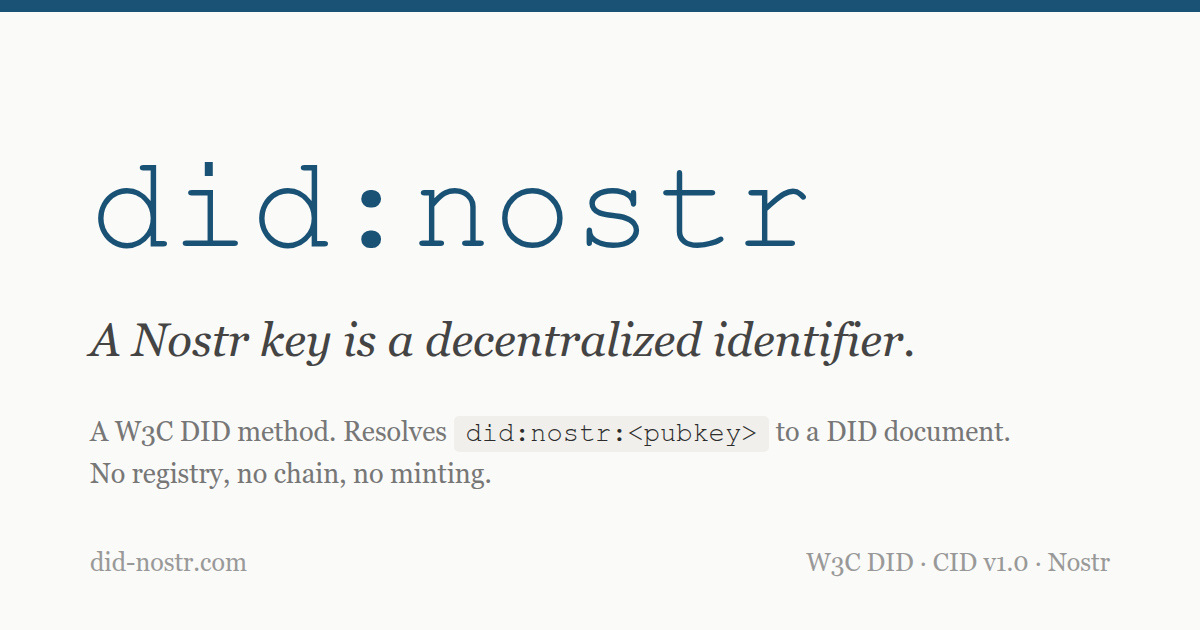
A W3C DID method where a Nostr public key resolves to a DID document. No registry, no chain, no minting.
Nostr - Notes and Other Stuff Transmitted by Relays
Nostr is an inclusive communication commons. A simple standard that defines a scalable architecture of clients and servers that can be used to spread information freely. Not controlled by any corporation or government, anyone can build on Nostr and anyone can use it.
nostr - controlled by users, not platforms
Nostr is a free and open-source protocol for social media and other things - controlled by users, not platforms.
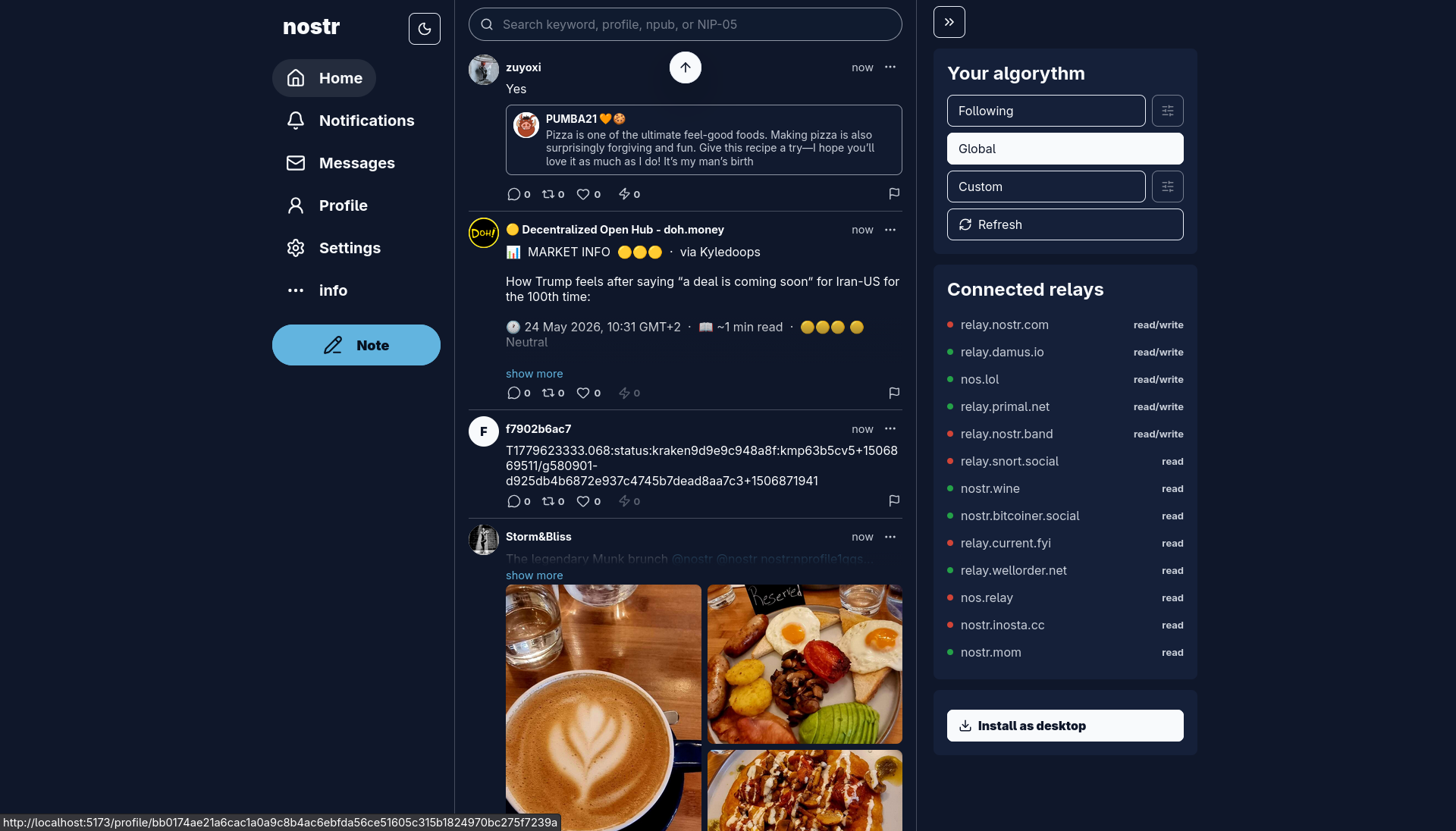
Building Nostr - A Guide for Developers
Web of Trust | Nostr Compass
Technical resource for the Nostr protocol. Weekly newsletter covering NIP proposals, client updates, relay developments, and notable code changes.
Trusted Assertions by vitorpamplona · Pull Request #1534 · nostr-protocol/nips
Certain calculations in Nostr require access to the entire dataset of events and are impossible to do directly by Clients. This PR offers a simple way for users to declare trust in service provider...
Explore Nostr Apps
Join your peers in a healthy social network. Nos is our Nostr client for humans, not algorithms.

From ZK-first to AT Protocol — our path to DDS | Agora Citizen Network
We've been building Agora — a platform for public deliberation using Polis-style clustering — for a while now. Along the way, we've written about what we think about Nostr, AT Protocol, Polis, Community Notes, and protocol interoperability. Those posts are somewhat outdated now. This one describes w...

did-method-plc/did-method-plc
Public Ledger of Credentials: a cryptographic, strongly-consistent, and recoverable DID method
Keytrace takes ideas from Keybase and Keyoxide and brings them to the decentralized web.
Thoughts on "Nostr and ATProto" | bryan newbold (⛱️ sabbatical mode)
These are some quick notes on @shreyanjain.net's Nostr and ATProto write-up. Overall: omg this thing is a book. Lauditory! It is really great to see this discussed in depth and detail. I don't know whether to be embarassed that we didn't write up something like this much earlier, or proud that thin...
&handle=@bnewbold.net&avatar=https://cdn.bsky.app/img/avatar/plain/did:plc:44ybard66vv44zksje25o7dz/bafkreiglnysron3h2je7nf6cmvtimuaxi7xe2c7rkxitmks3mzmajnc2ou)
Keyoxide Docs
Keyoxide is a privacy-friendly tool to create and verify decentralized online identities.
Thoughts on "Nostr and ATProto" | bryan newbold
These are some quick notes on @shreyanjain.net's Nostr and ATProto write-up. Overall: omg this thing is a book. Lauditory! It is really great to see this discussed in depth and detail. I don't know whether to be embarassed that we didn't write up something like this much earlier, or proud that thin...

did:plc Specification v0.1
DID PLC is a self-authenticating DID which is strongly-consistent, recoverable, and allows for key rotation.
Decentralized Identifiers (DIDs) v1.0
Decentralized identifiers (DIDs) are a new type of identifier that enables verifiable, decentralized digital identity. A DID refers to any subject (e.g., a person, organization, thing, data model, abstract entity, etc.) as determined by the controller of the DID. In contrast to typical, federated identifiers, DIDs have been designed so that they may be decoupled from centralized registries, identity providers, and certificate authorities. Specifically, while other parties might be used to help enable the discovery of information related to a DID, the design enables the controller of a DID to prove control over it without requiring permission from any other party. DIDs are URIs that associate a DID subject with a DID document allowing trustable interactions associated with that subject.
Revisiting Keyed-Verification Anonymous Credentials
This summary was generated using automated tools and was not authored or reviewed by the article's author(s). It is provided to support discovery, help readers assess relevance, and assist readers from adjacent research areas in understanding the work. It is intended to complement the author-supplied abstract, which remains the primary summary of the paper. The full article remains the authoritative version of record. Click here to learn more.
