

GNOME and KDE have started to consider LLM policies, and we should talk about what this is really about. KDE caught everyone's attention first by...
Scott Jenson: Are we really going to use the same Desktop UX forever?
Scott Jenson: Are we really going to use the same Desktop UX forever?
Scott Jenson: Are we really going to use the same Desktop UX forever?
Which direction is forward?
Software role changes tell us something about the goals in LLM deployment.
The Zig project's rationale for their firm anti-AI contribution policy
Zig has one of the most stringent anti-LLM policies of any major open source project: No LLMs for issues. No LLMs for pull requests. No LLMs for comments on the …
The Zig project's rationale for their firm anti-AI contribution policy
Zig has one of the most stringent anti-LLM policies of any major open source project: No LLMs for issues. No LLMs for pull requests. No LLMs for comments on the …
There continue to be reasons for software to be slow
A discussion on the various reasons why performance is slow, and which ones are unlikely to be affected by LLMs. Originally written as a counter-point to Dan Luu
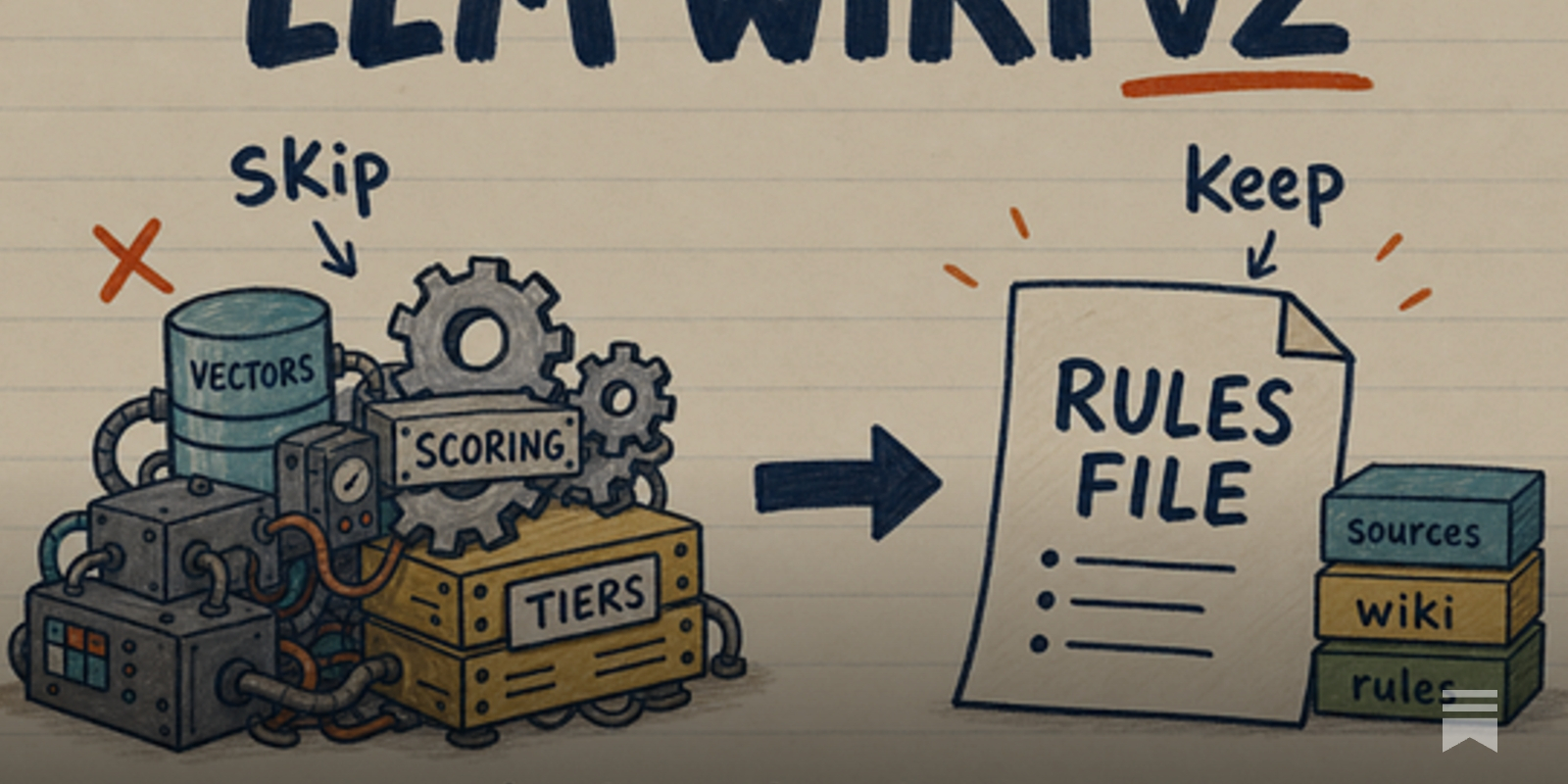
Karpathy's LLM Wiki v2: What to Keep, What to Skip
I rebuilt it, ran it daily for months, and most of the v2 hype is overkill.
open-slopware
Free/Open Source Software choosing to use and/or support LLM usage/AI, as well as alternatives and tips to requesting better policies or forking.
GPT Cloud Cover
Over on Bluesky, Zerodartz comments on the deluge of LLM-spewed content that’s already happening, and only likely to get worse: AI will be 99.9% of content in internet in a few years nobody is...
Andrew Ho on Twitter / X
Not really observations that others before me haven’t made, but:- Despite the seemingly magical nature of LLMs, reflection over a >3 month timescale suggests my total productivity hasn’t increased by over 100%, or perhaps even by over 50%, and a lot of time is actually wasted…— Andrew Ho (@andrewho03) September 3, 2026
Why KDE is Important
State of AI 2025: 100T Token LLM Usage Study | OpenRouter
Read OpenRouter's 2025 State of AI report — an empirical 100 trillion token study of real LLM usage, model trends, and developer insights.
Instant LLM Updates with Doc-to-LoRA and Text-to-LoRA
Recent LLM agents have shown impressive capabilities on complex computer use and long-horizon tasks. Yet, they still struggle with long-term memory and adaptation--two of the most important cognitive capabilities that still limit LLMs today. Without long-term memory, users have to provide LLMs with relevant content at the start of every new session, creating friction, discontinuity, and longer time-to-response. Additionally, due to the lack of adaptation, they do not learn from mistakes or user preferences from previous sessions, making each interaction as cumbersome as the first. Traditionally, these two problems are tackled by "updating" the model.
