

These guidelines help providers and deployers of AI systems and competent authorities in ensuring compliance with the transparency obligations under Article 50 of the AI Act.
Guidelines on transparency obligations for providers and deployers of AI systems
These guidelines define the scope of transparency obligations for providers and deployers of AI systems under article 50 of the AI Act.
Code of Practice on Transparency of AI-generated Content
This code of practice supports compliance with the AI Act transparency obligations related to marking and labelling of AI-generated content.
AI Principles
A guiding framework for our responsible development and use of AI, alongside transparency and accountability in our AI development process.

Guest Post — Research Needs a Shared Standard for AI Disclosure - The Scholarly Kitchen
Today's guest post presents outcomes of the WCRI's (World Conferences on Research Integrity) Focus Track to address this gap in clarity and standardization of AI disclosure.

GDPR for AI Systems: 2026 Compliance Guide (with EU AI Act Updates)
How to make AI systems GDPR-compliant in 2026 — the practitioner roadmap covering EU AI Act overlap, EDPB Opinion 28/2024, DPIAs, data minimization, sub-processor cascades, and the technical controls lawyers don't explain.
Responsible use of AI in the military? US publishes declaration outlining principles
12 "best practices" for using AI and autonomous systems emphasize human accountability.

Where AI Regulation Stands Today
The White House has released a National Artificial Intelligence Legislative Framework and new executive orders aiming to establish a single, nationwide standard for AI regulation...

AI Policy - Taylor & Francis
Learn about Taylor & Francis' AI Policy, which provides guidelines on the ethical use of artificial intelligence in research, publishing, and content creation to maintain integrity and transparency.

AI Agent Standards: Navigating New NIST Governance | Nemko Digital
NIST's new AI agent standards are here. Learn what they mean for AI governance, compliance, and liability. Get ahead of the new regulations.

Responsible AI Principles and Approach | Microsoft AI
Discover Microsoft AI tools, industry-specific governance solutions, and responsible AI practices to make smarter, more informed decisions about AI implementation.

The 2025 AI Agent Index Documenting Technical and Safety Features of Deployed Agentic AI Systems
Agentic AI systems are increasingly capable of performing professional and personal tasks with limited human involvement. However, tracking these developments is difficult because the AI agent ecosystem is complex, rapidly evolving, and inconsistently documented, posing obstacles to both researchers and policymakers. To address these challenges, this paper presents the 2025 AI Agent Index. The Index documents information regarding the origins, design, capabilities, ecosystem, and safety features of 30 state-of-the-art AI agents based on publicly available information and email correspondence with developers. In addition to documenting information about individual agents, the Index illuminates broader trends in the development of agents, their capabilities, and the level of transparency of developers. Notably, we find different transparency levels among agent developers and observe that most developers share little information about safety, evaluations, and societal impacts. The 2025 AI Agent Index is available online at https://aiagentindex.mit.edu.
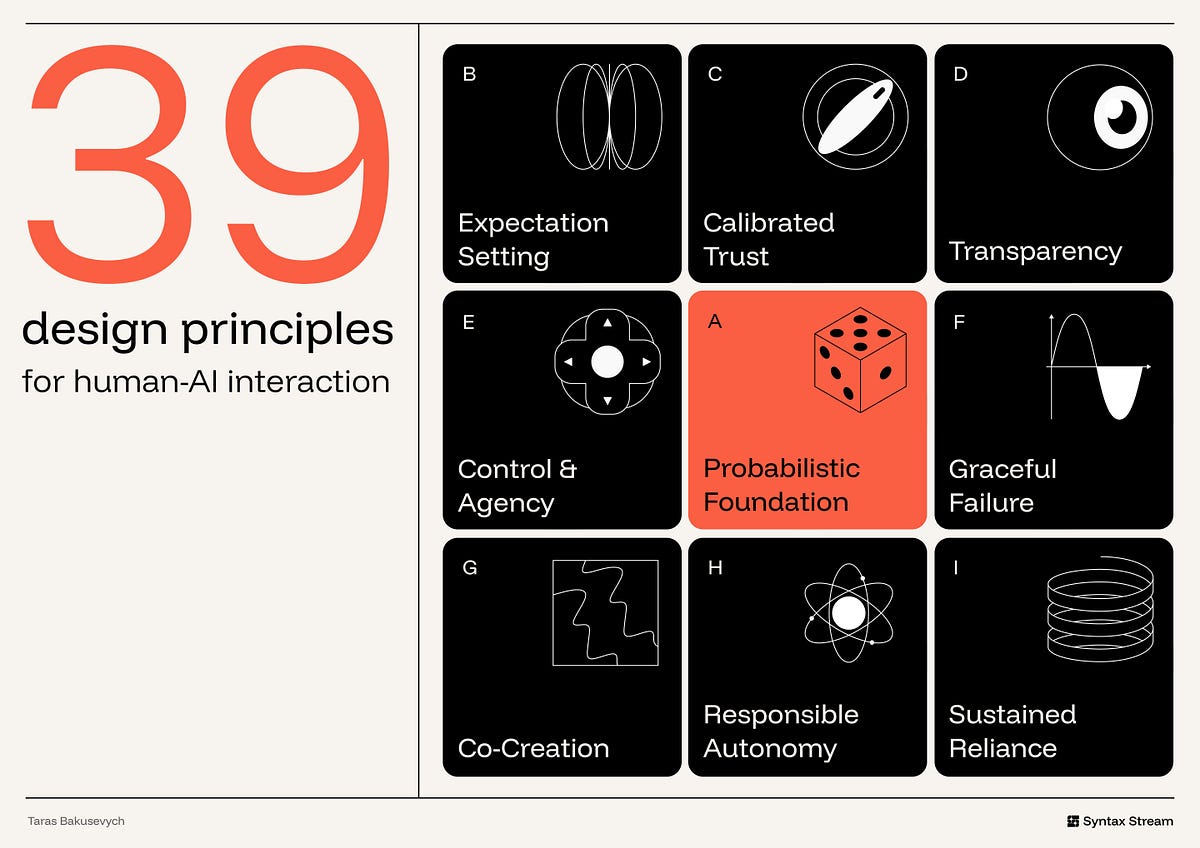
39 principles for designing human-AI interaction
An applied framework for designing AI interfaces that support appropriate reliance, user control, transparency, and responsible autonomy.
The 2025 AI Agent Index: Documenting Technical and Safety Features of Deployed Agentic AI Systems
Agentic AI systems are increasingly capable of performing professional and personal tasks with limited human involvement. However, tracking these developments is difficult because the AI agent ecosystem is complex, rapidly evolving, and inconsistently documented, posing obstacles to both researchers and policymakers. To address these challenges, this paper presents the 2025 AI Agent Index. The Index documents information regarding the origins, design, capabilities, ecosystem, and safety features of 30 state-of-the-art AI agents based on publicly available information and email correspondence with developers. In addition to documenting information about individual agents, the Index illuminates broader trends in the development of agents, their capabilities, and the level of transparency of developers. Notably, we find different transparency levels among agent developers and observe that most developers share little information about safety, evaluations, and societal impacts. The 2025 AI Agent Index is available online at https://aiagentindex.mit.edu

The 2025 AI Agent Index: Documenting Technical and Safety Features of Deployed Agentic AI Systems
Agentic AI systems are increasingly capable of performing professional and personal tasks with limited human involvement. However, tracking these developments is difficult because the AI agent ecosystem is complex, rapidly evolving, and inconsistently documented, posing obstacles to both researchers and policymakers. To address these challenges, this paper presents the 2025 AI Agent Index. The Index documents information regarding the origins, design, capabilities, ecosystem, and safety features of 30 state-of-the-art AI agents based on publicly available information and email correspondence with developers. In addition to documenting information about individual agents, the Index illuminates broader trends in the development of agents, their capabilities, and the level of transparency of developers. Notably, we find different transparency levels among agent developers and observe that most developers share little information about safety, evaluations, and societal impacts. The 2025 AI Agent Index is available online at https://aiagentindex.mit.edu
A Cross‐Disciplinary Analysis of <span style="font-variant:small-caps;">AI</span> Policies in Academic Peer Review
ABSTRACT Rapid advances of artificial intelligence (AI) have substantially impacted the field of academic publishing. This study examines AI integration in peer review by analysing policies from 439 high‐ and 363 middle‐impact factor (IF) journals across disciplines. Using grounded theory, we identify patterns in AI policy adoption. Results show 83% of high‐IF journals have AI guidelines, with varying stringency across disciplines. Meanwhile, only 75% of middle‐IF journals have AI guidelines. Science, technology, and medicine (STM) disciplines exhibit stricter regulations, while humanities and social sciences adopt more lenient approaches. Key ethical concerns focus on confidentiality risks, accountability gaps, and AI's inability to replicate critical human judgement. Publisher policies emphasise transparency, human oversight, and restricted AI usage for auxiliary tasks only, such as grammar checks or reviewer finding. Disciplinary differences highlight the need for tailored guidelines that balance efficiency gains with research integrity. This study proposes collaborative frameworks for responsible AI integration. It focuses on accountability, transparency, and interdisciplinary policy development to address peer review challenges. , Key Points Application of AI tools in peer review has received increasing attention. Among the 439 high‐IF journals investigated, 83% provided AI policies for peer review, while 75% of middle‐IF journals did so. AI policies focus on confidentiality risks, accountability gaps, and capacity deficiencies of AI. AI policies for peer review vary according to the affiliated publishers and disciplines. Tailored AI guidelines need to be established according to the discipline.

trace-spec/ROADMAP.md at 738358dfac58047eaf689ca824f9e15008aabf36 · agentrust-io/trace-spec
TRACE: Trust Runtime Attestation and Compliance Evidence. Open attestation standard for agentic AI governance. - agentrust-io/trace-spec