How does local news impact a county’s registered voter population, associated voting patterns, and political participation? Electoral turnout is one of the most studied topics in political science, and substantial research exists into demographic factors — including race, age, and socioeconomic status — that influence an individual’s likelihood to vote. Recent studies have begun to examine the impact of societal factors — such as the internet, social media, and news — on an individual’s ability to and likelihood of fulfilling their civic obligation. This paper explores the relationship between expanding news deserts and decreasing voter turnout, proposing that as a county loses access to local news — measured through disappearance of local papers and fluctuation in circulation — its voter turnout will likewise decrease. This hypothesis was tested by gathering newspaper circulation, registered voter, and final votes cast data for each of Nebraska’s 93 counties for four separate election years and running a regression of that data alongside multiple control variables and potential confounders. The data and regression supported this hypothesis, showing a relatively large and significant correlation between the two variables, suggesting that drops in local newspaper circulation decrease voter turnout rates. Faculty mentors: Matt Waite, Jill Martin, Dona-Gene Bartin
News Deserts Leave Voters Vulnerable to Election Misinformation
The disappearance of local news outlets means Americans across the country turn to less reliable online sources for election information.

The Effects of Canvassing, Telephone Calls, and Direct Mail on Voter Turnout: A Field Experiment.
Gerber, Alan S. & Donald P. Green (2000) “The Effects of Canvassing, Telephone Calls, and Direct Mail on Voter Turnout: A Field Experiment.” American Political Science Review 94(3):653-663.
Historical Voter Turnout | NYC Open Data
An Overlooked — and Increasingly Important — Clue to How People Vote
Most election post-mortems neglect a key determinant of how people vote — where they get their news.

Local News and National Politics
The level of journalistic resources dedicated to coverage of local politics is in a long-term decline in the US news media, with readership shifting to national outlets. We investigate whether this trend is demand- or supply-driven, exploiting a recent wave of local television station acquisitions by a conglomerate owner. Using extensive data on local news programming and viewership, we find that the ownership change led to (1) substantial increases in coverage of national politics at the expense of local politics, (2) a significant rightward shift in the ideological slant of coverage, and (3) a small decrease in viewership, all relative to the changes at other news programs airing in the same media markets. These results suggest a substantial supply-side role in the trends toward nationalization and polarization of politics news, with negative implications for accountability of local elected officials and mass polarization.

Local News and National Politics
The level of journalistic resources dedicated to coverage of local politics is in a long-term decline in the US news media, with readership shifting to national outlets. We investigate whether this trend is demand- or supply-driven, exploiting a recent wave of local television station acquisitions by a conglomerate owner. Using extensive data on local news programming and viewership, we find that the ownership change led to (1) substantial increases in coverage of national politics at the expense of local politics, (2) a significant rightward shift in the ideological slant of coverage, and (3) a small decrease in viewership, all relative to the changes at other news programs airing in the same media markets. These results suggest a substantial supply-side role in the trends toward nationalization and polarization of politics news, with negative implications for accountability of local elected officials and mass polarization.
Don’t dwell on “democracy,” and other new findings about how to market local news
"Here’s the paradox: 93% of people believe reliable local news is necessary for democracy, yet many of these same people react negatively to explicit 'democracy' messaging."

Mainstreaming the populist radical right? Online news exposure and voting behavior in the 2019 European Parliament election
How does media exposure relate to support for radical right populist parties (RRPPs)? We contribute to this classic debate by analyzing the web browsing histories and survey responses of six thousand study participants in France, Germany, Italy, Spain, and the UK during the 2019 European Parliament election. Linking direct measures of online news exposure to voting behavior allows us to assess the effects of the salience of issues politicized by RRPPs on their electoral support. The likelihood to vote for RRPPs was higher when the EU was more salient in individual media diets, while exposure to the less salient issue of immigration did not increase the propensity to vote for RRPPs. Alongside consistent results for other party families and interactions with pre-existing voting intentions, the findings indicate that the electoral effects of online media are contingent on the overall salience of a specific issue and voters’ predispositions.

The Minimal Persuasive Effects of Campaign Contact in General Elections: Evidence from 49 Field Experiments
Significant theories of democratic accountability hinge on how political campaigns affect Americans’ candidate choices. We argue that the best estimate of the effects of campaign contact and advertising on Americans’ candidates choices in general elections is zero. First, a systematic meta-analysis of 40 field experiments estimates an average effect of zero in general elections. Second, we present nine original field experiments that increase the statistical evidence in the literature about the persuasive effects of personal contact tenfold. These experiments’ average effect is also zero. In both existing and our original experiments, persuasive effects only appear to emerge in two rare circumstances. First, when candidates take unusually unpopular positions and campaigns invest unusually heavily in identifying persuadable voters. Second, when campaigns contact voters long before election day and measure effects immediately—although this early persuasion decays. These findings contribute to ongoing debates about how political elites influence citizens’ judgments.
How Media – Namely News, Ads and Social Posts – Can Shape an Election
How Media – Namely News, Ads and Social Posts – Can Shape an Election

The Twilight of the Polls? A Review of Trends in Polling Accuracy and the Causes of Polling Misses
Polls have had a number of high-profile misses in recent elections. We review the current polling environment, the performance of polls in a historical context, the mechanisms of polling error, and the causes of several recent misses in Britain and the US. Contrary to conventional wisdom, polling errors have been constant over time, although the level of error has always been substantially beyond that implied by stated margins of error. Generally, there is little evidence that voters lying about their vote intention (so-called ‘shy’ voters) is a substantial cause of polling error. Instead, polling errors have most commonly resulted from problems with representative samples and weighting, undecided voters breaking in one direction, and to a lesser extent late swings and turnout models. We conclude with a discussion of future directions for polling both in terms of fixing the problems identified and new approaches to understanding public opinion.

Reimagining American public media: A key infrastructure for local journalism
As the state of U.S. local journalism continues to deteriorate, contributing to growing news deserts and the proliferation of mis- and disinformation, alternative models for sustaining local news are increasingly paramount. One such alternative to the failing commercial model that deserves more attention, we argue, is the American public media system. While less robust than its international counterparts, the U.S. public media system tends to be less reliant on market support, less subject to commercial pressures, and more devoted to a universal service mission. This study explores to what extent the American public media system may serve to lessen the severity of the local journalism crisis. Drawing on interviews and conversations with two dozen public media practitioners and analysts, our research examines how public media could be reimagined and repurposed to better serve local information needs. We conclude that a renewed investment in the existing system in tandem with structural reforms presents a possible pathway towards a more sustainable future for local news.
Newspapers with a partisan aim filling the void of traditional media
As independent local papers collapse, a new industry is being fueled by ideological donors seeking to further political agendas.

Shifts in U.S. Social Media Use, 2020–2024: Decline, Fragmentation, and Enduring Polarization
Using nationally representative data from the 2020 and 2024 American National Election Studies (ANES), this paper describes how U.S. social media use has shifted across platforms, demographics, and politics. Overall platform reach declined, driven by growth in the share of Americans — especially the youngest and oldest cohorts — who report using no social media. Visiting and posting activity on Twitter/X and Facebook have fallen by nearly 50% since 2020, with the decline on Twitter/X driven primarily by reduced participation among Democratic users. While Facebook, YouTube, and Twitter/X lost ground, TikTok and Reddit grew modestly, consistent with a more fragmented digital public sphere. Platform audiences aged and became slightly more educated and racially diverse. Politically, most platforms shifted toward Republican users while remaining, on balance, Democratic-leaning. Twitter/X experienced the largest change: among posters, the partisan balance swung over 70 percentage points from Democrats to Republicans. Across platforms, political posting remains closely tied to affective polarization, as the most partisan respondents are also the most active. As casual users disengage while polarized partisans remain vocal, online discourse becomes narrower and more ideologically extreme.
A systematic review of worldwide causal and correlational evidence on digital media and democracy
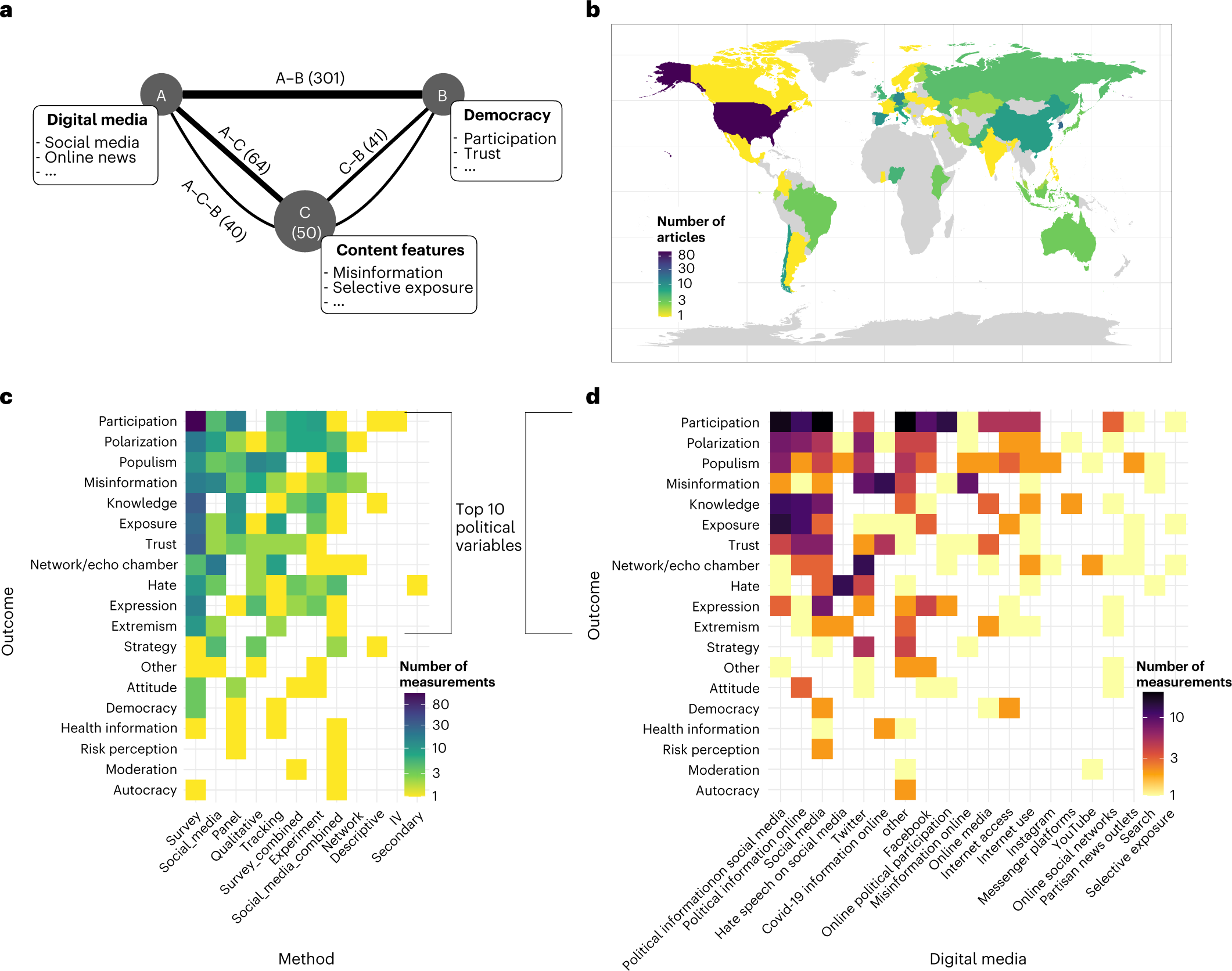
One of today’s most controversial and consequential issues is whether the global uptake of digital media is causally related to a decline in democracy. We conducted a systematic review of causal and correlational evidence (N = 496 articles) on the link between digital media use and different political variables. Some associations, such as increasing political participation and information consumption, are likely to be beneficial for democracy and were often observed in autocracies and emerging democracies. Other associations, such as declining political trust, increasing populism and growing polarization, are likely to be detrimental to democracy and were more pronounced in established democracies. While the impact of digital media on political systems depends on the specific variable and system in question, several variables show clear directions of associations. The evidence calls for research efforts and vigilance by governments and civil societies to better understand, design and regulate the interplay of digital media and democracy.