

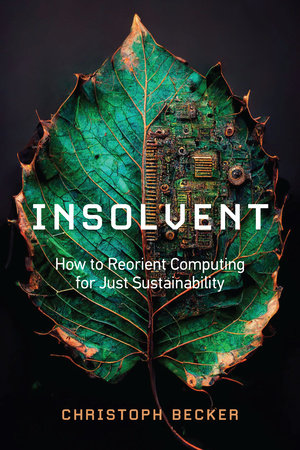
How we can enact meaningful change in computing to meet the urgent need for sustainability and justice.The deep entanglement of information technology with
Redefining our needs: Permacomputing and Vernacular computing
How to ensure an increasing focus on sustainability in computing?

LIMITS 2026 -- Workshop on Computing within Limits
LIMITS concerns the role of computing in human societies situated in a world of planetary boundaries and limits, such as limits of extractive logics, limits to a biosphere’s ability to recover, limits to our knowledge, or limits of technological solutions to societal issues. As an interdisciplinary group of researchers, practitioners, and scholars, we seek to reshape and orient the broader computing research agenda, grounded by an awareness that contemporary computing research is embedded in finite socio-ecological conditions and must reckon with with ecological limits in general, and climate- and climate justice-related limits in particular. LIMITS 2026 solicits submissions that move us closer towards computing that supports ecological and just futures for diverse human and non-human lifeforms and thriving biospheres.
LIMITS 2025 -- Workshop on Computing within Limits
The LIMITS workshop concerns the role of computing in human societies situated in a world of limits, such as limits of extractive logics, limits to a biosphere’s ability to recover, limits to our knowledge, or limits to technological solutions to societal issues. As an interdisciplinary group of researchers, practitioners, and scholars, we seek to reshape the computing research agenda, grounded by an awareness that contemporary computing research is intertwined with ecological limits in general, and climate- and climate justice-related limits in particular. LIMITS 2025 solicits submissions that move us closer towards computing that supports diverse human and non-human lifeforms and thriving biospheres.
Digital Degrowth: Radically Rethinking our Digital Futures
We are fast approaching the point of “peak digital”, with the continued mass production and excessive consumption of digital technologies set to become a key driver of climate crisis, ecological breakdown and ongoing societal instability.<br /> <br /><i>Digital Degrowth</i> is a call to completely rethink our digital futures in these fast-changing times. It explores how degrowth thinking and alternate forms of “radically sustainable computing” might support ambitions of sustainable, scaled-down and equitable ways of living with digital technologies. Neil Selwyn proposes a rebalancing of digital technology use: digital degrowth is not a call for simply making reduced use of the digital technologies that we already have – rather it is an argument to reimagine digital practices that maximise societal benefits with minimal environmental and social impact. Drawing on illustrative examples from across computer science, hacker and environmental activist communities, this book examines how core degrowth principles of conviviality, autonomy and care are already being used to reimagine alternate forms of digital technology.<br /> <br />Original and stimulating, this is essential reading for students and scholars of media and communication, sustainability studies, political ecology, computer/data sciences, and across the social sciences.

Sustainable software manifesto
The systems we build are never neutral. They can magnify harm or support a just and sustainable society. How we build today shapes tomorrow’s possibilities.
Liberatory Computing
We live under a capitalist mode of computing. The tools, languages, techniques, and assumptions of digital systems are structured by economic forces that shape not just what we can do, but what we can imagine doing. By separating production from use, producing inflexible software, and slicing up computing into siloed apps, your agency is held back by a tech industry that profits from a population rendered computationally passive.
Evaluating Sustainable Digitalization: A Carbon-Aware Framework for Enhancing Eco-Friendly Business Process Reengineering
In an era where sustainability is paramount, understanding the environmental impact of digitalizing business processes is critical. Despite the growing emphasis on sustainable practices, there is a lack of comprehensive methodologies to evaluate how digitalization impacts environmental sustainability compared to traditional processes. This paper introduces a carbon-aware methodological framework specifically designed to assess the sustainability of business process reengineering through digitalization. The Digital Green framework quantitatively analyzes the environmental costs associated with digital transformation, ensuring that truly sustainable digitalization results in lower resource consumption relative to the complexity of the process being digitalized. To demonstrate its effectiveness, the framework was applied to a case study involving the reengineering of an administrative process at a small university in southern Italy. The case study highlighted the framework’s ability to quantify the environmental benefits or detriments of digital transformation, thus guiding organizations toward more sustainable digital practices. This research contributes to the field by offering a concrete tool for aligning digitalization efforts with ecological sustainability, and by paving the way for integration with initiatives such as the Green Software Foundation’s Software Carbon Intensity (SCI) specifications.
Role of digitalization in environment, social and governance, and sustainability: Review-based study for implications
Digitalization gives people access to a vast network of untapped data, which has the potential to help society and the environment. Smart systems connected to the internet can systematically provide a unique opportunity to solve difficulties related to long-term sustainability. The goals are to create an egalitarian, ecologically sustainable, and healthy society. Technological resources are envisioned as game-changing instruments. Three key concerns integration benefits are highlighted here: (i) sustainable development goals, (ii) socio-economic development, and (iii) the role of digital technology in environmental sustainability. This viewpoint describes the potential that digitization can create a future sustainable society. The technological network would unite the urban and rural worlds under a shared banner of sustainable development, keeping all social elements in the loop. Nations that take a comprehensive strategy will be able to provide equitable growth and an efficient, sustainable, and digital existence for their citizens. As a result, digitization provides better living conditions, active public involvement, clean governance, and transparency in public welfare programs and processes. People who are well-informed, self-aware, and digitally equipped will be better learners, thinkers, reformers, participators, and change and growth agents, marching forward on sustainable progress. The advantages of digitization in hastening the transition to sustainable industrial processes and improving people's health and happiness are explored. Finally, the perspective encapsulates the advantages of digitization by offering a holistic vision of how technology could aid in addressing major challenges such as endangered world biodiversity and climate change.


Reclaiming the Computing Commons
Resisting the commodification of information is a political struggle, not a technical one.

Retrocomputing as a Model for Sustainable and Cognitive Computing: Lessons from Low-Resource Systems
This paper argues that retrocomputing constitutes a conceptually productive model for rethinking sustainability in contemporary computing. Early computing systems operated under strict hardware constraints, necessitating efficiency, clarity, and minimalism in both software and interaction design. In contrast, contemporary systems are frequently characterised by computational excess, software bloat, and attention-fragmenting interfaces. Drawing on examples from early home computing and command-line environments, this paper analyses how low-resource systems make visible forms of computational minimalism with relevance to present-day design challenges. A central theoretical contribution is the distinction between interface-level and system-structure-level design analysis, which demonstrates that cognitive effects arise not only from visual and interactional surface features but from deeper computational organisation. The discussion integrates perspectives from human-computer interaction and cognitive science, particularly in relation to attention, cognitive load, and user experience. The paper adopts a conceptual and exploratory approach grounded in systematic literature review, aiming to identify design-relevant patterns rather than to provide empirical validation. It introduces the concepts of computational minimalism and cognitive sustainability as complementary analytical frameworks, and derives five principles for sustainable system design. Crucially, the paper also address

Open source sustainability | TechCrunch
Open source sustainability has been nothing short of an oxymoron. Engineers around the world pour their sweat and frankly, their hearts into these passion

Don't Take the Black Pill - Andrew Kelley | SSW 2026
