

Abstract. Much of our knowledge of the world comes not from direct sensory experience, but from reliance on epistemic authorities: individuals or institutions that tell us what we ought to believe. For example, what most of us believe about natural selection, climate change, or the Holocaust comes from our reliance on epistemic authorities (scientists, historians). Sustaining epistemic authority depends, crucially, on social institutions that inculcate reliable second-order norms about whom to believe about what. The traditional media were crucial, in the age of mass democracy, with promulgating and sustaining such norms. The internet has obliterated the intermediaries who made that possible, and, in the process, undermined the epistemic standing of actual experts. This essay considers some possible changes to existing free speech doctrine to remedy the epistemological crisis brought about by the internet.
Democracy and the Epistemic Commons - The Consilience Project
We use cookies on our website, please read our Privacy Policy for more information Okay, thanks

The secret rules of the internet
The murky history of moderation, and how it’s shaping the future of free speech.

Social Media Vs Democracy
On the epistemic structure of voluntary servitude in the infosphere
This paper introduces the concept of Voluntary Epistemic Servitude (VES) to describe a social-epistemic pathology generated by the contemporary infosphere. Drawing on Étienne de La Boétie’s Discours de la Servitude Volontaire as a theoretical resource, we argue that algorithmic systems produce conditions in which agents not only delegate their core belief-forming processes to nontransparent architectures but come to prefer and actively reproduce this delegation through social mechanisms structurally isomorphic to those La Boétie identified in political tyranny. We show that VES is irreducible to existing social-epistemic categories such as epistemic injustice (Fricker 2007), epistemic bubbles and echo chambers (Nguyen 2020), and veritistic failure (Goldman 1999) because it operates at the level of epistemic preference formation rather than credibility attribution or informational access. The paper identifies a preference-laundering mechanism by which algorithmic systems colonize the second-order epistemic desires of agents, thereby undermining the conditions of epistemic autonomy that social epistemology has largely presupposed. We further develop a precise account of reflective access that distinguishes algorithmic opacity from ordinary preference opacity, introduce the concept of epistemic counterfactual capacity with a modal analysis connecting it to Williamson’s (2000) safety condition, situate VES as a structurally induced epistemic vice (Cassam 2019) and a form of misaligned extended cognition (Clark and Chalmers 1998), and provide a typology of three algorithmic architectures through which VES operates. We conclude by stating an explicit normative bridge principle and drawing on La Boétie’s positive ideal of free horizontal epistemic bonds to sketch the preconditions for epistemic liberation in algorithmically mediated environments.
There is no fresh air: A problem with the concept of echo chambers
Standardly, echo chambers are thought to be structures that we should avoid. Agents should keep away from them, to be able to assess a fuller range of evidence and avoid having their confidence in that information manipulated. This paper argues against that standard view. Not only can echo chambers be neutral or good for us, but the existing definitions apply so widely that such chambers are unavoidable. We are all in large numbers of echo chambers at any time – they can be found not just on social media or in political groups, but in almost every social or epistemic group we could categorise ourselves into. Because we are finite and fallible, we cannot escape them and need to exist in them just to get by. The concept, then, does not actually capture something as structurally problematic as the paradigmatic cases would suggest. Our way of using the term in social epistemology needs to change.
interfluidity » Consensus not censorship
We’ve become obsessed over the past few years with the problem of misinformation. And for good reason. “Flood the zone with shit” is now standard operating procedure for a variety of interests and factions. Groups who pretend to be above that kind of thing let confirmation bias do the same work, elevating conjectures they find convenient to believe far beyond the evidentiary basis for believing them, and transmuting concurrence among prestigious groups whose biases are aligned into “authority” to which they demand deferrence. Casual information consumers become divided into two camps, the “do your own research” types who imagine, mistakenly, that they are capable of seeing through all this (and so succumb to their own confirmation bias), and those who more accurately understand that they cannot reliably distinguish truth from bullshit (and so opt out of democratic deliberation with a shrug, other than perhaps to vote for the candidates whose political party they distrust less).
Historical pragmatism and the internet
This article argues that the literature describing the internet revolution in the 1990s was characterized by the rhetoric of the technological sublime. This rhetoric suffered from three fatal flaws: (1) it was not sufficiently grounded in the historical development of technology; (2) it viewed the internet in isolation, failing to consider the wider technological context; and (3) it failed to examine the internet in view of the social, economic, religious and political circumstances of its users. Several examples from history are cited, demonstrating that changes in various systems for the production, dissemination and preservation of cultural information both border and deborder the world. The article suggests that if internet researchers take a pragmatic, historically grounded approach, they will discover that the introduction of internet technology can be seen to have similar consequences. While the technology overcomes many boundaries (of space and time, politics and economics), other social borders may be created at the same time. It is easier to see old boundaries coming down than to see new ones being erected. Rather than being swept by utopian or dystopian enthusiasms, the article insists that the really interesting discoveries are to be made in locating the subtle social shifts taking place, relatively unnoticed, as a consequence of technological change.

Beyond Misinformation: Social Media and the Sculpting of Epistemic Agency
ABSTRACT The dominant account of social media's epistemic harms focuses on the spread of misinformation and the production of false beliefs at scale. This paper argues that the misinformation narrative, whatever its merits, has obscured a deeper and more intimate form of epistemic damage. Dominant social media platforms do not merely supply bad inputs to stable epistemic machinery. They reshape the machinery itself. I argue that social media platforms are powerful engines for sculpting epistemic agency via two mechanisms: normative learning, through which users internalize descriptive and injunctive norms about how to interact with evidence, and reinforcement learning, through which habitual patterns of epistemic response are developed. In these ways, platforms can reshape users' epistemic styles, including their testimonial policies, evidential thresholds for belief revision, and theoretical values governing how they select explanations. This should trouble us, as the constraints driving which styles are produced are systematically orthogonal to truth and ignore information about the environments agents inhabit. This discussion identifies a neglected form of epistemic hostility: not the exploitation of existing cognitive vulnerabilities to implant false beliefs, but the production of new vulnerabilities that can then be exploited. From this, more and better evidence cannot save us.

It's the (Democracy-Poisoning) Golden Age of Free Speech
At a time when anyone can broadcast live or post their thoughts to a social network, we should be living in a utopia of public discourse. We're not.

Epistemic Infrastructure: Building Shared Truth in an Era of Disaggregation
The Construct of Collective Perception

Democracy and the Epistemic Commons
The Consilience Project is a publication of the Civilization Research Institute (CRI)

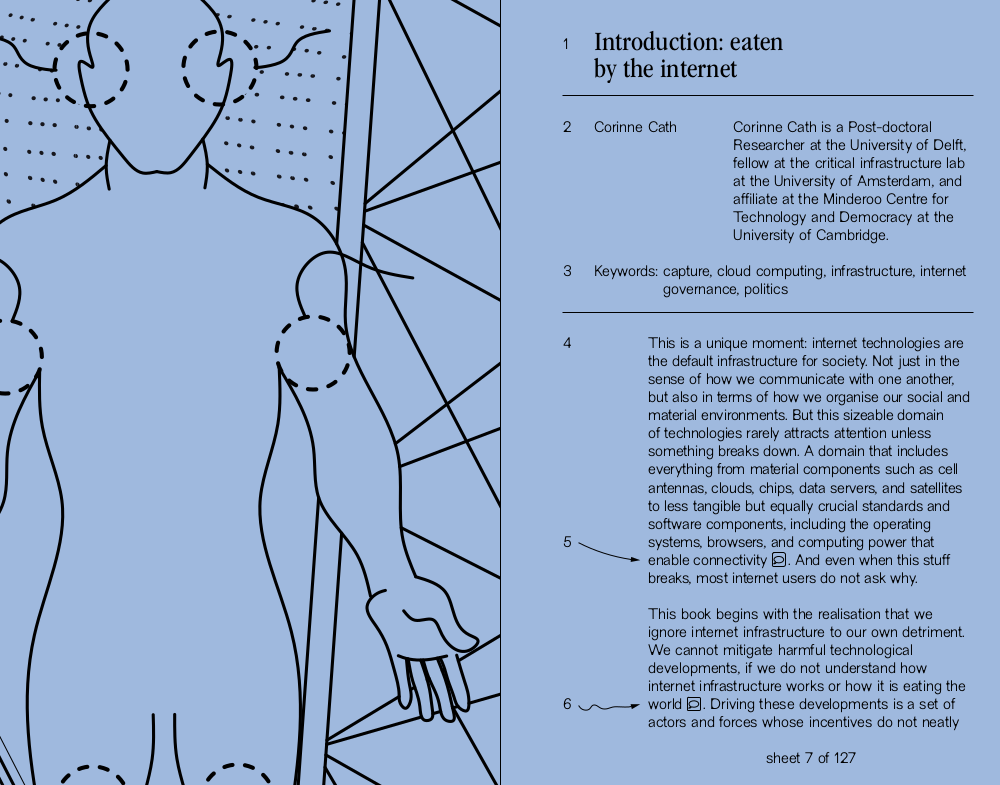
Eaten by the Internet
This book makes internet infrastructure visible as a force of political power, which is transforming the social world, from the bottom up—through fifteen chapters contributed by a global set of researchers, activists, and techies. We are living a unique moment: internet technologies are the default infrastructure for society, not just how we communicate but also how we organise our social life, politics, and economy, all the way down to our material environments, like cities. Our world is eaten by the internet. This means that those who control the internet control the bounds of public speech, economic production, social cohesion, and politics, making its infrastructure a core political terrain in the networked age. The book’s chapters cover a wide set of topics, spanning from the global politics of content moderation by internet infrastructure to the colonialism inherent in the race to plug the moon, from the harms wrought by blockchain companies in rural America to the particularities of online censorship across Asia. The chapters take on thorny topics, discussing power consolidation in the advertisement and cloud industry, the role of internet infrastructure in the war in Ukraine, and tech’s environmental impact—amongst others. In doing so, this book roots contemporary technology debates in the politics of internet infrastructure and urges us to ask how can we ensure our infrastructures sustain us, rather than consume us?
Information Access of the Oppressed: A Problem-Posing Framework for Envisioning Emancipatory Information Access Platforms
Online information access (IA) platforms are targets of authoritarian capture. These concerns are particularly serious and urgent today in light of the rising levels of democratic erosion worldwide, the emerging capabilities of generative AI technologies such as AI persuasion, and the increasing concentration of economic and political power in the hands of Big Tech. This raises the question of what alternative IA infrastructure we must reimagine and build to mitigate the risks of authoritarian capture of our information ecosystems. We explore this question through the lens of Paulo Freire's theories of emancipatory pedagogy. Freire's theories provide a radically different lens for exploring IA's sociotechnical concerns relative to the current dominating frames of fairness, accountability, confidentiality, transparency, and safety. We make explicit, with the intention to challenge, the dichotomy of how we relate to technology as either technologists (who envision and build technology) and its users. We posit that this mirrors the teacher-student relationship in Freire's analysis. By extending Freire's analysis to IA, we challenge the notion that it is the burden of the (altruistic) technologists to come up with interventions to mitigate the risks that emerging technologies pose to marginalized communities. Instead, we advocate that the first task for the technologists is to pose these as problems to the marginalized communities, to encourage them to make and unmake the technology as part of their material struggle against oppression. Their second task is to redesign our online technology stacks to structurally expose spaces for community members to co-opt and co-construct the technology in aid of their emancipatory struggles. We operationalize Freire's theories to develop a problem-posing framework for envisioning emancipatory IA platforms of the future.

The architecture of the internet creates risks for democracy
Will democracy survive the internet? Do we need to choose between Facebook’s surveillance capitalism or democracy? Layered lines of evidence can inform questions like these. When considered together, the evidence gives rise to a concerning picture, as summarized in a recent report for the European Commission that I co-led.

Tim Berners Lee: Thoughts On The Internet Evolution
"I’ve always believed the web is for everyone. That's why I and others fight fiercely to protect it."

Fix the internet, save democracy

The internet has evolved into a state that is actively hostile towards global democracy. A thesis is emerging that to save global democracy, you must fix the internet.
The IndieWeb Is Punk Manifesto

The Retweeting Class

Funding The Web: From Cartel to Covenant

Protocols, Not Platforms: A Technological Approach to Free Speech
The architecture of the internet creates risks for democracy