Artists, raison d'être: Can we re-think tech that works for people, & not just corporations? Can we improve the world our children inherit? Deliberate, discuss, develop. This is DARKSHAPES. We build
The rise (and future fall) of Discord
I want to talk about Discord. Not about all the issues like privacy, accessibility, performance. No, the good things. The part where it completely revolutionized the internet. And how it will destroy it all.
darkshapes
Umbrella organization rethinking machine-learning technology as tools that work for people, not just corporations
Against the dark forest
The complex of ideas I’m going to call the Dark Internet Forest emerges from mostly insidery tech thinking, but from multiple directions.
Reclaiming Social Spaces: Are Open Source Platforms a Path for More Human Connection?
What if social media platforms were built to serve their communities, not billionaires? Join us with the founders of Blacksky as we explore the potential of open source social media.
The Dark Forest Theory of the Internet
Why the dark forests of the internet — podcasts, newsletters, and other private channels — are growing, and why might that pose a problem
Trust and Faith in Our Web
I’m not Brennan, but I’m very interested in decentralization and a fan of AtProto specifically, so I’d like to weigh in. First I should mention I’ve personally never been able to get into microblogging, so I haven’t touched bluesky myself, despite having an account for ATProto reasons. But I agree it’s concerning that the company chooses to continue to host the content of harmful individuals and calling that act “neutral”. I’m certainly against the idea of the “marketplace of ideas” as it’s cle...

The crusade against open-source abuse | TechCrunch
There’s a dark cloud on the horizon. The behavior of cloud infrastructure providers threatens the viability of open source. Thankfully, several leaders have mobilized to propose multiple solutions.

LURK
Welcome to LURK, we host, facilitate and archive discussions around net- and computational culture and politics, proto- and post-free culture practices, (experimental) (sound) (new media) (software) art, and things like that…
What technology takes from us – and how to take it back | Rebecca Solnit
The long read: Decisions outsourced, chatbots for friends, the natural world an afterthought: Silicon Valley is giving us life void of connection. There is a way out – but it’s going to take collective effort
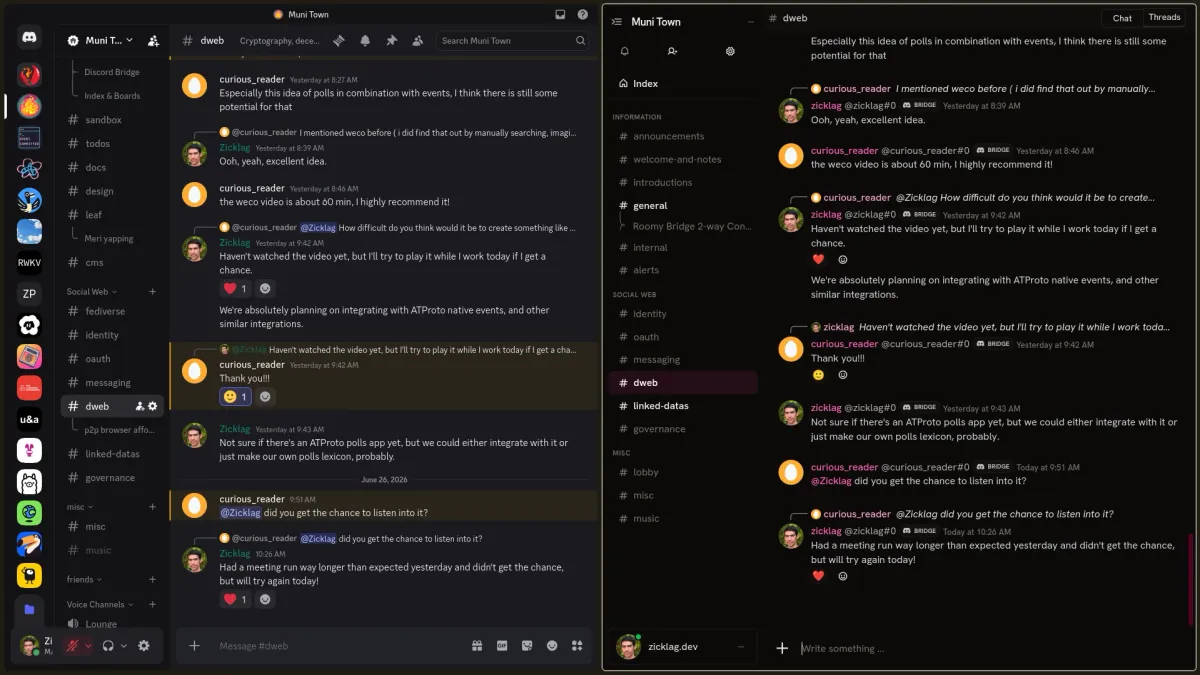
A bridge beyond Discord
Millions of digital communities have already made a home for themselves on Discord, and we'd rather not force them to make a binary choice between the critical mass of members they've built up on Discord and the agency afforded to them on Roomy.
Growing up in the online world: a national consultation
We are consulting on further measures to prepare children for the future in an age of rapid technological change. This includes potential age restrictions on social media and other services such as gaming sites and AI chatbots, restrictions on addictive design features and risky functionalities, and better support for parents and families.

Bluesky & Open Social Media Tech
Strengthening Online Communities | Rise Against Big Tech Powerbase
softer computing club
a cozy community of humans and computers on the planet earth
Join the Hubs Discord Server!
We are a community of artists, developers, and other creatives that supports an immersive 3D web via our open-source, WebXR project. Our community builds good things. 🌐 | 21838 members

AI, I tried to love you – Writings and rehearsals by Nathan Schneider
Among my peers who study the cultures and economies surrounding technology, I often find myself more tech-positive than most. On the whole I like computers, like the internet, and like in general the emergent human creativity that these things have enabled and revealed. A source of my appreciation is that I expend a lot of effort on the practice of “slow computing,” which is to say, choosing tools and technical communities that I can feel in right relationship with. I tend to approach new socio-technologies (like gig economies, blockchains, and social media) not from a perspective of why is this so bad? so much as asking how could we do this right?