


Proposal: standard.site.declaration Draft for Discussion Abstract AT Protocol provides portable identity, portable content, and portable social graphs. What it currently lacks is a standard mechanism for discovering machine-readable declarations associated with digital content. Today, creators and organisations publish declarations about digital assets through websites, registries, the C2PA provenance framework, and other systems. These declarations may describe provenance, copyright ownership...
Standard.site - One schema. Every platform.
Standard.site provides shared lexicons for long-form publishing on AT Protocol. Making content easier to discover, index, and move across the ATmosphere.
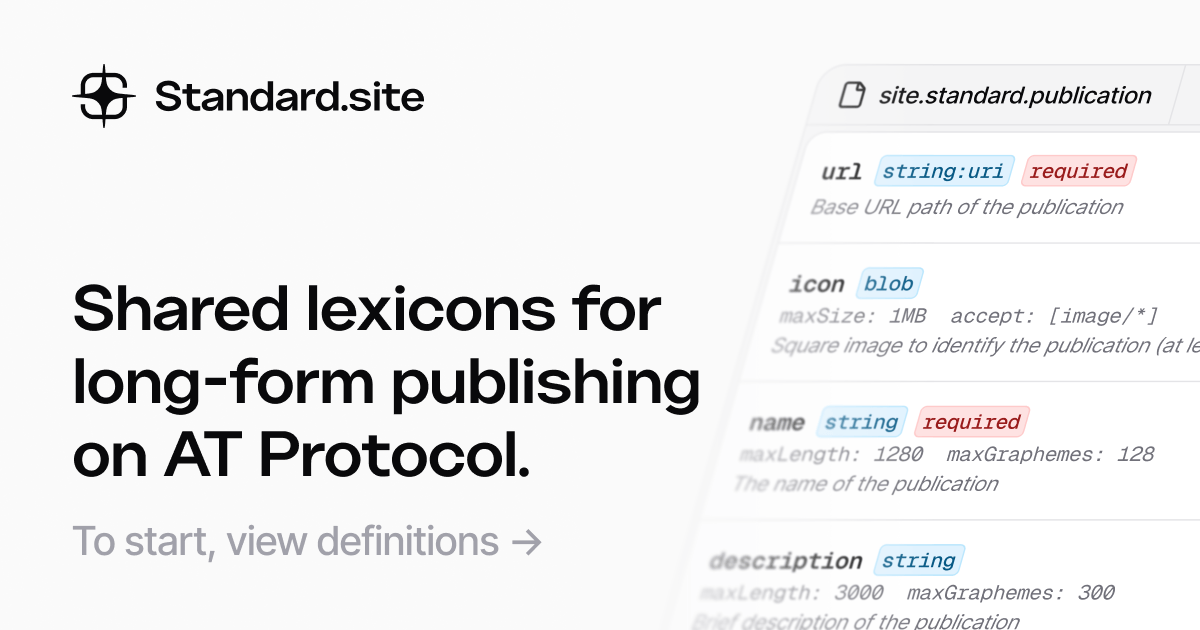
Standard.site - One schema. Every platform.
Standard.site provides shared lexicons for long-form publishing on AT Protocol. Making content easier to discover, index, and move across the ATmosphere.
thoughts on standard.site | jola.dev
standard.site is a huge success as an atproto community lexicon, but there's some stuff we can improve, let's talk about it!
Blog | Lexicon Community | Offprint
A working group that stewards a shared namespace for AT Protocol schemas: built in the open, governed collectively, and free for anyone to use.


Publishing My Eleventy Blog to the ATmosphere with Standard.site
A walkthrough of how I wired up Standard.site AT Protocol lexicons into this 11ty blog: from writing a custom publish script to migrating to Sequoia, with code for the link tags, and handle verification.

Chad Kohalyk (@chadkoh@indieweb.social)
Web publishing is facing its next challenge: a new iteration of centralizing platforms. BUT there is also a new wave of open protocols and standards that can help us gain our independence. Next month in NYC we are gathering a group of frontier technologists and popular web publishers to discuss how we can sail into this next platform shift as captains. #ProtocolsForPublishers https://pfp.unternet.co
CID (Content IDentifier)
Self-describing content-addressed identifiers for distributed systems
Why Don't We Just Do This Together? - AT Protocol
Jim sits down with members of the core team building and governing Standard.site, the shared Lexicon for publishing longform writing on atproto. Brooke from pckt.blog, Jared from Leaflet, and Miguel from Offprint cover the design tradeoffs in creating a new shared format, tales of data migrations, strategies for shared governance, and why you shouldn't buy a premium domain name.
cuducos.me/std-pub
📰 A single-page application to manage standard.site publication on the AT Protocol
15 Open-Source Tools for Digital Sovereignty (2026) | Comparisons & Alternatives | Vucense
Own your digital stack. The 15 best open-source tools for privacy, security, and full control over your data — reviewed and ranked for 2026.

Seeing the Politics of Decentralized Social Media Protocols
Calls to decentralize feed-based social media have been driven by concerns about the concentrated power of centralized platforms and their societal impact. In response, numerous decentralized social media protocols have emerged, each interpreting “decentralization” in a different way. We analyze four such protocols (ActivityPub, AT Protocol, Nostr, and Farcaster) drawing on protocol documentation, media coverage, direct usage, and semi-structured interviews with protocol developers and experts to situate each protocol within its socio-technical goals. To support this analysis, we develop a grounded lexicon that facilitates the description and comparison of analogous components across each protocol. With it, we show how each protocol distributes control over key components differently, shaping who holds power over critical aspects such as user identity, curation, and infrastructural ownership. By examining protocols as socio-technical artifacts, we show how they prioritize different values and make distinct trade-offs, providing CSCW researchers with a lens to more effectively evaluate and design future decentralized social media systems.

Steps Towards an Infrastructure for Scholarly Synthesis
Sharing, reusing, and synthesizing knowledge is central to the research process, both individually, and with others. These core functions are not supported by our formal scholarly publishing infrastructure: instead of the smooth functioning of functional infrastructure, researchers resort to laborious ”hacks” and workarounds to ”mine” publications for what they need, and struggle to efficiently share the resulting information with others. Information scientists have proposed an alternative infrastructure based on the more appropriately granular model of a discourse graph of claims, and evidence, along with key rhetorical relationships between them. However, despite significant technical progress on standards and platforms, the predominant infrastructure remains steadfastly document-based. Drawing from infrastructure studies, we locate the current infrastructural bottlenecks in the lack of local systems that integrate discourse-centric models to augment synthesis work, from which an infrastructure for synthesis can be grown. Through 3 years of research through design and field deployment in a distributed community of hypertext notebook users, we elaborate a design vision of what can and should be built in order to grow a discourse-centric synthesis infrastructure: a thriving “installed base” of researchers authoring local, shareable discourse graphs to improve synthesis work, enhance primary research and research training, and augment collaborative research. We discuss how this design vision — and our empirical work — contributes steps towards a new infrastructure for synthesis, and increases HCI’s capacity to advance collective intelligence and solve infrastructure-level problems.
The FOSDEM 2027 AT Protocol devroom proposal is taking shape. @edouard.paris and @viivi.rocks are leading the submission, due October 4. The draft covers protocol infrastructure, applications, governance, and critical perspectives. Share project ideas and use cases in the Discourse thread.
FOSDEM 2027 ATProto devroom proposal
discourse.atmosphere.communityWeb publishing is facing its next challenge: a new iteration of centralizing platforms. BUT there is also a new wave of open protocols+standards to gain independence. Next month in NYC let's discuss how we can sail into this next platform shift as captains. #ProtocolsForPublishers pfp.unternet.co
Protocols for Publishers
pfp.unternet.coWhat if a PDS became more than a repository for posts? We propose using AT Protocol as a creator-controlled publication layer for declaration metadata describing digital works, making rights, provenance, and other trusted metadata independently verifiable and easier to discover.

From Personal Data Server to Personal Metadata Server
liccium.leaflet.pub

