


I recently gave a Why Julia? talk to a roomful of computational fluid dynamicists and astrophysicists. (John Gibson, UNH & KITP, Julia - a high-performance dynamic programming language for technical computing, Kavli Institute, UCSB 2017-02-02). I got two main skeptical responses. One Python expert in the audience pointed out that much of what I was touting in Julia is available in Python: Numba for fast array math, %jit macros for just-in-time computation. I read up on these things afterwards a...
Julia vs Numba and Cython: Looking Beyond Microbenchmarks
We compare the performance of Julia and Numba, for a minimal benchmark that enables to see some fundamental difference between Julia and accelerated-Python.
Why Numba and Cython are not substitutes for Julia - Stochastic Lifestyle
Sometimes people ask: why does Julia need to be a new language? What about Julia is truly different from tools like Cython and Numba? The purpose of this blog post is to describe how Julia’s design gives a very different package development experience than something like Cython, and how that can lead to many more optimizations. What I really want to show is: Julia’s compilation setup is built for specialization of labor which is required for scientific progress Composition of Julia codes can utilize the compilation process to build new programs which are greater than the sum of the parts I will also explain some of the engineering tradeoffs which were made to make this happen. There are many state-of-the-art scientific computing and data science packages in Julia and what I want to describe is how these are using the more “hardcore ... READ MORE
Julia vs. Python: A comprehensive comparison
The debate between Julia and Python sparks intense discussions. Julia, known for its compiled nature, boasts remarkable speed, while…
Why I no longer recommend Julia
For many years I used the Julia programming language for transforming, cleaning, analyzing, and visualizing data, doing statistics, and performing simulations.
Comparison of plotting packages
I want to write a small 2d physical simulation to sharpen my Julia skills and learn how to use Julia to display more than “regular plots” I saw a post suggesting using either Makie, Plots or Javis I don’t want to start a fan war but would appreciate a comparison of the different use cases where each of the packages shines and where it can be challenging to use
aviatesk/JETLS.jl
A new language server for Julia, enabling modern, compiler-powered tooling.
Calculus with Julia
This is a set of notes for learning calculus using the Julia language. Julia is an open-source programming language with an easy to learn syntax that is well suited for this task.
How to solve the two language problem?
An overview of software technologies to get speed and simplicity at once. Comparing Python, C++, Cython, Numba, Julia and more.

Turing: Probabalistic Programming in Julia | Cameron Pfiffer | JuliaCon 2019
SciPy 1.0: fundamental algorithms for scientific computing in Python
SciPy is an open-source scientific computing library for the Python programming language. Since its initial release in 2001, SciPy has become a de facto standard for leveraging scientific algorithms in Python, with over 600 unique code contributors, thousands of dependent packages, over 100,000 dependent repositories and millions of downloads per year. In this work, we provide an overview of the capabilities and development practices of SciPy 1.0 and highlight some recent technical developments.

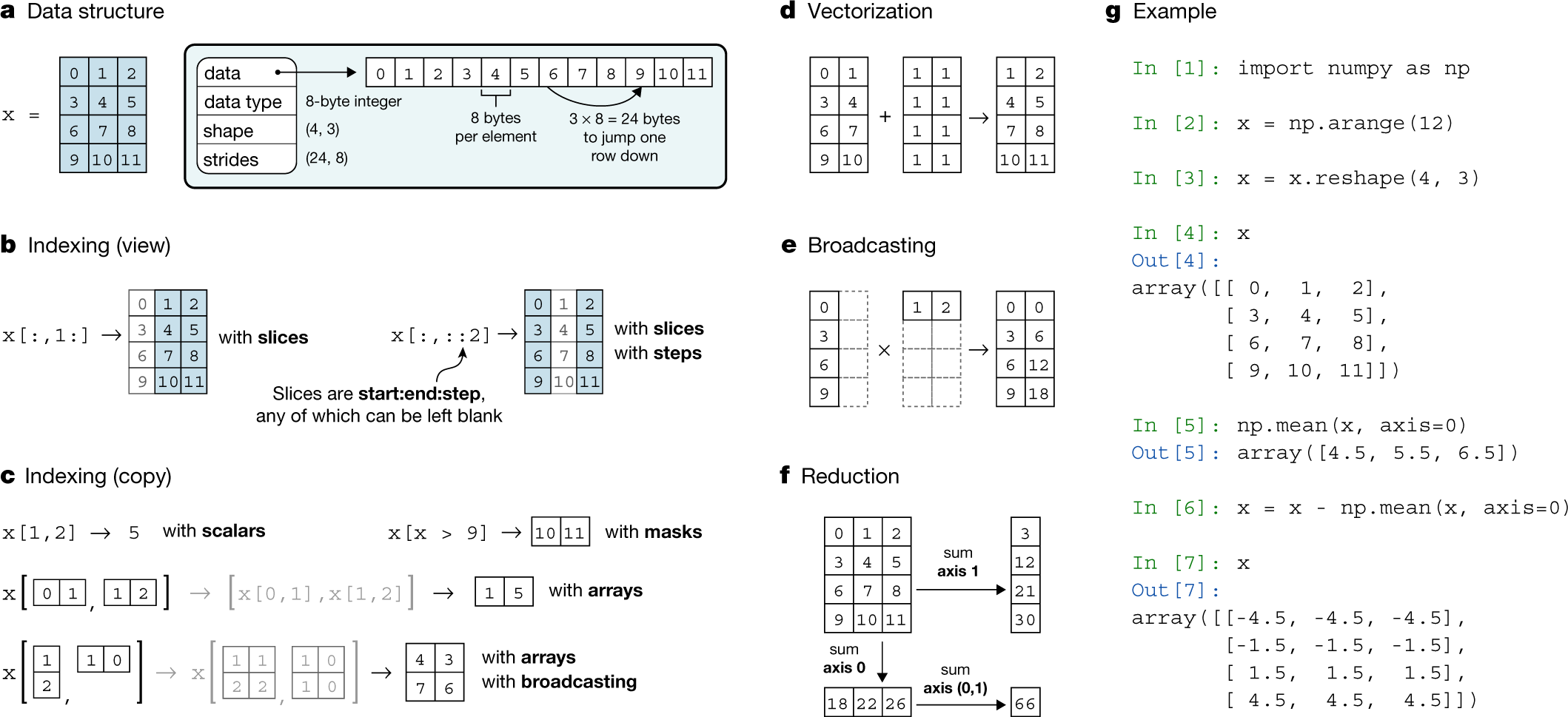
Array programming with NumPy
Array programming provides a powerful, compact and expressive syntax for accessing, manipulating and operating on data in vectors, matrices and higher-dimensional arrays. NumPy is the primary array programming library for the Python language. It has an essential role in research analysis pipelines in fields as diverse as physics, chemistry, astronomy, geoscience, biology, psychology, materials science, engineering, finance and economics. For example, in astronomy, NumPy was an important part of the software stack used in the discovery of gravitational waves1 and in the first imaging of a black hole2. Here we review how a few fundamental array concepts lead to a simple and powerful programming paradigm for organizing, exploring and analysing scientific data. NumPy is the foundation upon which the scientific Python ecosystem is constructed. It is so pervasive that several projects, targeting audiences with specialized needs, have developed their own NumPy-like interfaces and array objects. Owing to its central position in the ecosystem, NumPy increasingly acts as an interoperability layer between such array computation libraries and, together with its application programming interface (API), provides a flexible framework to support the next decade of scientific and industrial analysis.
Introducing Julia 1 | Supersonic Labs
Julia 1 is our compact decision model. Explore the research, evaluation results, limitations, and model repository.

julia_tutorials/From Macros to DSLs in Julia - Part 1 - Macros.ipynb at master · johnmyleswhite/julia_tutorials
Tutorials on Julia topics. Contribute to johnmyleswhite/julia_tutorials development by creating an account on GitHub.