


As part of the Digital Library's transition to Open Access, new features for researchers are available in the Premium Edition. Click here to learn more.
Analyzing Semantic Concept Patterns to Detect Academic Plagiarism
As part of the Digital Library's transition to Open Access, new features for researchers are available in the Premium Edition. Click here to learn more.

Citation‐based plagiarism detection: Practicability on a large‐scale scientific corpus
The automated detection of plagiarism is an information retrieval task of increasing importance as the volume of readily accessible information on the web expands. A major shortcoming of current automated plagiarism detection approaches is their dependence on high character‐based similarity. As a result, heavily disguised plagiarism forms, such as paraphrases, translated plagiarism, or structural and idea plagiarism, remain undetected. A recently proposed language‐independent approach to plagiarism detection, C itation‐based P lagiarism D etection ( CbPD ), allows the detection of semantic similarity even in the absence of text overlap by analyzing the citation placement in a document's full text to determine similarity. This article evaluates the performance of CbPD in detecting plagiarism with various degrees of disguise in a collection of 185,000 biomedical articles. We benchmark CbPD against two character‐based detection approaches using a ground truth approximated in a user study. Our evaluation shows that the citation‐based approach achieves superior ranking performance for heavily disguised plagiarism forms. Additionally, we demonstrate CbPD to be computationally more efficient than character‐based approaches. Finally, upon combining the citation‐based with the traditional character‐based document similarity visualization methods in a hybrid detection prototype, we observe a reduction in the required user effort for document verification.

Using structural information and citation evidence to detect significant plagiarism cases in scientific publications
Abstract In plagiarism detection (PD) systems, two important problems should be considered: the problem of retrieving candidate documents that are globally similar to a document q under investigation, and the problem of side‐by‐side comparison of q and its candidates to pinpoint plagiarized fragments in detail. In this article, the authors investigate the usage of structural information of scientific publications in both problems, and the consideration of citation evidence in the second problem. Three statistical measures namely Inverse Generic Class Frequency, Spread, and Depth are introduced to assign a degree of importance (i.e., weight) to structural components in scientific articles. A term‐weighting scheme is adjusted to incorporate component‐weight factors, which is used to improve the retrieval of potential sources of plagiarism. A plagiarism screening process is applied based on a measure of resemblance, in which component‐weight factors are exploited to ignore less or nonsignificant plagiarism cases. Using the notion of citation evidence, parts with proper citation evidence are excluded, and remaining cases are suspected and used to calculate the similarity index. The authors compare their approach to two flat‐based baselines, TF‐IDF weighting with a Cosine coefficient, and shingling with a Jaccard coefficient. In both baselines, they use different comparison units with overlapping measures for plagiarism screening. They conducted extensive experiments using a dataset of 15,412 documents divided into 8,657 source publications and 6,755 suspicious queries, which included 18,147 plagiarism cases inserted automatically. Component‐weight factors are assessed using precision, recall, and F ‐measure averaged over a 10‐fold cross‐validation and compared using the ANOVA statistical test. Results from structural‐based candidate retrieval and plagiarism detection are evaluated statistically against the flat baselines using paired‐ t tests on 10‐fold cross‐validation runs, which demonstrate the efficacy achieved by the proposed framework. An empirical study on the system's response shows that structural information, unlike existing plagiarism detectors, helps to flag significant plagiarism cases, improve the similarity index, and provide human‐like plagiarism screening results.

Improving Academic Plagiarism Detection for STEM Documents by Analyzing Mathematical Content and Citations
Identifying academic plagiarism is a pressing task for educational and research institutions, publishers, and funding agencies. Current plagiarism detection systems reliably find instances of copied and moderately reworded text. However, reliably detecting concealed plagiarism, such as strong paraphrases, translations, and the reuse of nontextual content and ideas is an open research problem. In this paper, we extend our prior research on analyzing mathematical content and academic citations. Both are promising approaches for improving the detection of concealed academic plagiarism primarily in Science, Technology, Engineering and Mathematics (STEM). We make the following contributions: i) We present a two-stage detection process that combines similarity assessments of mathematical content, academic citations, and text. ii) We introduce new similarity measures that consider the order of mathematical features and outperform the measures in our prior research. iii) We compare the effectiveness of the math-based, citation-based, and text-based detection approaches using confirmed cases of academic plagiarism. iv) We demonstrate that the combined analysis of math-based and citation-based content features allows identifying potentially suspicious cases in a collection of 102K STEM documents. Overall, we show that analyzing the similarity of mathematical content and academic citations is a striking supplement for conventional text-based detection approaches for academic literature in the STEM disciplines.

Duplicate and fake publications in the scientific literature: how many SCIgen papers in computer science?
Two kinds of bibliographic tools are used to retrieve scientific publications and make them available online. For one kind, access is free as they store information made publicly available online. For the other kind, access fees are required as they are compiled on information provided by the major publishers of scientific literature. The former can easily be interfered with, but it is generally assumed that the latter guarantee the integrity of the data they sell. Unfortunately, duplicate and fake publications are appearing in scientific conferences and, as a result, in the bibliographic services. We demonstrate a software method of detecting these duplicate and fake publications. Both the free services (such as Google Scholar and DBLP) and the charged-for services (such as IEEE Xplore) accept and index these publications.

The world’s largest collection of open access research papers
The world’s largest collection of open access research papers
The world’s largest collection of open access research papers
The world’s largest collection of open access research papers
The world’s largest collection of open access research papers
The world’s largest collection of open access research papers
Testing of detection tools for AI-generated text
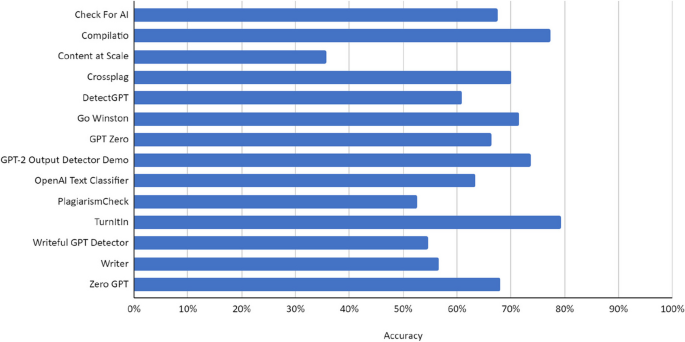
Recent advances in generative pre-trained transformer large language models have emphasised the potential risks of unfair use of artificial intelligence (AI) generated content in an academic environment and intensified efforts in searching for solutions to detect such content. The paper examines the general functionality of detection tools for AI-generated text and evaluates them based on accuracy and error type analysis. Specifically, the study seeks to answer research questions about whether existing detection tools can reliably differentiate between human-written text and ChatGPT-generated text, and whether machine translation and content obfuscation techniques affect the detection of AI-generated text. The research covers 12 publicly available tools and two commercial systems (Turnitin and PlagiarismCheck) that are widely used in the academic setting. The researchers conclude that the available detection tools are neither accurate nor reliable and have a main bias towards classifying the output as human-written rather than detecting AI-generated text. Furthermore, content obfuscation techniques significantly worsen the performance of tools. The study makes several significant contributions. First, it summarises up-to-date similar scientific and non-scientific efforts in the field. Second, it presents the result of one of the most comprehensive tests conducted so far, based on a rigorous research methodology, an original document set, and a broad coverage of tools. Third, it discusses the implications and drawbacks of using detection tools for AI-generated text in academic settings.
Testing of detection tools for AI-generated text
Recent advances in generative pre-trained transformer large language models have emphasised the potential risks of unfair use of artificial intelligence (AI) generated content in an academic environment and intensified efforts in searching for solutions to detect such content. The paper examines the general functionality of detection tools for AI-generated text and evaluates them based on accuracy and error type analysis. Specifically, the study seeks to answer research questions about whether existing detection tools can reliably differentiate between human-written text and ChatGPT-generated text, and whether machine translation and content obfuscation techniques affect the detection of AI-generated text. The research covers 12 publicly available tools and two commercial systems (Turnitin and PlagiarismCheck) that are widely used in the academic setting. The researchers conclude that the available detection tools are neither accurate nor reliable and have a main bias towards classifying the output as human-written rather than detecting AI-generated text. Furthermore, content obfuscation techniques significantly worsen the performance of tools. The study makes several significant contributions. First, it summarises up-to-date similar scientific and non-scientific efforts in the field. Second, it presents the result of one of the most comprehensive tests conducted so far, based on a rigorous research methodology, an original document set, and a broad coverage of tools. Third, it discusses the implications and drawbacks of using detection tools for AI-generated text in academic settings.
The Application and Its Consequences for Non-Standard Knowledge Work
As part of the Digital Library's transition to Open Access, new features for researchers are available in the Premium Edition. Click here to learn more.

As we may think
As part of the Digital Library's transition to Open Access, new features for researchers are available in the Premium Edition. Click here to learn more.
How Grobid uses Crossref metadata to enrich bibliographic information - Crossref
Crossref members register around 37,000 records daily. All this metadata is openly shared with the global scholarly community through our free APIs. We receive over two billion calls to our API each month, signalling its use by hundreds of tools and services worldwide, supporting the discovery and assessment of scholarly metadata. As part of a new series in our blog, we will spotlight the diversity of tools and integrations that rely on Crossref metadata to serve the scholarly community. In this initial post, we chat to Luca Foppiano, the developer and maintainer of Grobid1, to learn about how Grobid uses Crossref metadata to improve the extraction and enrichment of bibliographic information from scholarly PDFs.

Boston Public Library Aims To Increase Access To a Vast Historic Archive Using AI - Slashdot
An anonymous reader quotes a report from NPR: Boston Public Library, one of the oldest and largest public library systems in the country, is launching a project this summer with OpenAI and Harvard Law School to make its trove of historically significant government documents more accessible to the p...

Home | Bellingcat's Online Investigation Toolkit
A toolkit for open source researchers

The Consensus Trap: Dissecting Subjectivity and the “Ground Truth” Illusion in Data Annotation
As part of the Digital Library's transition to Open Access, new features for researchers are available in the Premium Edition. Click here to learn more.
