


We propose a new approach to Physical Telepresence, based on shared workspaces with the ability to capture and remotely render the shapes of people and objects. In this paper, we describe the concept of shape transmission, and propose interaction ...
10 Examples of Affordances - The Boffins Portal
Affordance is a concept in design that refers to the possible actions or uses that an object or environment offers a user. It is the relationship between an object and the person using it and what the person perceives they can do with the object based on its physical characteristics. In other words, affordance is ... Read more

Screen As Room: An Architectural Perspective on User Interfaces — Christoph Locher · Interaction Designer
With the use of video games as social spaces being observed for several years and the increased focus put on virtual social spaces due to the scarceness of physical social spaces in the last months, the concept of “spatial interfaces” is once again at the center of discussions. I want to add an alternative perspective to this, looking at the properties of physical spaces as metaphors, rather than models, for interfaces and exploring seven of them in more detail.
Screen As Room: An Architectural Perspective on User Interfaces — Christoph Locher · Interaction Designer
With the use of video games as social spaces being observed for several years and the increased focus put on virtual social spaces due to the scarceness of physical social spaces in the last months, the concept of “spatial interfaces” is once again at the center of discussions. I want to add an alternative perspective to this, looking at the properties of physical spaces as metaphors, rather than models, for interfaces and exploring seven of them in more detail.
What are Affordances? — updated 2026
Affordances are the characteristics or properties of an object that suggest how it can be used. It shows a user that an object can be interacted with.

Quiet, and Sometimes Silent
Quiet, and Sometimes Silent is an on-going project that explores proximity, intimacy, and subtle communication. Two DIY wearable pieces talk to each other through LoRa, a wireless protocol that enables small data-packet transmissions using a free, hobbyist radio frequency. As two people approach each other, their headpieces morph into different shapes – flapping, shrinking, producing buzzing sensations and movements. Together, they turn into mutating sculptures, communicating with nonverbal subtlety. This project draws correlation between protocols outside of heavily surveilled mass superstructures and the state of acquainted human relationships, exploring the idea that small movements and sporadic data exchange can resemble our loose social connections with the people around us.
About — Every Object an Archive
We interview people about their experiences with technological objects that were once everywhere, but are now being replaced or redesigned. We are interested in the physical experience of living with these objects, their handfeel and relationships to our bodies. We are also interested in how they shaped our habits, relationships, and ways of being. Technologies are more than physical objects: whole worlds of infrastructure, process, policy and culture are built around them.

Architecture and the Internet: Designing places in cyberspace
Cyberspace, as the information space is called, has become accessible in the past decade through the World Wide Web. And although it can only be experienced through the mediation of computers, it is quickly becoming an alternative stage for everyday economic, cultural, and other human activities. As such, there is a potential and a need to design it according to place–like principles. Making places for human inhabitation is, of course, what architects, landscape architects, and town planners have been doing in physical space for thousands of years. It is curious, therefore, that Cyberspace designers have not capitalized on the theories, experiences, and practices that have been guiding physical place–making. While most 3D environments closely mimic physical spaces, they are, by and large, devoid of the essential characteristics that differentiate a ‘place’ from mere ‘space.’ And only rarely are they sensitive to, and take advantage of, the peculiarities of Cyberspace. We believe that this state of affairs is temporary, characteristic of early adoption stages of new technologies. As the Web matures, and as it assumes more fully its role as a destination rather than as means of communication, there will be a growing need to design it according to place–making principles. By looking at physical architecture as a case study and metaphor for organizing space into meaningful places, this paper explores the possibility of organizing Cyberspace into spatial settings that not only afford social interaction, but, like physical places, also embody and express cultural values. At the same time, because Cyberspace lacks materiality, is free from physical constraints, and because it can only be ‘inhabited’ by proxy, these ‘places’ may not necessarily resemble their physical counterparts.
Real-time Motion Retargeting to Highly Varied User-Created Morphologies - Chris Hecker's Website
Chris Hecker[1] Bernd Raabe[2] Ryan W. Enslow[3]John DeWeese[4] Jordan Maynard[5] Kees van Prooijen[6]
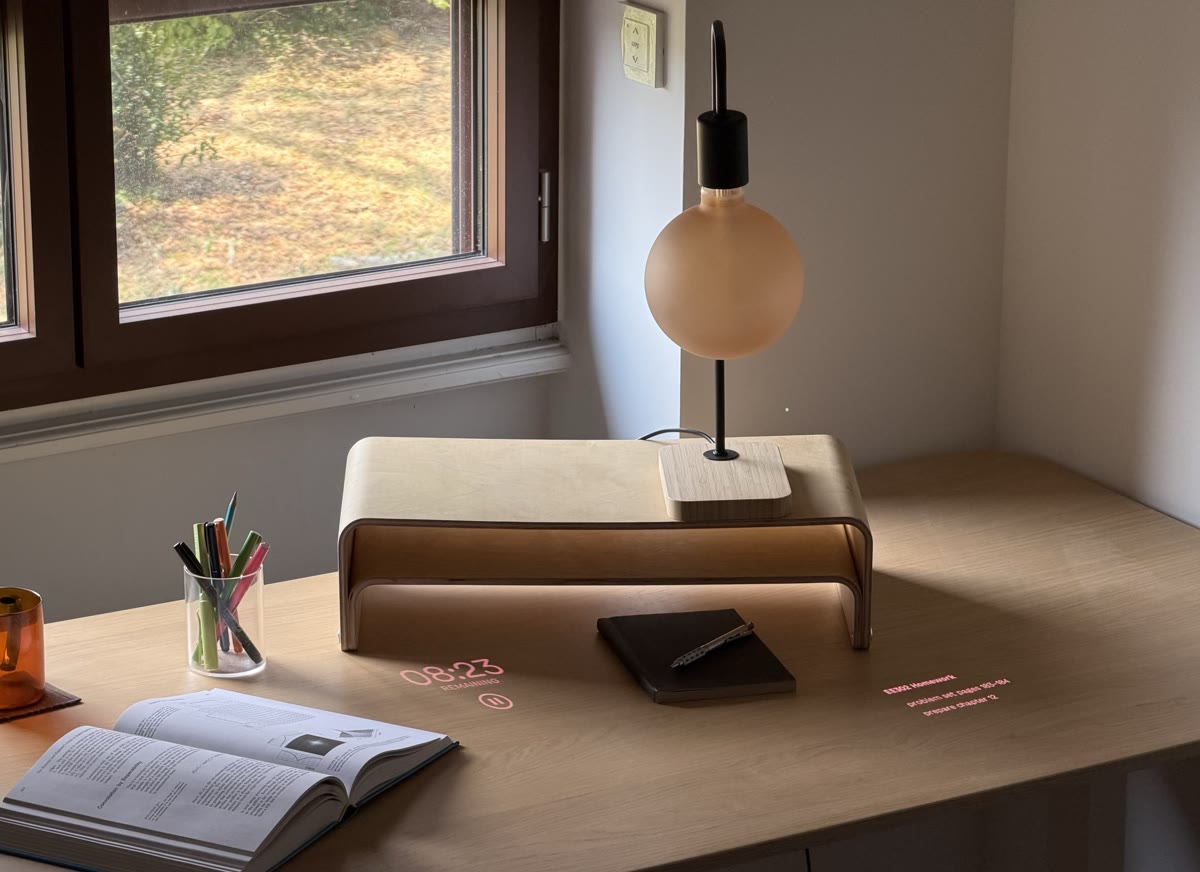
The Lightbulb Computer — Reimagining Spatial & Ambient Computing with Projectors
A new direction for computing: projecting information into the real world to augment it, with a device that combines a projector and computer vision in the shape of a large lightbulb.
The inequities of our remote gathering tools
As we’ve been transitioning our in-person communities to virtual ones, our modes of interaction are now firmly established in tiny…


RoboScape: Physics-informed Embodied World Model
World models have become indispensable tools for embodied intelligence, serving as powerful simulators capable of generating realistic robotic videos while addressing critical data scarcity challenges. However, current embodied world models exhibit limited physical awareness, particularly in modeling 3D geometry and motion dynamics, resulting in unrealistic video generation for contact-rich robotic scenarios. In this paper, we present RoboScape, a unified physics-informed world model that jointly learns RGB video generation and physics knowledge within an integrated framework. We introduce two key physics-informed joint training tasks: temporal depth prediction that enhances 3D geometric consistency in video rendering, and keypoint dynamics learning that implicitly encodes physical properties (e.g., object shape and material characteristics) while improving complex motion modeling. Extensive experiments demonstrate that RoboScape generates videos with superior visual fidelity and physical plausibility across diverse robotic scenarios. We further validate its practical utility through downstream applications including robotic policy training with generated data and policy evaluation. Our work provides new insights for building efficient physics-informed world models to advance embodied intelligence research. The code is available at: https://github.com/tsinghua-fib-lab/RoboScape.
Focusmate - Virtual coworking for getting anything done
Stop procrastination forever with virtual body doubling. Join for free and tackle any task, from studying and coding to meal prep and everything in between. As featured in BBC, NPR, The New York Times, and HBR.

ambientROOM
Urp: a luminous-tangible workbench for urban planning and design
In recent years, virtual reality technology has gradually attracted widespread attention from the society, because virtual reality technology could produce many scenes that humans cannot experience personally, such as diving into the deep sea or into ...

Human-computer intra-action: a relational approach to digital media and technologies
The growing pervasiveness of digital technologies has exposed the entanglements of Human-Computer Interaction (HCI) with its surrounding context, from the immediate vicinity of interfaces to global issues. While often providing solutions to societal issues, interactive technologies also many times contribute to them. They impact and are impacted by the world, in a process of continuous mutual influence and co-constitution that raises important implications not only to user experience, effectiveness and efficiency, but also to ethics, social responsibility and environmental health. In this article, I draw on the new materialism notion of intra-action to propose a conceptual shift to a relational approach for HCI, which I refer to as Human-Computer Intra-Action (HCIA), capable of capturing from the outset the inherent relationships with the world that inform the design of interactive technology. To that end, I propose the notion of relationalities to reflect the synergies and antagonisms around those relationships, and discuss emerging notions of spatiality and temporality by considering the increasing hybridity of socio-technical engagements both in space (local versus remote) and in time (immediate versus stretched). Based on that, I propose a preliminary method for mapping intra-actions associated to interactive technologies, envisaged as a starting point to a relational take on their design process.
