


As part of the Digital Library's transition to Open Access, new features for researchers are available in the Premium Edition. Click here to learn more.
Modeling the Engagement-Disengagement Cycle of Compulsive Phone Use | Proceedings of the 2019 CHI Conference on Human Factors in Computing Systems
As part of the Digital Library's transition to Open Access, new features for researchers are available in the Premium Edition. Click here to learn more.

Feeling of Computing — Conversations
Revisiting creative behaviour as an epistemic process: lessons from 12 computational artists and designers | Proceedings of the 35th Australian Computer-Human Interaction Conference
As part of the Digital Library's transition to Open Access, new features for researchers are available in the Premium Edition. Click here to learn more.

Close to the Metal — Real Life
The value of reintroducing friction into our interactions with computers

The world is not a desktop | Interactions
As part of the Digital Library's transition to Open Access, new features for researchers are available in the Premium Edition. Click here to learn more.
FRICTIONAL AI WORKSHOP
Topics of the Workshop In its third edition, this workshop builds on and expands its exploration of friction-in-design in AI systems, hosting a full-day event that challenges the pursuit of seamless, rapid interactions. In contrast to the conventional narrative that human over-reliance on AI stems
User-tailorable systems: pressing the issues with buttons
As part of the Digital Library's transition to Open Access, new features for researchers are available in the Premium Edition. Click here to learn more.
The World's Most Satisfying Checkbox | !Boring Software
The Art of Game Feel (a.k.a Juice) in Product Design

Feeling of Computing
Feeling of Computing is an online community with a welcoming, cooperative, and revolutionary spirit. We are unified in the belief that the computer is tragically less humane than it could be. There’s a world of possibilities that get more beautiful the further away from the norm you go. We’re here to explore this world together, to discuss ideas about theory and practice, and to champion and support our members’ research and development efforts to reimagine the computer.
Alexander Obenauer
Exploring new and renewed ideas for how personal computing and the interfaces we think with can better serve people’s lives – expanding opportunity, agency, curiosity, and creativity.
Our interfaces have lost their senses
We programmed them by punching cards, plugging in wires, and flipping switches. Programmers walked among banks of switches and cables, physically choreographing their logic. Being on a computer used to be a full-body experience.
A small matter of programming: perspectives on end user computing
A Small Matter of Programming asks why it has been so d…

Usability/UX/Accessability Research? · Issue #819 · w3c-fedid/FedCM
I'm curious if this work has any usability, UX, or accessibility research that supports the designs here? Are there non-goals, or handling of failure case scenarios that have been envisioned an...
By Humans, For Humans – Mindful Design
Now, more than ever, we need to consider the real, human impact of the work we do. This is a fundamental principle of Mindful Design.

The case against efficiency: friction in social media
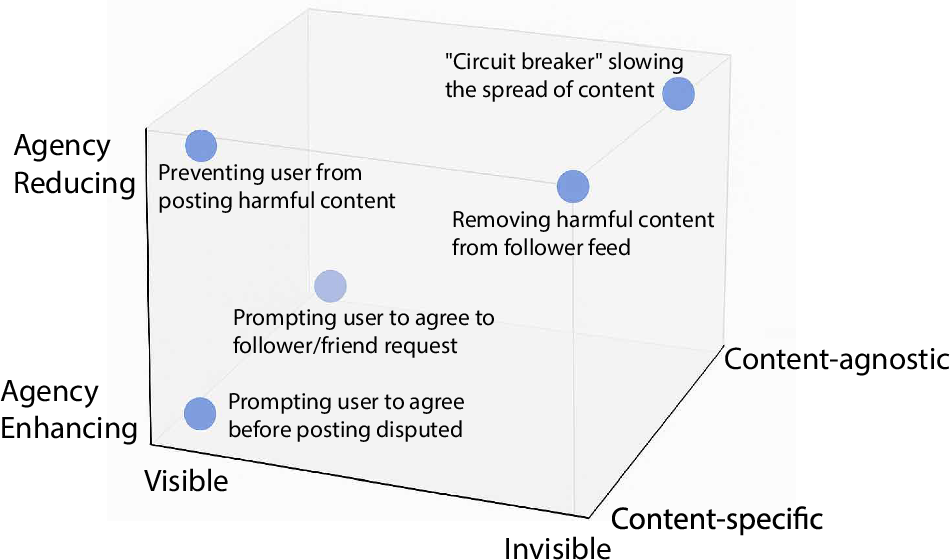
Social media platforms frequently prioritize efficiency to maximize ad revenue and user engagement, often sacrificing deliberation, trust, and reflective, purposeful cognitive engagement in the process. This manuscript examines the potential of friction—design choices that intentionally slow user interactions—as an alternate approach. We present a case against efficiency as the dominant paradigm on social media and advocate for a complex systems approach to understanding and analyzing friction. Drawing from interdisciplinary literature, real-world examples, and industry experiments, we highlight the potential for friction to mitigate issues like polarization, disinformation, and toxic content without resorting to censorship. We propose a state space representation of friction to establish a multidimensional framework and language for analyzing the diverse forms and functions through which friction can be implemented. Additionally, we propose several experimental designs to examine the impact of friction on system dynamics, user behavior, and information ecosystems, each designed with complex systems solutions and perspectives in mind. Our case against efficiency underscores the critical role of friction in shaping digital spaces, challenging the relentless pursuit of efficiency and exploring the potential of thoughtful slowing.
Retrocomputing as a Model for Sustainable and Cognitive Computing: Lessons from Low-Resource Systems
This paper argues that retrocomputing constitutes a conceptually productive model for rethinking sustainability in contemporary computing. Early computing systems operated under strict hardware constraints, necessitating efficiency, clarity, and minimalism in both software and interaction design. In contrast, contemporary systems are frequently characterised by computational excess, software bloat, and attention-fragmenting interfaces. Drawing on examples from early home computing and command-line environments, this paper analyses how low-resource systems make visible forms of computational minimalism with relevance to present-day design challenges. A central theoretical contribution is the distinction between interface-level and system-structure-level design analysis, which demonstrates that cognitive effects arise not only from visual and interactional surface features but from deeper computational organisation. The discussion integrates perspectives from human-computer interaction and cognitive science, particularly in relation to attention, cognitive load, and user experience. The paper adopts a conceptual and exploratory approach grounded in systematic literature review, aiming to identify design-relevant patterns rather than to provide empirical validation. It introduces the concepts of computational minimalism and cognitive sustainability as complementary analytical frameworks, and derives five principles for sustainable system design. Crucially, the paper also address
