In recent years, virtual reality technology has gradually attracted widespread attention from the society, because virtual reality technology could produce many scenes that humans cannot experience personally, such as diving into the deep sea or into ...

Creating Magic Through Technology: Headset Prototyping for AR/VR
After Cybernetics: Treatise for Future Urbanisms — Against Catastrophe
Since 2014, Zaha Hadid Virtual Reality Group, part of Hadid Partners Architecture Firm, has had a focus on cybernetic architecture. This architecture involves what they label the ‘metaverse’. The metaverse integrates physical with digital worlds seamlessly. In industry parlance it is a world populated by what are euphemistically titled ‘cyber-physical’ assets.

Spatial - Create Immersive UGC, Virtual Classrooms, Experiential Marketing
Join 2M+ creators & brands building and publishing social games, brand experiences, virtual learning, galleries, onboarding, & training. No-code + Unity-based tools. Web (No Download Required), Mobile, VR.

Digital Dualism versus Augmented Reality - Cyborgology
The Society Pages (TSP) is an open-access social science project headquartered in the Department of Sociology at the University of Minnesota
Wanix: The Spirit of Plan 9 in Wasm
Screen As Room: An Architectural Perspective on User Interfaces — Christoph Locher · Interaction Designer
With the use of video games as social spaces being observed for several years and the increased focus put on virtual social spaces due to the scarceness of physical social spaces in the last months, the concept of “spatial interfaces” is once again at the center of discussions. I want to add an alternative perspective to this, looking at the properties of physical spaces as metaphors, rather than models, for interfaces and exploring seven of them in more detail.
Project Shadowglass
A stealth-focused immersive sim set within a dark fantasy kingdom. Plan daring heists, infiltrate forbidden locales, and escape with priceless artifacts. Features revolutionary 3D pixel art graphics and lasting consequences where every action could leave a trail back to you.

Unity Technologies Aims to Bring Video Game Tools Into the Real World
The video game software leader is pushing to sell tools for making virtual worlds to marketers, architects and car makers

Creating Magic Through Technology: Headset Prototyping for AR/VR, Thu, Jan 22, 2026, 4:00 PM | Meetup
Join **Nathan Matsuda**, a pioneering **researcher at Meta**, for an engaging conversation with our hosts about the art and science of building **next-generation AR/VR head

Muse: Designing a studio for ideas
Physical workspaces inspire a fast, fluid digital tool for creative thinking.
Architecture and the Internet: Designing places in cyberspace
Cyberspace, as the information space is called, has become accessible in the past decade through the World Wide Web. And although it can only be experienced through the mediation of computers, it is quickly becoming an alternative stage for everyday economic, cultural, and other human activities. As such, there is a potential and a need to design it according to place–like principles. Making places for human inhabitation is, of course, what architects, landscape architects, and town planners have been doing in physical space for thousands of years. It is curious, therefore, that Cyberspace designers have not capitalized on the theories, experiences, and practices that have been guiding physical place–making. While most 3D environments closely mimic physical spaces, they are, by and large, devoid of the essential characteristics that differentiate a ‘place’ from mere ‘space.’ And only rarely are they sensitive to, and take advantage of, the peculiarities of Cyberspace. We believe that this state of affairs is temporary, characteristic of early adoption stages of new technologies. As the Web matures, and as it assumes more fully its role as a destination rather than as means of communication, there will be a growing need to design it according to place–making principles. By looking at physical architecture as a case study and metaphor for organizing space into meaningful places, this paper explores the possibility of organizing Cyberspace into spatial settings that not only afford social interaction, but, like physical places, also embody and express cultural values. At the same time, because Cyberspace lacks materiality, is free from physical constraints, and because it can only be ‘inhabited’ by proxy, these ‘places’ may not necessarily resemble their physical counterparts.
inFORM: dynamic physical affordances and constraints through shape and object actuation
We propose a new approach to Physical Telepresence, based on shared workspaces with the ability to capture and remotely render the shapes of people and objects. In this paper, we describe the concept of shape transmission, and propose interaction ...

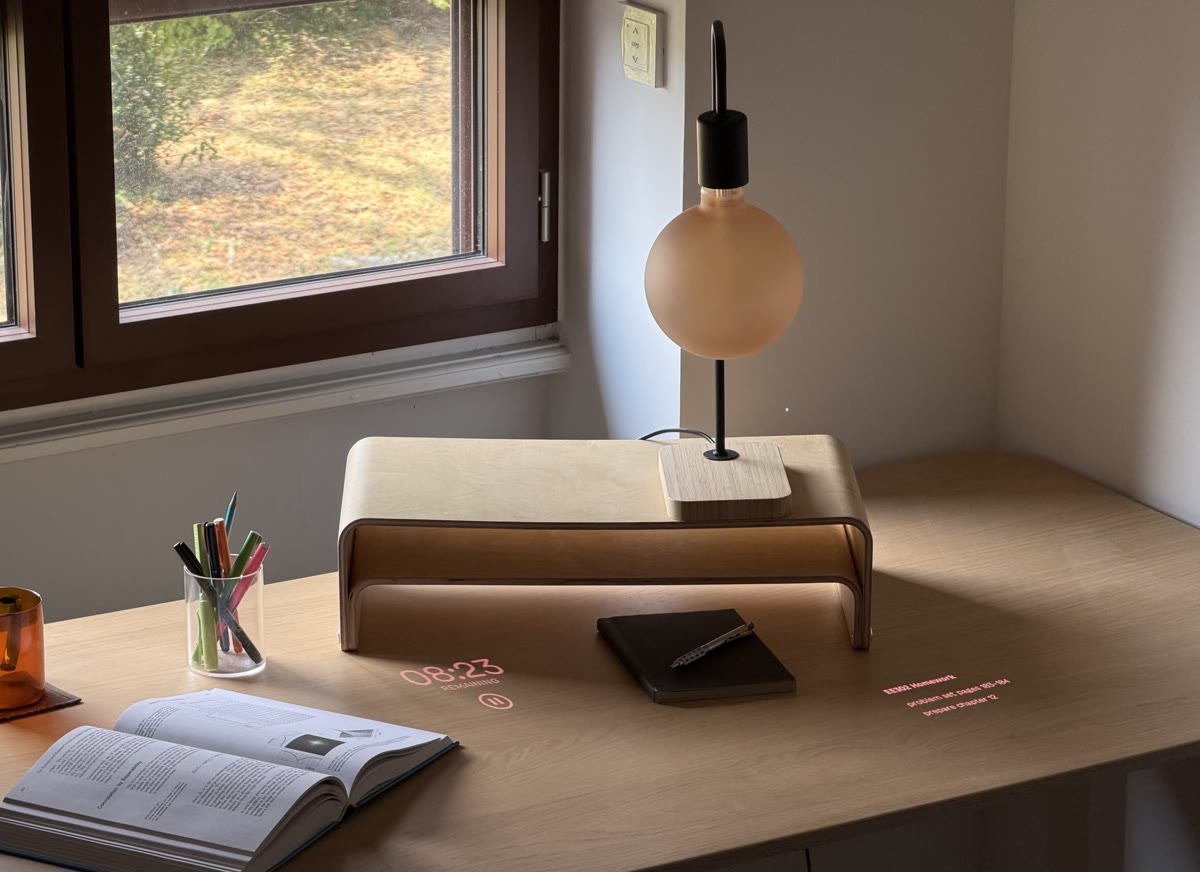
The Lightbulb Computer — Reimagining Spatial & Ambient Computing with Projectors
A new direction for computing: projecting information into the real world to augment it, with a device that combines a projector and computer vision in the shape of a large lightbulb.
WebVR - virtual reality in your browsers
Slides for my Talk about WebVR. Presented at BED-Con in Berlin 2016 (http://bed-con.org/2016/)