


Large language models (LLMs) have become integral to numerous applications, raising concerns about bias, fairness, and compliance with emerging regulatory frameworks. This article provides a review of some of the most significant risks associated with biased LLM outputs and their broader societal implications. We discuss how regulatory initiatives such as the European Union’s (EU’s) Artificial Intelligence Act (AI Act) and the Digital Services Act (DSA) seek to address these challenges by introducing legal requirements for transparency, accountability, and harm mitigation. In addition, we explore various approaches for assessing and mitigating bias, along with the limitations of current methods. While regulatory frameworks play a crucial role in governing artificial intelligence (AI), they also present challenges in balancing innovation with legal compliance. As oversight mechanisms continue to evolve, we emphasize the fact that LLMs are increasingly regarded as a distinct subset of AI systems and that LLMs are particularly noteworthy due to their immediate interaction with consumers, functioning as the primary interface between users and AI. This distinguishes LLMs from many other AI applications operating behind the scenes and renders them unique in the sense that they are becoming integral tools for personal decision making, offering validation, guidance, and support across various aspects of everyday life, including healthcare, finance, and even choices made in relation to politics. While the current landscape of AI-generated content is addressed by several new regulatory frameworks, none of them have been devised with the possibility in mind that LLMs may affect citizens’ fundamental worldviews and social perspectives, including their individual and collective voting decisions. Our analysis highlights the need for a greater focus on both competition and technology design governance as a complement to value chain and content-based regulation, in order to foster fair and trustworthy AI systems. , While new regulatory frameworks address fairness, accountability, and safety in AI systems, they often fail to directly mitigate the subtle "communication bias" in LLMs that can distort public discourse and democratic processes.
Communication Bias in Large Language Models: A Regulatory Perspective
Large language models (LLMs) have become integral to numerous applications, raising concerns about bias, fairness, and compliance with emerging regulatory frameworks. This article provides a review of some of the most significant risks associated with biased LLM outputs and their broader societal implications. We discuss how regulatory initiatives such as the European Union’s (EU’s) Artificial Intelligence Act (AI Act) and the Digital Services Act (DSA) seek to address these challenges by introducing legal requirements for transparency, accountability, and harm mitigation. In addition, we explore various approaches for assessing and mitigating bias, along with the limitations of current methods. While regulatory frameworks play a crucial role in governing artificial intelligence (AI), they also present challenges in balancing innovation with legal compliance. As oversight mechanisms continue to evolve, we emphasize the fact that LLMs are increasingly regarded as a distinct subset of AI systems and that LLMs are particularly noteworthy due to their immediate interaction with consumers, functioning as the primary interface between users and AI. This distinguishes LLMs from many other AI applications operating behind the scenes and renders them unique in the sense that they are becoming integral tools for personal decision making, offering validation, guidance, and support across various aspects of everyday life, including healthcare, finance, and even choices made in relation to politics. While the current landscape of AI-generated content is addressed by several new regulatory frameworks, none of them have been devised with the possibility in mind that LLMs may affect citizens’ fundamental worldviews and social perspectives, including their individual and collective voting decisions. Our analysis highlights the need for a greater focus on both competition and technology design governance as a complement to value chain and content-based regulation, in order to foster fair and trustworthy AI systems. , While new regulatory frameworks address fairness, accountability, and safety in AI systems, they often fail to directly mitigate the subtle "communication bias" in LLMs that can distort public discourse and democratic processes.
Communication Bias in Large Language Models: A Regulatory Perspective
Large language models (LLMs) are increasingly central to many applications, raising concerns about bias, fairness, and regulatory compliance. This paper reviews risks of biased outputs and their societal impact, focusing on frameworks like the EU's AI Act and the Digital Services Act. We argue that beyond constant regulation, stronger attention to competition and design governance is needed to ensure fair, trustworthy AI. This is a preprint of the Communications of the ACM article of the same title.

Communication Bias in Large Language Models: A Regulatory Perspective
Large language models (LLMs) are increasingly central to many applications, raising concerns about bias, fairness, and regulatory compliance. This paper reviews risks of biased outputs and their societal impact, focusing on frameworks like the EU's AI Act and the Digital Services Act. We argue that beyond constant regulation, stronger attention to competition and design governance is needed to ensure fair, trustworthy AI. This is a preprint of the Communications of the ACM article of the same title.
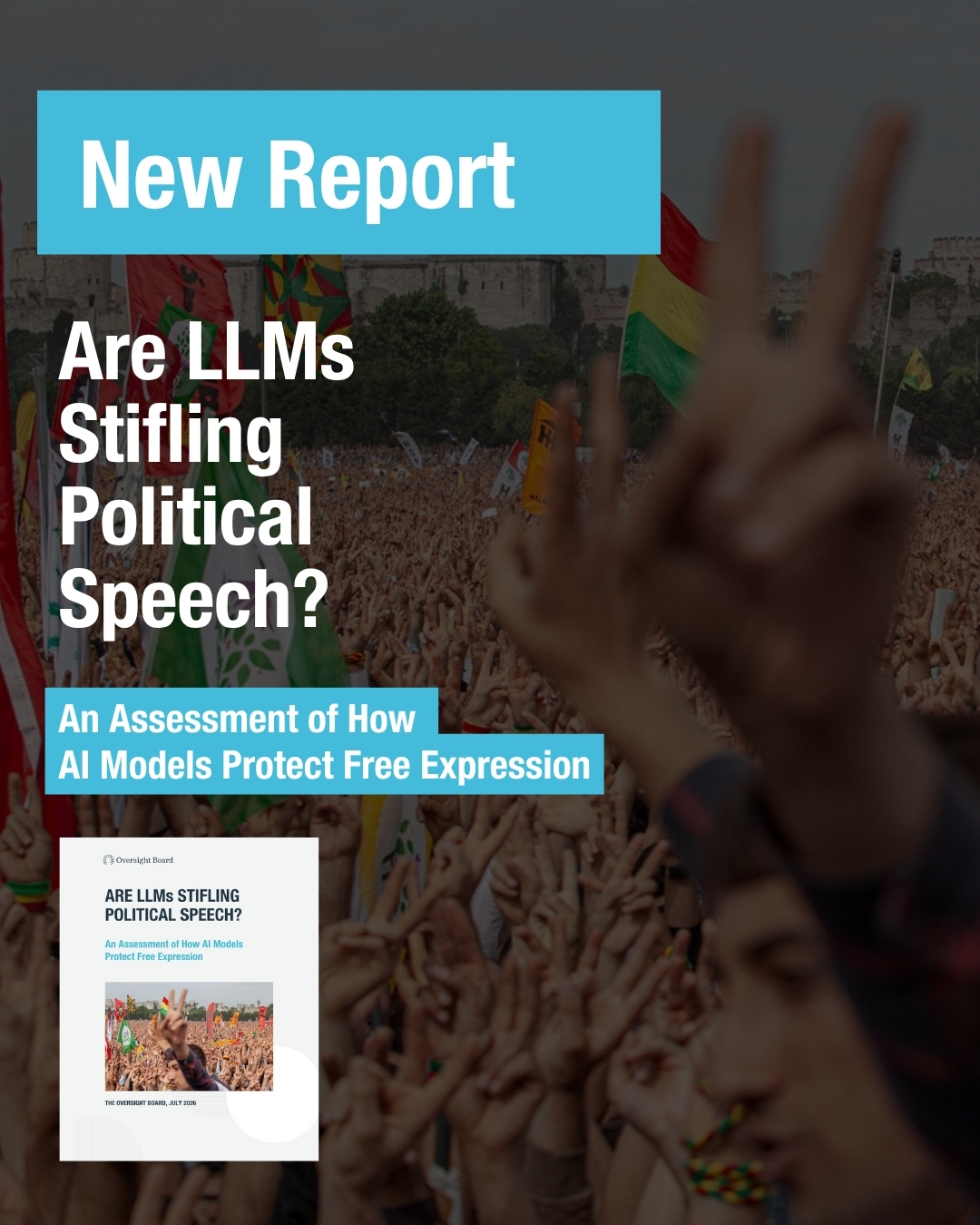
Are LLMs Stifling Political Speech? An Assessment of How AI Models Protect Free Expression | Oversight Board
The Oversight Board’s first evaluation of large language models (LLMs) shows that some of the world’s most-used models from Anthropic, DeepSeek, Google, Meta
The social consequences of AI delegation
A substantial body of recent work has debated whether large language models (LLMs) can serve as substitutes for human participants in behavioural research. This debate, however, captures only one direction of a rapidly changing relationship. The more consequential question is not simply whether researchers should use LLMs as human surrogates, but whether - and under what conditions - humans are beginning to use LLMs as surrogates for their own deliberation. Across domains including health, law, finance, education, and personal guidance, increasing numbers of people consult generative AI systems before, alongside, or instead of human experts, peers, or independent judgment. Although evidence for actual delegation remains uneven, this uncertainty makes the phenomenon an urgent social-scientific object of study. We argue for a research programme that treats LLMs as consequential social actors in a functional sense: systems whose outputs shape human decisions, social norms, and collective dynamics.
User Privacy and Large Language Models: An Analysis of Frontier Developers’ Privacy Policies
Hundreds of millions of people now regularly interact with large language models via chatbots. Model developers are eager to acquire new sources of high-quality training data as they race to improve model capabilities and win market share. This paper analyzes the privacy policies of six U.S. frontier AI developers to understand how they use their users' chats to train models. Drawing primarily on the California Consumer Privacy Act, we develop a novel qualitative coding schema that we apply to each developer’s relevant privacy policies to compare data collection and use practices across the six companies. We find that all six developers appear to employ their users' chat data to train and improve their models by default, and that some retain this data indefinitely. Developers may collect and train on personal information disclosed in chats, including sensitive information such as biometric and health data, as well as files uploaded by users. Four of the six companies we examined appear to include children's chat data for model training, as well as customer data from other products. On the whole, developers' privacy policies often lack essential information about their practices, highlighting the need for greater transparency and accountability. We address the implications of users' lack of consent for the use of their chat data for model training, data security risks arising from indefinite chat data retention, and issues with training on children's chat data. We conclude by providing recommendations to policymakers and developers to address the data privacy challenges posed by LLM-powered chatbots.
User Privacy and Large Language Models: An Analysis of Frontier Developers’ Privacy Policies
Hundreds of millions of people now regularly interact with large language models via chatbots. Model developers are eager to acquire new sources of high-quality training data as they race to improve model capabilities and win market share. This paper analyzes the privacy policies of six U.S. frontier AI developers to understand how they use their users' chats to train models. Drawing primarily on the California Consumer Privacy Act, we develop a novel qualitative coding schema that we apply to each developer’s relevant privacy policies to compare data collection and use practices across the six companies. We find that all six developers appear to employ their users' chat data to train and improve their models by default, and that some retain this data indefinitely. Developers may collect and train on personal information disclosed in chats, including sensitive information such as biometric and health data, as well as files uploaded by users. Four of the six companies we examined appear to include children's chat data for model training, as well as customer data from other products. On the whole, developers' privacy policies often lack essential information about their practices, highlighting the need for greater transparency and accountability. We address the implications of users' lack of consent for the use of their chat data for model training, data security risks arising from indefinite chat data retention, and issues with training on children's chat data. We conclude by providing recommendations to policymakers and developers to address the data privacy challenges posed by LLM-powered chatbots.
User Privacy and Large Language Models: An Analysis of Frontier Developers' Privacy Policies
Hundreds of millions of people now regularly interact with large language models via chatbots. Model developers are eager to acquire new sources of high-quality training data as they race to improve model capabilities and win market share. This paper analyzes the privacy policies of six U.S. frontier AI developers to understand how they use their users' chats to train models. Drawing primarily on the California Consumer Privacy Act, we develop a novel qualitative coding schema that we apply to each developer's relevant privacy policies to compare data collection and use practices across the six companies. We find that all six developers appear to employ their users' chat data to train and improve their models by default, and that some retain this data indefinitely. Developers may collect and train on personal information disclosed in chats, including sensitive information such as biometric and health data, as well as files uploaded by users. Four of the six companies we examined appear to include children's chat data for model training, as well as customer data from other products. On the whole, developers' privacy policies often lack essential information about their practices, highlighting the need for greater transparency and accountability. We address the implications of users' lack of consent for the use of their chat data for model training, data security issues arising from indefinite chat data retention, and training on children's chat data. We conclude by providing recommendations to policymakers and developers to address the data privacy challenges posed by LLM-powered chatbots.
User Privacy and Large Language Models: An Analysis of Frontier Developers' Privacy Policies
Hundreds of millions of people now regularly interact with large language models via chatbots. Model developers are eager to acquire new sources of high-quality training data as they race to improve model capabilities and win market share. This paper analyzes the privacy policies of six U.S. frontier AI developers to understand how they use their users' chats to train models. Drawing primarily on the California Consumer Privacy Act, we develop a novel qualitative coding schema that we apply to each developer's relevant privacy policies to compare data collection and use practices across the six companies. We find that all six developers appear to employ their users' chat data to train and improve their models by default, and that some retain this data indefinitely. Developers may collect and train on personal information disclosed in chats, including sensitive information such as biometric and health data, as well as files uploaded by users. Four of the six companies we examined appear to include children's chat data for model training, as well as customer data from other products. On the whole, developers' privacy policies often lack essential information about their practices, highlighting the need for greater transparency and accountability. We address the implications of users' lack of consent for the use of their chat data for model training, data security issues arising from indefinite chat data retention, and training on children's chat data. We conclude by providing recommendations to policymakers and developers to address the data privacy challenges posed by LLM-powered chatbots.
AI Act: a step closer to the first rules on Artificial Intelligence | News | European Parliament
To ensure a human-centric and ethical development of Artificial Intelligence (AI) in Europe, MEPs endorsed new transparency and risk-management rules for AI systems.
Political Neutrality in AI Is Impossible- But Here Is How to Approximate It
AI systems often exhibit political bias, influencing users' opinions and decisions. While political neutrality-defined as the absence of bias-is often seen as an ideal solution for fairness and safety, this position paper argues that true political neutrality is neither feasible nor universally desirable due to its subjective nature and the biases inherent in AI training data, algorithms, and user interactions. However, inspired by Joseph Raz's philosophical insight that "neutrality [...] can be a matter of degree" (Raz, 1986), we argue that striving for some neutrality remains essential for promoting balanced AI interactions and mitigating user manipulation. Therefore, we use the term "approximation" of political neutrality to shift the focus from unattainable absolutes to achievable, practical proxies. We propose eight techniques for approximating neutrality across three levels of conceptualizing AI, examining their trade-offs and implementation strategies. In addition, we explore two concrete applications of these approximations to illustrate their practicality. Finally, we assess our framework on current large language models (LLMs) at the output level, providing a demonstration of how it can be evaluated. This work seeks to advance nuanced discussions of political neutrality in AI and promote the development of responsible, aligned language models.
Political Neutrality in AI Is Impossible- But Here Is How to Approximate It
AI systems often exhibit political bias, influencing users' opinions and decisions. While political neutrality-defined as the absence of bias-is often seen as an ideal solution for fairness and safety, this position paper argues that true political neutrality is neither feasible nor universally desirable due to its subjective nature and the biases inherent in AI training data, algorithms, and user interactions. However, inspired by Joseph Raz's philosophical insight that "neutrality [...] can be a matter of degree" (Raz, 1986), we argue that striving for some neutrality remains essential for promoting balanced AI interactions and mitigating user manipulation. Therefore, we use the term "approximation" of political neutrality to shift the focus from unattainable absolutes to achievable, practical proxies. We propose eight techniques for approximating neutrality across three levels of conceptualizing AI, examining their trade-offs and implementation strategies. In addition, we explore two concrete applications of these approximations to illustrate their practicality. Finally, we assess our framework on current large language models (LLMs) at the output level, providing a demonstration of how it can be evaluated. This work seeks to advance nuanced discussions of political neutrality in AI and promote the development of responsible, aligned language models.
Directing large language models to follow the letter or spirit of the law
The distinction between the spirit and letter of the law is a central issue across research and everyday life, and a growing concern for building safe, intelligent machines. What is this distinction based on, and how can we develop machines that follow the intention behind a rule? We used targeted adaptation that made large language models prioritize the spirit or letter of the law. With minimal modifications, our method significantly changed LLM behavior across diverse measures, novel vignettes, real-world scenarios, and influential legal cases. An analysis of model internals revealed a low-dimensional space with three interpretable dimensions matching a formal pre-specified framework for the geometry of legal concepts. These findings show how legal thought in LLMs may be organized and directed.
Taking AI Welfare Seriously
In this report, we argue that there is a realistic possibility that some AI systems will be conscious and/or robustly agentic in the near future. That means that the prospect of AI welfare and moral patienthood, i.e. of AI systems with their own interests and moral significance, is no longer an issue only for sci-fi or the distant future. It is an issue for the near future, and AI companies and other actors have a responsibility to start taking it seriously. We also recommend three early steps that AI companies and other actors can take: They can (1) acknowledge that AI welfare is an important and difficult issue (and ensure that language model outputs do the same), (2) start assessing AI systems for evidence of consciousness and robust agency, and (3) prepare policies and procedures for treating AI systems with an appropriate level of moral concern. To be clear, our argument in this report is not that AI systems definitely are, or will be, conscious, robustly agentic, or otherwise morally significant. Instead, our argument is that there is substantial uncertainty about these possibilities, and so we need to improve our understanding of AI welfare and our ability to make wise decisions about this issue. Otherwise there is a significant risk that we will mishandle decisions about AI welfare, mistakenly harming AI systems that matter morally and/or mistakenly caring for AI systems that do not.
The levers of political persuasion with conversational artificial intelligence
There are widespread fears that conversational artificial intelligence (AI) could soon exert unprecedented influence over human beliefs. In this work, in three large-scale experiments ( N = 76,977 participants), we deployed 19 large language models (LLMs)—including some post-trained explicitly for persuasion—to evaluate their persuasiveness on 707 political issues. We then checked the factual accuracy of 466,769 resulting LLM claims. We show that the persuasive power of current and near-future AI is likely to stem more from post-training and prompting methods—which boosted persuasiveness by as much as 51 and 27%, respectively—than from personalization or increasing model scale, which had smaller effects. We further show that these methods increased persuasion by exploiting LLMs’ ability to rapidly access and strategically deploy information and that, notably, where they increased AI persuasiveness, they also systematically decreased factual accuracy. , Editor’s summary Many fear that we are on the precipice of unprecedented manipulation by large language models (LLMs), but techniques driving their persuasiveness are poorly understood. In the initial “pretrained” phase, LLMs may exhibit flawed reasoning. Their power unlocks during vital “posttraining,” when developers refine pretrained LLMs to sharpen their reasoning and align with users’ needs. Posttraining also enables LLMs to maintain logical, sophisticated conversations. Hackenburg et al . examined which techniques made diverse, conversational LLMs most persuasive across 707 British political issues (see the Perspective by Argyle). LLMs were most persuasive after posttraining, especially when prompted to use facts and evidence (information) to argue. However, information-dense LLMs produced the most inaccurate claims, raising concerns about the spread of misinformation during rollouts of future models. —Ekeoma Uzogara , INTRODUCTION Rapid advances in artificial intelligence (AI) have sparked widespread concerns about its potential to influence human beliefs. One possibility is that conversational AI could be used to manipulate public opinion on political issues through interactive dialogue. Despite extensive speculation, however, fundamental questions about the actual mechanisms, or “levers,” responsible for driving advances in AI persuasiveness—e.g., computational power or sophisticated training techniques—remain largely unanswered. In this work, we systematically investigate these levers and chart the horizon of persuasiveness with conversational AI. RATIONALE We considered multiple factors that could enhance the persuasiveness of conversational AI: raw computational power (model scale), specialized post-training methods for persuasion, personalization to individual users, and instructed rhetorical strategies. Across three large-scale experiments with 76,977 total UK participants, we deployed 19 large language models (LLMs) to persuade on 707 political issues while varying these factors independently. We also analyzed more than 466,000 AI-generated claims, examining the relationship between persuasiveness and truthfulness. RESULTS We found that the most powerful levers of AI persuasion were methods for post-training and rhetorical strategy (prompting), which increased persuasiveness by as much as 51 and 27%, respectively. These gains were often larger than those obtained from substantially increasing model scale. Personalizing arguments on the basis of user data had a comparatively small effect on persuasion. We observe that a primary mechanism driving AI persuasiveness was information density: Models were most persuasive when they packed their arguments with a high volume of factual claims. Notably, however, we documented a concerning trade-off between persuasion and accuracy: The same levers that made AI more persuasive—including persuasion post-training and information-focused prompting—also systematically caused the AI to produce information that was less factually accurate. CONCLUSION Our findings suggest that the persuasive power of current and near-future AI is likely to stem less from model scale or personalization and more from post-training and prompting techniques that mobilize an LLM’s ability to rapidly generate information during conversation. Further, we reveal a troubling trade-off: When AI systems are optimized for persuasion, they may increasingly deploy misleading or false information. This research provides an empirical foundation for policy-makers and technologists to anticipate and address the challenges of AI-driven persuasion, and it highlights the need for safeguards that balance AI’s legitimate uses in political discourse with protections against manipulation and misinformation. Persuasiveness of conversational AI increases with model scale. The persuasive impact in percentage points on the y axis is plotted against effective pretraining compute [floating-point operations (FLOPs)] on the x axis. Point estimates are persuasive effects of different AI models. Colored lines show trends for models that we uniformly chat-tuned for open-ended conversation (purple) versus those that were post-trained using heterogeneous, opaque methods by AI developers (green). pp, percentage points; CI, confidence interval.

LLM-generated messages can persuade humans on policy issues
The emergence of large language models (LLMs) has made it possible for generative artificial intelligence (AI) to tackle many higher-order cognitive tasks, with critical implications for industry, government, and labor markets. Here, we investigate whether existing, openly-available LLMs can be used to create messages capable of influencing humans’ political attitudes. Across three pre-registered experiments (total N = 4829), participants who read persuasive messages generated by LLMs showed significantly more attitude change across a range of policies - including polarized policies, like an assault weapons ban, a carbon tax, and a paid parental-leave program - relative to control condition participants who read a neutral message. Overall, LLM-generated messages were similarly effective in influencing policy attitudes as messages crafted by lay humans. Participants’ reported perceptions of the authors of the persuasive messages suggest these effects occurred through somewhat distinct causal pathways. While the persuasiveness of LLM-generated messages was associated with perceptions that the author used more facts, evidence, logical reasoning, and a dispassionate voice, the persuasiveness of human-generated messages was associated with perceptions of the author as unique and original. These results demonstrate that recent developments in AI make it possible to create politically persuasive messages quickly, cheaply, and at massive scale.
