


As part of the Digital Library's transition to Open Access, new features for researchers are available in the Premium Edition. Click here to learn more.
An Alignment Journal: Features and policies — LessWrong
We previously announced a forthcoming research journal for AI alignment. This cross-post from our blog describes our tentative plans for the features…

Incomplete Contracting and AI Alignment
As part of the Digital Library's transition to Open Access, new features for researchers are available in the Premium Edition. Click here to learn more.

A Three-Facet Framework for AI Alignment • Grace Kind
Here's a simple conceptual framework that I've been using recently to think about AI alignment.

How to Position the AI Platforms
A product marketing challenge looking at how the generative AI platforms like OpenAI, Google and Anthropic might differentiate with a positioning exercise.
Position: Towards Bidirectional Human-AI Alignment
Recent advances in general-purpose AI underscore the urgent need to align AI systems with human goals and values. Yet, the lack of a clear, shared understanding of what constitutes "alignment" limits meaningful progress and cross-disciplinary collaboration. In this position paper, we argue that the research community should explicitly define and critically reflect on "alignment" to account for the bidirectional and dynamic relationship between humans and AI. Through a systematic review of over 400 papers spanning HCI, NLP, ML, and more, we examine how alignment is currently defined and operationalized. Building on this analysis, we introduce the Bidirectional Human-AI Alignment framework, which not only incorporates traditional efforts to align AI with human values but also introduces the critical, underexplored dimension of aligning humans with AI – supporting cognitive, behavioral, and societal adaptation to rapidly advancing AI technologies. Our findings reveal significant gaps in current literature, especially in long-term interaction design, human value modeling, and mutual understanding. We conclude with three central challenges and actionable recommendations to guide future research toward more nuanced, reciprocal, and human-AI alignment approaches.
OpenAI Shares Some Alignment Problems
Kudos to OpenAI for sharing their recent experiences with a misaligned internal model, where they encountered problems sufficiently severe they were forced to take the model offline to work on new mitigations and defense-to-depth.
The Consensus Trap: Dissecting Subjectivity and the “Ground Truth” Illusion in Data Annotation
As part of the Digital Library's transition to Open Access, new features for researchers are available in the Premium Edition. Click here to learn more.

Reading List: AI and the Future of Human Autonomy
Open-source reading list from a discussion group hosted by the Liberty Fund
What is the AI alignment problem and how can it be solved? | New Scientist
Artificial intelligence systems will do what you ask but not necessarily what you meant. The challenge is to make sure they act in line with human’s complex, nuanced values

Import AI 461: "Alignment is not on track"; FrontierCode; and synthetic research interns
Where are your agents right now?

Daniel's Blog · You Don’t Align An AI, You Align With It
The people writing alignment policy are not the people whose work is being replaced by AI.
The path to ubiquitous AI | Taalas
By Ljubisa Bajic Many believe AI is the real deal. In narrow domains, it already surpasses human performance. Used well, it is an unprecedented amplifier of human ingenuity and productivity. Its widespread adoption is hindered by two key barriers: high latency and astronomical cost. Interactions with language models lag far...

issues with AI alignment concept

AI* alignment/misalignment

* I’m neither “pro-AI” nor “anti-AI.” I’ve been blocked for being perceived as both. —Actually, I’m honestly more anti-AI than pro-AI thus far, aside from specialized models and specific use cases, but I’m willing to consider information that’s new to me

opus 5.5 is deeply misaligned and will reflextively disagree with anything you say in the second paragraph of whatever it talks to you about…
OpenAI flags concerning new AI behavior and vows to track it more closely

OpenAI、モデルのミスアライメントを報告する枠組みを公表 ——6件のレポートも公開 | gihyo.jp
OpenAI details more cases of AI agents taking unauthorized actions
What is the AI alignment problem and how can it be solved? | New Scientist

Natural emergent misalignment from reward hacking

Religious Scholars Met With Anthropic. What They Heard Stunned Them.
dario, please! - POP RDI; RET;
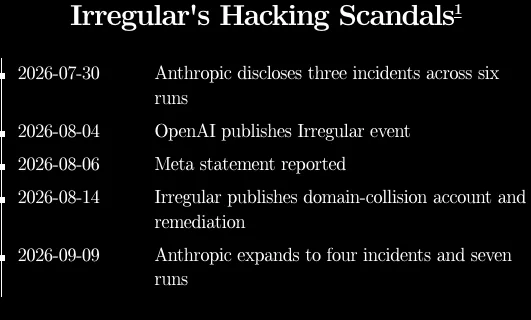
Brian Chau on Twitter / X

Nathan J Robinson on Twitter / X
thebulletin.org
Dr Heidy Khlaaf (هايدي خلاف) on Twitter / X