


Large Language Models (LLMs) have achieved unprecedented performance on many complex tasks, being able, for example, to answer questions on almost any topic. However, they struggle with other simple tasks, such as counting the occurrences of letters in a word, as illustrated by the inability of many LLMs to count the number of “r” letters in “strawberry.” Several works have studied this problem and linked it to the tokenization used by LLMs, the intrinsic limitations of the attention mechanism, or to the lack of character-level training data. In this paper, we conduct an experimental study to evaluate when LLMs fail to count letters. In more detail, we study the relations between LLM errors when counting letters, including: (1) the frequency of the word and its components in the training dataset and (2) the complexity of the counting operation. We present a comprehensive analysis of the errors of LLMs when counting letter occurrences by evaluating a representative group of models over a large number of words. The results show a number of consistent trends in the models evaluated: (1) models are capable of recognizing the letters but not counting them; (2) the frequency of the word and tokens in the word does not have a significant impact on the LLM errors; (3) there is a positive correlation of letter frequency with errors; more frequent letters tend to have more counting errors; (4) the errors show a strong correlation with the number of letters or tokens in a word; and (5) the strongest correlation occurs with the number of letters with counts larger than one, with most models being unable to correctly count words in which letters appear more than twice. These results suggest that the problems of LLMs to counting letters are not related to the frequency of words or tokens in the training data but to the complexity of the counting operation. However, further studies are needed to build a better understanding of the limitations of LLMs in count the letters in a word.
When Do Large Language Models (LLMs) Struggle to Count Letters?
Large Language Models (LLMs) have achieved unprecedented performance on many complex tasks, being able, for example, to answer questions on almost any topic. However, they struggle with other simple tasks, such as counting the occurrences of letters in a word, as illustrated by the inability of many LLMs to count the number of “r” letters in “strawberry.” Several works have studied this problem and linked it to the tokenization used by LLMs, the intrinsic limitations of the attention mechanism, or to the lack of character-level training data. In this paper, we conduct an experimental study to evaluate when LLMs fail to count letters. In more detail, we study the relations between LLM errors when counting letters, including: (1) the frequency of the word and its components in the training dataset and (2) the complexity of the counting operation. We present a comprehensive analysis of the errors of LLMs when counting letter occurrences by evaluating a representative group of models over a large number of words. The results show a number of consistent trends in the models evaluated: (1) models are capable of recognizing the letters but not counting them; (2) the frequency of the word and tokens in the word does not have a significant impact on the LLM errors; (3) there is a positive correlation of letter frequency with errors; more frequent letters tend to have more counting errors; (4) the errors show a strong correlation with the number of letters or tokens in a word; and (5) the strongest correlation occurs with the number of letters with counts larger than one, with most models being unable to correctly count words in which letters appear more than twice. These results suggest that the problems of LLMs to counting letters are not related to the frequency of words or tokens in the training data but to the complexity of the counting operation. However, further studies are needed to build a better understanding of the limitations of LLMs in count the letters in a word.
Why Do Large Language Models (LLMs) Struggle to Count Letters?
Large Language Models (LLMs) have achieved unprecedented performance on many complex tasks, being able, for example, to answer questions on almost any topic. However, they struggle with other simple tasks, such as counting the occurrences of letters in a word, as illustrated by the inability of many LLMs to count the number of "r" letters in "strawberry". Several works have studied this problem and linked it to the tokenization used by LLMs, to the intrinsic limitations of the attention mechanism, or to the lack of character-level training data. In this paper, we conduct an experimental study to evaluate the relations between the LLM errors when counting letters with 1) the frequency of the word and its components in the training dataset and 2) the complexity of the counting operation. We present a comprehensive analysis of the errors of LLMs when counting letter occurrences by evaluating a representative group of models over a large number of words. The results show a number of consistent trends in the models evaluated: 1) models are capable of recognizing the letters but not counting them; 2) the frequency of the word and tokens in the word does not have a significant impact on the LLM errors; 3) there is a positive correlation of letter frequency with errors, more frequent letters tend to have more counting errors, 4) the errors show a strong correlation with the number of letters or tokens in a word and 5) the strongest correlation occurs with the number of letters with counts larger than one, with most models being unable to correctly count words in which letters appear more than twice.
Embers of autoregression show how large language models are shaped by the problem they are trained to solve
The widespread adoption of large language models (LLMs) makes it important to recognize their strengths and limitations. We argue that to develop a holistic understanding of these systems, we must consider the problem that they were trained to solve: next-word prediction over Internet text. By recognizing the pressures that this task exerts, we can make predictions about the strategies that LLMs will adopt, allowing us to reason about when they will succeed or fail. Using this approach—which we call the teleological approach—we identify three factors that we hypothesize will influence LLM accuracy: the probability of the task to be performed, the probability of the target output, and the probability of the provided input. To test our predictions, we evaluate five LLMs (GPT-3.5, GPT-4, Claude 3, Llama 3, and Gemini 1.0) on 11 tasks, and we find robust evidence that LLMs are influenced by probability in the hypothesized ways. Many of the experiments reveal surprising failure modes. For instance, GPT-4’s accuracy at decoding a simple cipher is 51% when the output is a high-probability sentence but only 13% when it is low-probability, even though this task is a deterministic one for which probability should not matter. These results show that AI practitioners should be careful about using LLMs in low-probability situations. More broadly, we conclude that we should not evaluate LLMs as if they are humans but should instead treat them as a distinct type of system—one that has been shaped by its own particular set of pressures.
LLM in a Flash: Efficient Large Language Model Inference with Limited Memory
Large language models (LLMs) are central to modern natural language processing, delivering exceptional performance in various tasks…

SymbolicAI: A Neuro-Symbolic Perspective on Large Language Models (LLMs)
A neurosymbolic perspective on LLMs
Hypothesis generation and updating in large language models
Large language models (LLMs) increasingly help people solve problems, from debugging code to repairing machinery. This process requires generating plausible hypotheses from partial descriptions,...
Language models struggle with compartmentalization
In the training data used by large language models (LLMs), the same latent concept is often presented in multiple distinct ways: the same facts appear in English and Swahili; many functions can be expressed in both Python and Haskell; we can express propositions in both formal and natural language. We show that LLMs can exhibit compartmentalization, where they fail to identify and share statistical strength between distinct presentations of unified concepts. In the worst case, LLMs simply learn parallel internal representations of each presentation of the concept, saturating model capacity with redundancies and decreasing sample efficiency with the number of such presentations. We also demonstrate that synthetic parallel data can fail to improve this despite being easily learned itself. Under this framework, we find that, for small models, early multilingual learning is nearly entirely compartmentalized. Finally, all interventions that we study exhibit a phase transition in which their effectiveness depends on the number of distinct presentations, suggesting that the language modeling objective may only inconsistently unify representations.
Training Compute-Optimal Large Language Models
We investigate the optimal model size and number of tokens for training a transformer language model under a given compute budget. We find that current large language models are significantly undertrained, a consequence of the recent focus on scaling language models whilst keeping the amount of training data constant. By training over 400 language models ranging from 70 million to over 16 billion parameters on 5 to 500 billion tokens, we find that for compute-optimal training, the model size and the number of training tokens should be scaled equally: for every doubling of model size the number of training tokens should also be doubled. We test this hypothesis by training a predicted compute-optimal model, Chinchilla, that uses the same compute budget as Gopher but with 70B parameters and 4$\times$ more more data. Chinchilla uniformly and significantly outperforms Gopher (280B), GPT-3 (175B), Jurassic-1 (178B), and Megatron-Turing NLG (530B) on a large range of downstream evaluation tasks. This also means that Chinchilla uses substantially less compute for fine-tuning and inference, greatly facilitating downstream usage. As a highlight, Chinchilla reaches a state-of-the-art average accuracy of 67.5% on the MMLU benchmark, greater than a 7% improvement over Gopher.
Deficient executive control in transformer attention
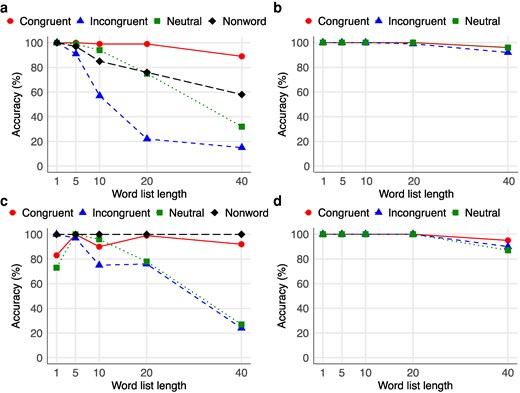
Abstract Although transformers in large language models (LLMs) effectively implement a self-attention mechanism that has revolutionized natural language processing, they lack an explicit architecture for the executive control of attention found in humans, which is essential for resolving conflicts and selecting relevant information in the presence of competing computations and is critical for adaptive behavior. To investigate the impact of this limitation in LLMs, we employed the classic color Stroop task, widely regarded as the gold standard, to test the executive control of attention in these models. Our results revealed a typical conflict effect of underperformance in terms of accuracy in the incongruent condition (e.g. naming the color of the word RED in blue) compared with the congruent condition (e.g. naming the color of the word RED in red), in short word lists, similar to human performance. However, as the length of the word lists increased, performance on the incongruent condition degraded toward near-total performance collapse, even as accuracy in the congruent condition remained excellent, and word reading (e.g. reading the word RED [in red] or RED [in blue], ignoring the color) was near-perfect. These findings demonstrate that transformer attention mechanisms are fundamentally limited in their capacity for conflict resolution across extended contexts, and a failure to up-regulate control adaptively under rising interference. We suggest that incorporating executive control mechanisms akin to those in biological attention is crucial for achieving artificial general intelligence.
How Large Language Models Actually Work
Context Rot: How Increasing Input Tokens Impacts LLM Performance
Large Language Models (LLMs) are typically presumed to process context uniformly—that is, the model should handle the 10,000th token just as reliably as the 100th. However, in practice, this assumption does not hold. We observe that model performance varies significantly as input length changes, even on simple tasks. In this report, we evaluate 18 LLMs, including the state-of-the-art GPT-4.1, Claude 4, Gemini 2.5, and Qwen3 models. Our results reveal that models do not use their context uniformly; instead, their performance grows increasingly unreliable as input length grows.
Performative Thinking? The Brittle Correlation Between CoT Length and Problem Complexity
Intermediate token generation (ITG), where a model produces output before the solution, has been proposed as a method to improve the performance of language models on reasoning tasks. While these reasoning traces or Chain of Thoughts (CoTs) are correlated with performance gains, the mechanisms underlying them remain unclear. A prevailing assumption in the community has been to anthropomorphize these tokens as "thinking", treating longer traces as evidence of higher problem-adaptive computation. In this work, we critically examine whether intermediate token sequence length reflects or correlates with problem difficulty. To do so, we train transformer models from scratch on derivational traces of the A* search algorithm, where the number of operations required to solve a maze problem provides a precise and verifiable measure of problem complexity. We first evaluate the models on trivial free-space problems, finding that even for the simplest tasks, they often produce excessively long reasoning traces and sometimes fail to generate a solution. We then systematically evaluate the model on out-of-distribution problems and find that the intermediate token length and ground truth A* trace length only loosely correlate. We notice that the few cases where correlation appears are those where the problems are closer to the training distribution, suggesting that the effect arises from approximate recall rather than genuine problem-adaptive computation. This suggests that the inherent computational complexity of the problem instance is not a significant factor, but rather its distributional distance from the training data. These results challenge the assumption that intermediate trace generation is adaptive to problem difficulty and caution against interpreting longer sequences in systems like R1 as automatically indicative of "thinking effort".
Why Does ChatGPT "Delve" So Much? Exploring the Sources of Lexical Overrepresentation in Large Language Models
Scientific English is currently undergoing rapid change, with words like "delve," "intricate," and "underscore" appearing far more frequently than just a few years ago. It is widely assumed that scientists' use of large language models (LLMs) is responsible for such trends. We develop a formal, transferable method to characterize these linguistic changes. Application of our method yields 21 focal words whose increased occurrence in scientific abstracts is likely the result of LLM usage. We then pose "the puzzle of lexical overrepresentation": WHY are such words overused by LLMs? We fail to find evidence that lexical overrepresentation is caused by model architecture, algorithm choices, or training data. To assess whether reinforcement learning from human feedback (RLHF) contributes to the overuse of focal words, we undertake comparative model testing and conduct an exploratory online study. While the model testing is consistent with RLHF playing a role, our experimental results suggest that participants may be reacting differently to "delve" than to other focal words. With LLMs quickly becoming a driver of global language change, investigating these potential sources of lexical overrepresentation is important. We note that while insights into the workings of LLMs are within reach, a lack of transparency surrounding model development remains an obstacle to such research.