

Infoenon — Where Information Meets Phenomenon
Search publisher-controlled information, public knowledge, and the open social web.

Practicing Information Sensibility: How Gen Z Engages with Online Information
Assessing the trustworthiness of information online is complicated. Literacy-based paradigms are both widely used to help and widely critiqued. We conducted a study with 35 Gen Zers from across the U.S. to understand how they assess information online. We found that they tended to encounter -- rather than search for -- information, and that those encounters were shaped more by social motivations than by truth-seeking queries. For them, information processing is fundamentally a social practice. Gen Zers interpreted online information together, as aspirational members of social groups. Our participants sought information sensibility: a socially-informed awareness of the value of information encountered online. We outline key challenges they faced and practices they used to make sense of information. Our findings suggest that like their information sensibility practices, solutions and strategies to address misinformation should be embedded in social contexts online.

The Panoptic Sort: A Political Economy of Personal Information
A Political Economy of Personal Information

Welcome - OpenWebSearch.eu – Promoting Europe‘s Independence in Web Search
Michael Granitzer University Passau and Open Search Foundation, Coordinator of OpenWebSearch.EU

Information scraps: How and why information eludes our personal information management tools
In this article we investigate information scraps —personal information where content has been scribbled on Post-it notes, scrawled on the corners of sheets of paper, stuck in our pockets, sent in email messages to ourselves, and stashed in miscellaneous digital text files. Information scraps encode information ranging from ideas and sketches to notes, reminders, shipment tracking numbers, driving directions, and even poetry. Although information scraps are ubiquitous, we have much still to learn about these loose forms of information practice. Why do we keep information scraps outside of our traditional PIM applications? What role do information scraps play in our overall information practice? How might PIM applications be better designed to accommodate and support information scraps' creation, manipulation and retrieval? We pursued these questions by studying the information scrap practices of 27 knowledge workers at five organizations. Our observations shed light on information scraps' content, form, media, and location. From this data, we elaborate on the typical information scrap lifecycle, and identify common roles that information scraps play: temporary storage, archiving, work-in-progress, reminding, and management of unusual data. These roles suggest a set of unmet design needs in current PIM tools: lightweight entry, unconstrained content, flexible use and adaptability, visibility, and mobility.

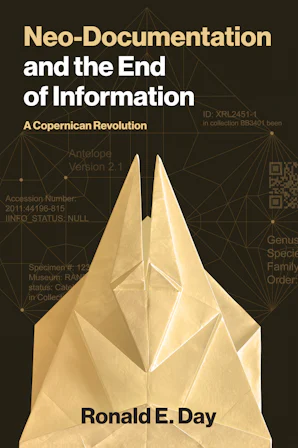
Neo-Documentation and the End of Information
Ronald Day’s Neo-Documentation and the End of Information critiques the modern conception of information as representational “content.” The...
Website Informer
Website.informer: complete data lookup & free aggregated report on any domain including whois, visitors, IP & DNS details, competitors, owners, etc
The Information Philosopher - dedicated to the new information philosophy
Information Philosopher is dedicated to the new Information Philosophy, with explanations for Freedom, Values, and Knowledge.
Information Scent: How Users Decide Where to Go Next
When deciding which links to click on the web, users choose those with the highest information scent — which is a mix of cues that they get from the link label, the context in which the link is shown, and their prior experiences.

Living in Data: A Citizen's Guide to a Better Information Future (Paperback)
Jer Thorp’s analysis of the word “data” in 10,325 New York Times stories written between 1984 and 2018 shows a distinct trend: among the words most closely associated with “data,” we find not only its classic companions “information” and “digital,” but also a variety of new neighbors—from “scandal” and “misinformation” to “ethics,” “friends,” and “play.”To live in data in the twenty-first century

Information foraging
Information foraging is a theory that applies the ideas from optimal foraging theory to understand how human users search for information. The theory is based on the assumption that, when searching for information, humans use "built-in" foraging mechanisms that evolved to help our animal ancestors find food. Importantly, a better understanding of human search behavior can improve the usability of websites or any other user interface.
Information archivée dans le Web
Information archivée dans le Web
atproto-aware concept search engine
a mockup of a webpage search engine that only indexes webpages that are referenced in atproto records. Surfaces related links based on social and community context.
What the Hell is Going On? - David Perell
David shares how the new age of information abundance is transforming commerce, education, and politics. Read here.

