

Large-scale quantitative analyses have shown that individuals frequently talk to each other about similar things in different online spaces. Why do these overlapping communities exist? We provide an answer grounded in the analysis of 20 interviews with active participants in clusters of highly related subreddits. Within a broad topical area, there are a diversity of benefits an online community can confer. These include (a) specific information and discussion, (b) socialization with similar others, and (c) attention from the largest possible audience. A single community cannot meet all three needs. Our findings suggest that topical areas within an online community platform tend to become populated by groups of specialized communities with diverse sizes, topical boundaries, and rules. Compared with any single community, such systems of overlapping communities are able to provide a greater range of benefits.
The echo chamber effect on social media
Significance We explore the key differences between the main social media platforms and how they are likely to influence information spreading and the formation of echo chambers. To assess the different dynamics, we perform a comparative analysis on more than 100 million pieces of content concerning controversial topics (e.g., gun control, vaccination, abortion) from Gab, Facebook, Reddit, and Twitter. The analysis focuses on two main dimensions: 1) homophily in the interaction networks and 2) bias in the information diffusion toward like-minded peers. Our results show that the aggregation in homophilic clusters of users dominates online dynamics. However, a direct comparison of news consumption on Facebook and Reddit shows higher segregation on Facebook. , Social media may limit the exposure to diverse perspectives and favor the formation of groups of like-minded users framing and reinforcing a shared narrative, that is, echo chambers. However, the interaction paradigms among users and feed algorithms greatly vary across social media platforms. This paper explores the key differences between the main social media platforms and how they are likely to influence information spreading and echo chambers’ formation. We perform a comparative analysis of more than 100 million pieces of content concerning several controversial topics (e.g., gun control, vaccination, abortion) from Gab, Facebook, Reddit, and Twitter. We quantify echo chambers over social media by two main ingredients: 1) homophily in the interaction networks and 2) bias in the information diffusion toward like-minded peers. Our results show that the aggregation of users in homophilic clusters dominate online interactions on Facebook and Twitter. We conclude the paper by directly comparing news consumption on Facebook and Reddit, finding higher segregation on Facebook.

Echo chambers can emerge without algorithmic personalization or a preference for homogeneity
Online ideological segregation—often described as “echo chambers”—is commonly attributed to algorithmic personalization (“filter bubbles”) or users’ preferences for like-minded environments. We propose a different mechanism. Using a minimal agent-based model, we show that strong segregation can arise even without algorithmic personalization and without users preferring homogeneous environments. Even when users exit communities only after finding themselves almost entirely surrounded by disagreement, cascading exits can push initially mixed communities toward high homogeneity. Once small imbalances arise, feedback between exit and regrouping generates a self-reinforcing process of system-level sorting. Extending the model further reveals that algorithmic personalization can, under some conditions, reduce segregation by lowering dissatisfaction, slowing exit cascades, and stabilizing mixed communities. As an empirical illustration, a longitudinal analysis of the subreddit r/MensRights shows that users whose language is more distant from the community’s evolving semantic center are more likely to exit. Taken together, these findings suggest that echo chambers need not depend on users seeking homogeneous environments or algorithmic personalization alone, but can also emerge from exit dynamics in the interaction structures characteristic of online platforms. More broadly, they show how interventions aimed at individual exposure can produce aggregate dynamics that differ from their intended effects, complicating both scientific and policy debates over online polarization.
Community by Design
Social media empower distributed content creation by algorithmically harnessing "the social fabric" (explicit and implicit signals of association) to serve this content. While this overcomes the bottlenecks and biases of traditional gatekeepers, many believe it has unsustainably eroded the very social fabric it depends on by maximizing engagement for advertising revenue. This paper participates in open and ongoing considerations to translate social and political values and conventions, specifically social cohesion, into platform design. We propose an alternative platform model that includes the social fabric an explicit output as well as input. Citizens are members of communities defined by explicit affiliation or clusters of shared attitudes. Both have internal divisions, as citizens are members of intersecting communities, which are themselves internally diverse. Each is understood to value content that bridge (viz. achieve consensus across) and balance (viz. represent fairly) this internal diversity, consistent with the principles of the Hutchins Commission (1947). Content is labeled with social provenance, indicating for which community or citizen it is bridging or balancing. Subscription payments allow citizens and communities to increase the algorithmic weight on the content they value in the content serving algorithm. Advertisers may, with consent of citizen or community counterparties, target them in exchange for payment or increase in that party's algorithmic weight. Underserved and emerging communities and citizens are optimally subsidized/supported to develop into paying participants. Content creators and communities that curate content are rewarded for their contributions with algorithmic weight and/or revenue. We discuss applications to productivity (e.g. LinkedIn), political (e.g. X), and cultural (e.g. TikTok) platforms.

The evolution of expert communities
A look at how online forums grow, thrive, and then decay.

Governing Together: Toward Infrastructure for Community-Run Social Media
Decentralizing the governance of social computing systems to communities promises to empower them to make independent decisions, with nuance and in accordance with their values. Yet, communities do not govern in isolation. Many problems communities face are common, or move across their boundaries. We therefore propose designing for "inter-community governance:" mechanisms that support relationships and interactions between communities to coordinate on governance issues. Drawing from workshops with 24 individuals on decentralized, community-run social media, we present six challenges in designing for inter-community governance surfaced through ideas proposed in workshops. Together, these ideas come together as an ecosystem of resources, infrastructures, and tools that highlight three key principles for designing for inter-community governance: modularity, forkability, and polycentricity. We end with a discussion of how the ideas proposed in workshops might be implemented in future work aiming to support community governance in social computing systems broadly.
Online communities and social communities: a primer
What are online communities and for what goals can they be used? A primer with plenty of community marketing and management tips.
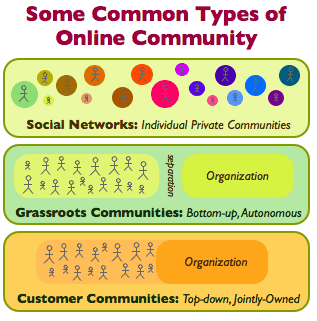
From Social Network to Sense Making
Building Communities Across the Social Web
Introducing a network for thoughtful conversations
The quality of conversations on the Internet is terrible. Most platforms like Twitter, Facebook, Instagram, Reddit, etc. optimize for engagement as their key metric. This spawns and rewards behavior that leads to bragging of gameable metrics such as likes and followers, self-feeding thought bubbles, knee-jerk reactions, “if you’re not on our side, you’re on their side” mentality, and thought policing even by people who think they’re fighting for a good cause. Today’s Internet doesn’t incentiviz

Thoughts on Communities | unDraw Blog
Even with the best intentions and people eager to join, most attempts to create communities fail and will continue to do so.

Community Interaction and Conflict on the Web
Community Interaction and Conflict on the Web
Permissioned Data Shapes: Community-Moderated Content - Nick's Blog
A community can own spaces the way a person does: a club's members post to each other under a dedicated community DID, with a feed space for content, a moderation space for notes, a labels space for filtering, and a single app view as the only window into any of it.
Semble: Collective knowledge foraging in trail-based social networks beyond feeds (Lightning Talk)
Virality Prediction and Community Structure in Social Networks
How does network structure affect diffusion? Recent studies suggest that the answer depends on the type of contagion. Complex contagions, unlike infectious diseases (simple contagions), are affected by social reinforcement and homophily. Hence, the spread within highly clustered communities is enhanced, while diffusion across communities is hampered. A common hypothesis is that memes and behaviors are complex contagions. We show that, while most memes indeed spread like complex contagions, a few viral memes spread across many communities, like diseases. We demonstrate that the future popularity of a meme can be predicted by quantifying its early spreading pattern in terms of community concentration. The more communities a meme permeates, the more viral it is. We present a practical method to translate data about community structure into predictive knowledge about what information will spread widely. This connection contributes to our understanding in computational social science, social media analytics and marketing applications.

Overlapping context-specific communities, on a whole spectrum of public commons to cozy private spaces, all interoperable in a global network — yeahhhh we've got a big opportunity here!

Everyone Fled the Feed for the Group Chat.
inputs-outputs.leaflet.pub