

Casting Time: Action Range: Self Components: S, M (a weapon with which you have proficiency and that is worth 1+ CP) Duration: Instantaneous
Composing Time: Compositional Async in Solid 2.0
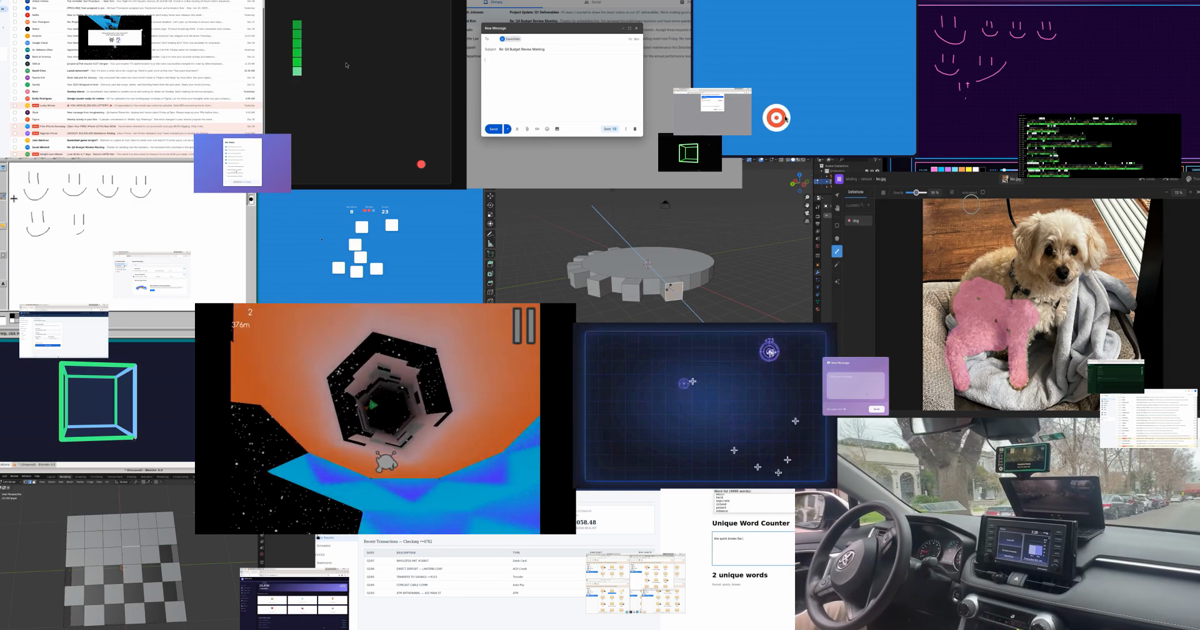
The First Fully General Computer Action Model
We trained a model on our 11-million-hour video dataset. Our model can explore complex websites, complete multi-action CAD modeling sequences, and drive a car in the real world, all at 30 FPS.
Functional Programmers need to take a look at Zig.
I’ve been tinkering around with Zig to explore what’s possible with comptime. Whenever I evaluate a new language I use three axes:
The PARA Method: The Simple System for Organizing Your Digital Life in Seconds
Learn how to organize your digital life in seconds. Stop wasting time looking for information and gain greater focus on what matters most.

Going, Going… LIVE! — Real-time UI in Solid 2.0
[PoE 3.12] Dual Replica Nebulis Cold Shockwave Totem Build [Shapr DPS 14M]
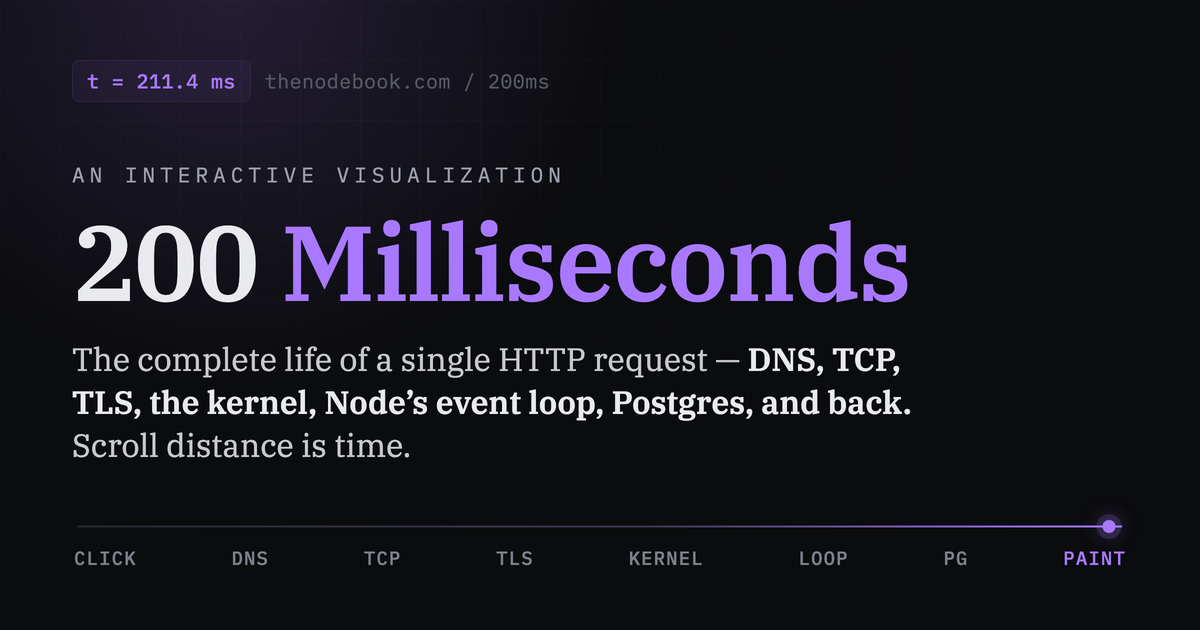
200 Milliseconds — the complete life of one HTTP request, visualized
A single HTTP request, traced in real time through DNS, TCP, TLS, the kernel, Node's event loop, and Postgres — then back to the pixel. Scroll distance equals time.
Article 09: Performance: Instancing, LOD, Draw Calls — Three.js From Zero · MasterAllArts
Performance: Instancing, LOD, Draw Calls is Article 09 of Three.js From Zero, a MasterAllArts free interactive lesson for artists learning creative 3D on the web.

US used 'Claude' to strike over 1000 targets in first 24 hours of war
Despite a spat and Pentagon ban, Anthropic’s ‘AI is being used in the kill chain while Hegseth says ‘no stupid rules of engagement’

I made a build visualizer to understand Bun’s compile times
I built buildprof (Github), an open-source tracing tool that shows where the time goes when you compile software on Linux. Here’s a realtime video of it profiling a clean build of ripgrep: Watch the …

The frontier is open-source today
GLM-5.2 - open weights - single-shot our AI-resistant backend take-home to a higher level than Opus 4.8, and built offmute-v2: state-of-the-art timestamp-accurate diarization. A head-to-head with no detail glossed over.

Inside Baseball: The Automated Ball-Strike System as an Object Lesson in Technological Rule Enforcement
Clearly-defined rules are often assumed to be straightforward to automate and evaluate. We challenge this assumption through an in-depth study of Major League Baseball's (MLB) seven-year experimentation with the Automated Ball-Strike System (ABS). ABS is envisioned to call balls and strikes accurately: a seemingly straightforward use of technology to objectively determine the distance between a pitch and the strike zone. Although the strike zone is an area clearly defined in the rulebook, it took MLB seven years to figure out how to automate calling balls and strikes with ABS, showing how even seemingly straightforward rules require a complex translation process to operationalize via technological systems. In this paper, we trace the design decisions that led to the current implementation of ABS. Our case study reveals that "distance" exists even between a clear rule and its technological implementation. Using analytic frameworks from Science and Technology Studies (STS), we show that such distance exists because (1) historically, the "ground truth" of the strike zone is contested: the rule in practice has always reflected a hybrid between the rulebook definition and umpires' enforcement decisions; and (2) the use of ABS is embedded in an existing eco-system, where the implementation of a technological enforcement system needs to balance multiple stakeholder values. This perspective challenges conventional evaluation paradigms that center on the distance between a formalized rule and its technological implementation, and instead calls for evaluating how such systems are experienced in practice. Addressing this question requires in-depth social science approaches, contributing to ongoing conversations in FAccT about the implementation and evaluation of sociotechnical systems.

Thireus/GGUF-Tool-Suite
Produce your own Dynamic 3.0 Quants and achieve optimum accuracy & SOTA quantization performance! Input a target size and the toolchain will create a GGUF recipe tuned to your hardware within seconds — flexible model sizing and lowest achievable perplexity/kld for GGUF enthusiasts seeking precise and automated dynamic quant production.

