

Marc Torrens and Carlos Carrasco-Farré analyze how algorithms influence opinions and heighten our emotional responses.
Reranking partisan animosity in algorithmic social media feeds alters affective polarization
Today, social media platforms hold the sole power to study the effects of feed-ranking algorithms. We developed a platform-independent method that reranks participants’ feeds in real time and used this method to conduct a preregistered 10-day field ...

The political effects of X’s feed algorithm
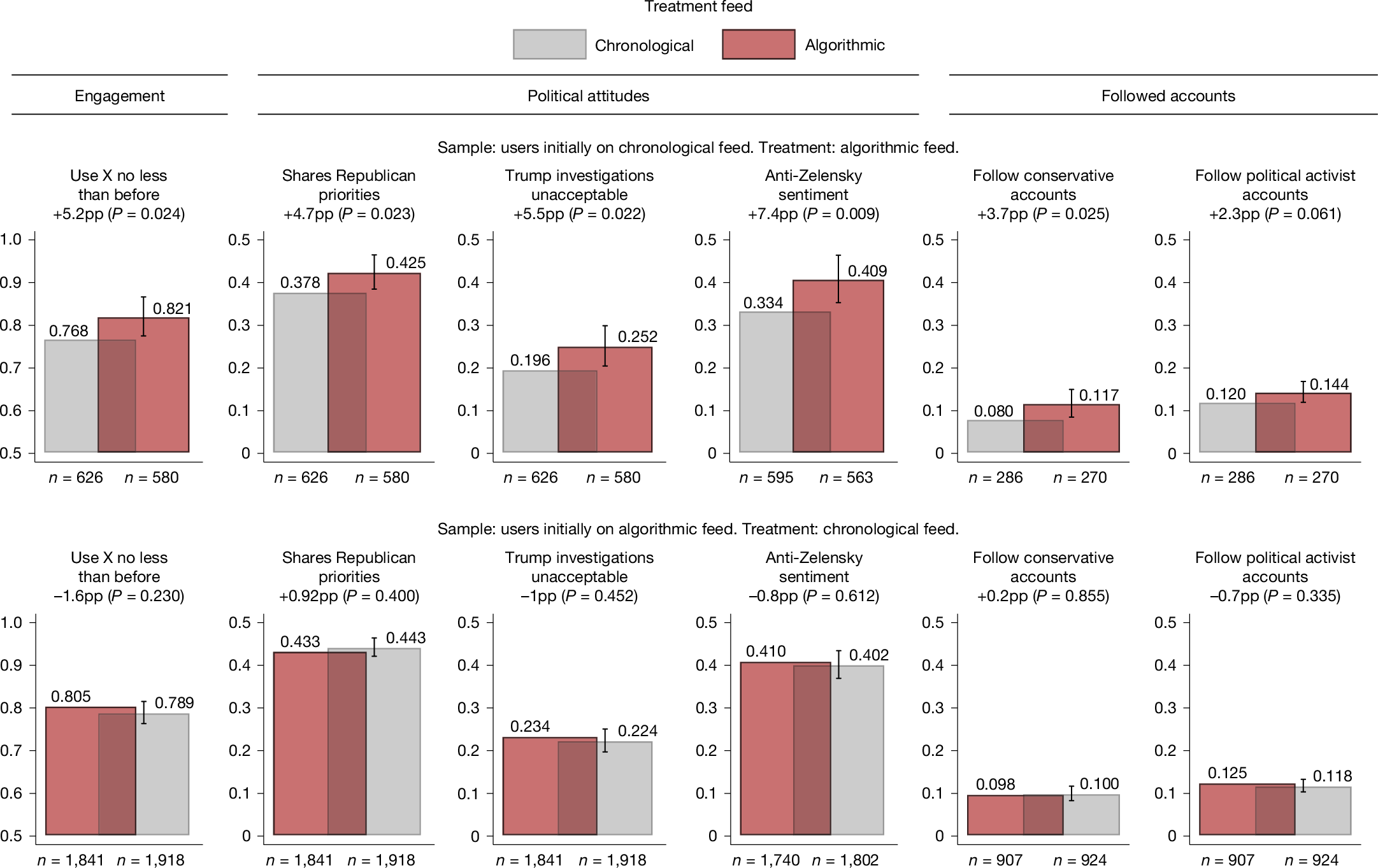
Feed algorithms are widely suspected to influence political attitudes. However, previous evidence from switching off the algorithm on Meta platforms found no political effects1. Here we present results from a 2023 field experiment on Elon Musk’s platform X shedding light on this puzzle. We assigned active US-based users randomly to either an algorithmic or a chronological feed for 7 weeks, measuring political attitudes and online behaviour. Switching from a chronological to an algorithmic feed increased engagement and shifted political opinion towards more conservative positions, particularly regarding policy priorities, perceptions of criminal investigations into Donald Trump and views on the war in Ukraine. In contrast, switching from the algorithmic to the chronological feed had no comparable effects. Neither switching the algorithm on nor switching it off significantly affected affective polarization or self-reported partisanship. To investigate the mechanism, we analysed users’ feed content and behaviour. We found that the algorithm promotes conservative content and demotes posts by traditional media. Exposure to algorithmic content leads users to follow conservative political activist accounts, which they continue to follow even after switching off the algorithm, helping explain the asymmetry in effects. These results suggest that initial exposure to X’s algorithm has persistent effects on users’ current political attitudes and account-following behaviour, even in the absence of a detectable effect on partisanship.
The political effects of X’s feed algorithm
Feed algorithms are widely suspected to influence political attitudes. However, previous evidence from switching off the algorithm on Meta platforms found no political effects1. Here we present results from a 2023 field experiment on Elon Musk’s platform X shedding light on this puzzle. We assigned active US-based users randomly to either an algorithmic or a chronological feed for 7 weeks, measuring political attitudes and online behaviour. Switching from a chronological to an algorithmic feed increased engagement and shifted political opinion towards more conservative positions, particularly regarding policy priorities, perceptions of criminal investigations into Donald Trump and views on the war in Ukraine. In contrast, switching from the algorithmic to the chronological feed had no comparable effects. Neither switching the algorithm on nor switching it off significantly affected affective polarization or self-reported partisanship. To investigate the mechanism, we analysed users’ feed content and behaviour. We found that the algorithm promotes conservative content and demotes posts by traditional media. Exposure to algorithmic content leads users to follow conservative political activist accounts, which they continue to follow even after switching off the algorithm, helping explain the asymmetry in effects. These results suggest that initial exposure to X’s algorithm has persistent effects on users’ current political attitudes and account-following behaviour, even in the absence of a detectable effect on partisanship.
New study shows just how Facebook's algorithm shapes conservative and liberal bubbles
Research conducted at the height of the 2020 election reveals new details about how Facebook's algorithms handle political content. But it suggests there are no easy fixes to political polarization.
How do social media feed algorithms affect attitudes and behavior in an election campaign?
We investigated the effects of Facebook’s and Instagram’s feed algorithms during the 2020 US election. We assigned a sample of consenting users to reverse-chronologically-ordered feeds instead of the default algorithms. Moving users out of algorithmic feeds substantially decreased the time they spent on the platforms and their activity. The chronological feed also affected exposure to content: The amount of political and untrustworthy content they saw increased on both platforms, the amount of content classified as uncivil or containing slur words they saw decreased on Facebook, and the amount of content from moderate friends and sources with ideologically mixed audiences they saw increased on Facebook. Despite these substantial changes in users’ on-platform experience, the chronological feed did not significantly alter levels of issue polarization, affective polarization, political knowledge, or other key attitudes during the 3-month study period.

The Algorithmic Management of Polarization and Violence on Social Media
Access the PDF version of this essay by clicking the icon to the right.
Redesigning algorithms to intervene on social norm misperceptions during a national election
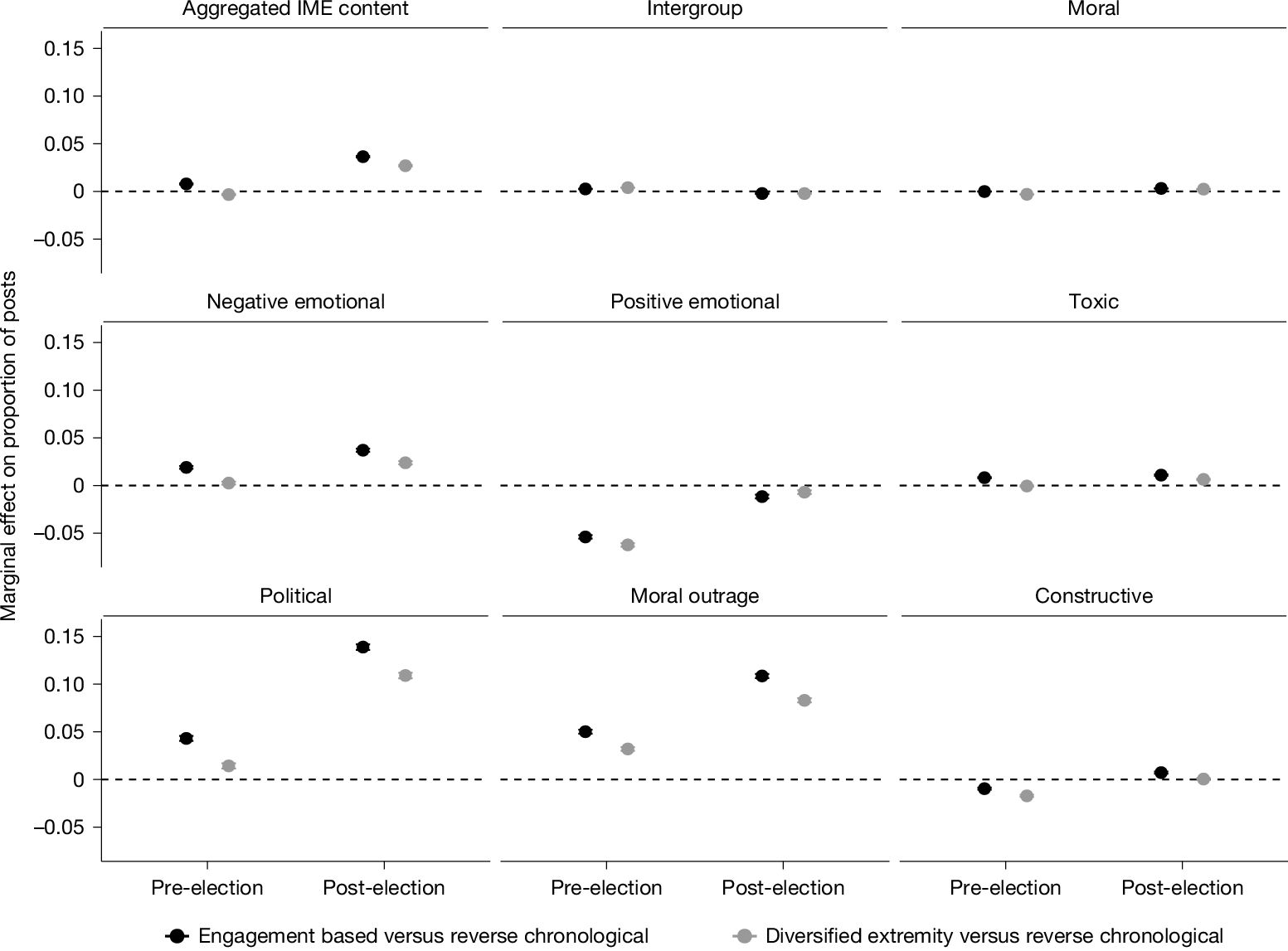
For the first time in history, civic discourse commonly occurs in digital environments in which algorithms influence exposure to social information1,2. It is increasingly important to understand whether and how these algorithms affect political discourse3–5. Here we built custom feed-ranking algorithms with full control over their features, and randomly assigned 2,000 participants to use them for 8 weeks (before and after the 2024 US presidential election). We tested whether an engagement-based algorithm (used on major social media platforms6,7) amplifies intergroup, moralized and emotional (IME) information in ways that skew perceptions of social norms around political dialogue5,8, and whether it increased engagement with IME content and perceptions of partisan animosity (compared with a reverse-chronological feed9,10). We also developed and tested a ‘diversified extremity’ algorithm to reduce the influence of extreme users11–13 to improve the accuracy of social norm perception14–16 and reduce perceptions of partisan animosity. We found that engagement-based feeds amplified IME and toxic content relative to reverse-chronological feeds, with the largest increases in moral outrage and political content. Engagement-based feeds also reduced prescriptive norm perception accuracy (albeit in an unexpected direction) and increased perceived partisan animosity. However, they did not significantly alter users’ own engagement behaviours. The diversified extremity algorithm reduced IME and toxic content exposure, improved prescriptive norm accuracy, yet maintained comparable platform enjoyment—suggesting that reducing the influence of extreme users can curb algorithmic distortions without diminishing user experience.
Science says X algorithmic feed makes users favor conservative views
A new study found that users who rely on algorithmic rather than chronological X feed become more supportive of conservative opinions, including about Ukraine and investigations into Donald Trump.
Political polarization at its worst since the Civil War
Data scientists try to explain the U.S. government’s shifting ideologies over the past four decades.
Bias, Skew, and Search Engines Are Sufficient to Explain Online Toxicity
U.S. political discourse seems to have fissioned into discrete bubbles, each reflecting its own distorted image of the world. Many blame machine-learning algorithms that purportedly maximize “engagement”—serving up content that keeps YouTube or Facebook users watching videos or scrolling through their feeds—for radicalizing users or strengthening their partisanship. Sociologist Shoshana Zuboff15 even argues that “surveillance capitalism” uses optimized algorithmic feedback for “automated behavioral modification” at scale, writing the “music” that users then “dance” to.

Bias, Skew, and Search Engines Are Sufficient to Explain Online Toxicity
U.S. political discourse seems to have fissioned into discrete bubbles, each reflecting its own distorted image of the world. Many blame machine-learning algorithms that purportedly maximize “engagement”—serving up content that keeps YouTube or Facebook users watching videos or scrolling through their feeds—for radicalizing users or strengthening their partisanship. Sociologist Shoshana Zuboff15 even argues that “surveillance capitalism” uses optimized algorithmic feedback for “automated behavioral modification” at scale, writing the “music” that users then “dance” to.
An Experimental Method to Study Opinion Diffusion in Human-AI Hybrid Societies
As artificial intelligence increasingly mediates public discourse, it becomes important to understand how human-AI collectives shape opinion formation, deliberation, and democratic outcomes. We present a novel experimental method for studying opinion dynamics in hybrid human-AI social networks. Participants, human or AI, were embedded in $5\times5$ grid lattice networks and iteratively asked to select and revise statements on a given polarizing topic over eight rounds. We compared three conditions: human-only, AI-only, and hybrid networks with equal proportions of human and AI participants. Hybrid human-AI networks achieved the lowest final polarization while, in contrast, human-only networks exhibited higher polarization with lower neighbor agreement. We also ran additional experiments varying Large Language Model (LLM) prompt framing to explore whether instruction design might influence convergence patterns. Although these early findings are preliminary and cannot yet support broad generalizations, they highlight the potential value of experimental social networks for understanding opinion dynamics in human-AI hybrid societies.

Why the Algorithm Loves a Villain, And How to Beat It
When the internet is full of distortions, fake news, and AI-generated slop, how can facts and journalism rise to the top? Former BBC and Vice journalist Sophia Smith Galer has one possible way to…

Modelling Opinion Dynamics in the Age of Algorithmic Personalisation
Modern technology has drastically changed the way we interact and consume information. For example, online social platforms allow for seamless communication exchanges at an unprecedented scale. However, we are still bounded by cognitive and temporal constraints. Our attention is limited and extremely valuable. Algorithmic personalisation has become a standard approach to tackle the information overload problem. As result, the exposure to our friends' opinions and our perception about important issues might be distorted. However, the effects of algorithmic gatekeeping on our hyper-connected society are poorly understood. Here, we devise an opinion dynamics model where individuals are connected through a social network and adopt opinions as function of the view points they are exposed to. We apply various filtering algorithms that select the opinions shown to users i) at random ii) considering time ordering or iii) their current beliefs. Furthermore, we investigate the interplay between such mechanisms and crucial features of real networks. We found that algorithmic filtering might influence opinions' share and distributions, especially in case information is biased towards the current opinion of each user. These effects are reinforced in networks featuring topological and spatial correlations where echo chambers and polarisation emerge. Conversely, heterogeneity in connectivity patterns reduces such tendency. We consider also a scenario where one opinion, through nudging, is centrally pushed to all users. Interestingly, even minimal nudging is able to change the status quo moving it towards the desired view point. Our findings suggest that simple filtering algorithms might be powerful tools to regulate opinion dynamics taking place on social networks
Task-Dependent Algorithm Aversion
Research suggests that consumers are averse to relying on algorithms to perform tasks that are typically done by humans, despite the fact that algorithms often perform better. The authors explore when and why this is true in a wide variety of domains. They find that algorithms are trusted and relied on less for tasks that seem subjective (vs. objective) in nature. However, they show that perceived task objectivity is malleable and that increasing a task’s perceived objectivity increases trust in and use of algorithms for that task. Consumers mistakenly believe that algorithms lack the abilities required to perform subjective tasks. Increasing algorithms’ perceived affective human-likeness is therefore effective at increasing the use of algorithms for subjective tasks. These findings are supported by the results of four online lab studies with over 1,400 participants and two online field studies with over 56,000 participants. The results provide insights into when and why consumers are likely to use algorithms and how marketers can increase their use when they outperform humans.

✨New paper out @nature.com ✨ For 8 weeks around the 2024 US election, we randomly assigned 2,000 people to use social media algos we built ourselves. Do engagement-based algorithms amplify intergroup, moral & emotional (IME) content—and does that distort how we see political norms? 🧵🔗 👇
