

Lagoon gives developers what they dream about. It's a system that allows developers to run the exact same code in their local and production environment. The same Docker images, the same service configurations, and the same code.
Docker: Accelerated Container Application Development
Docker is a platform designed to help developers build, share, and run container applications. We handle the tedious setup, so you can focus on the code.
The Industry-Leading Container Runtime | Docker
Read about our industry-leading Docker container runtimes. Docker Engine allows containerized apps to run consistently on any infrastructure — from anywhere.
DuckLake Architecture Deep Dive
DuckLake is a next generation data lakehouse and open table format. It is significantly simpler and faster than Apache Iceberg or Delta Lake because it uses a SQL database for storing the catalog and metadata. This post covers an architecture deep dive with a detailed Q&A section. DuckLake consists of 3 components: storage, catalog, and compute. Each can be scaled independently, hosted locally with ease, and deployed to the cloud for production. MotherDuck offers managed DuckLake lakehouses for additional simplicity and performance.
Docker Engine API v1.50 reference | Docker Docs
Reference documentation and Swagger (OpenAPI) specification for the Docker Engine API.
Full featured documentation deployment platform
Read the Docs is a documentation building and hosting platform aimed at helping developers creating documentation from code with versioned documentation, integrated search, pull request previews and more.


What is Podman? How is it Different Than Docker?
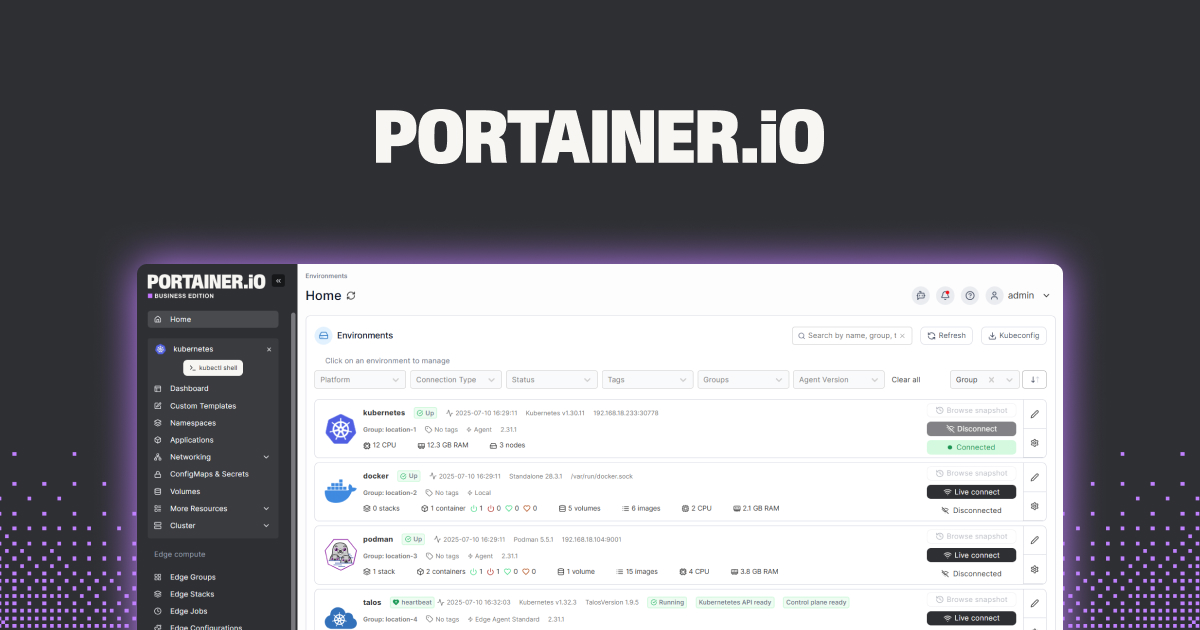
Portainer.io - Enterprise Kubernetes & Docker Container Management Platform
Operational control for Kubernetes and Docker without specialist overhead. Govern multi-cluster infrastructure or deploy OT software at scale.
The World's Largest Public Container Registry | Docker
Docker Hub is the world's largest registry for images, models, and MCP servers, with curated content and governance that developers and teams can rely on.
How eBPF is shaping the future of Linux and platform engineering
When Docker burst onto the scene in 2013, Linux containers seemed like an overnight success. But the evolution to containers—and microservices and Kubernetes—was actually decades in the making, based on kernel primitives in the Linux operating system. Docker used these primitives, namely cgroups and namespaces, as building blocks to create a lightweight, easy-to-use software packaging format. Linux containers had been used by Google and others for many years, but Docker made them easily accessible to mainstream developers.

Artifacts: versioned storage that speaks Git
Give your agents, developers, and automations a home for code and data. We’ve just launched Artifacts: Git-compatible versioned storage built for agents. Create tens of millions of repos, fork from any remote, and hand off a URL to any Git client.
The Lore Version Control System - Lore Developer Documentation
A reference document explaining the rationale, goals, and theoretical design of Lore. This is not a peer-reviewed paper; it is a public-facing standalone description of the system, intended to make the why of Lore - the problems it was built to solve and the design choices that follow from those problems - as legible as a reader can make it without reading the source code.
EPA Launches Initiative to Strengthen Support for Water Systems, Maximize Impact to Ensure Clean, Safe Water for All | US EPA
EPA launched the Real Water Technical Assistance (RealWaterTA) initiative, a back-to-basics approach to support drinking water and wastewater systems using proven, best-practice approaches that will most effectively address local needs.

Seamark - Distributed Container Registry
Push and pull Docker images on the AT Protocol. Same Docker, decentralized.
Comparator | Reservoir
Reservoir is the package registry for Lake, the build system and package manager of the Lean programming language and theorem prover.