

Command buffers are objects used to record commands which can be subsequently submitted to a device queue for execution. There are two levels of command buffers - primary command buffers, which can execute secondary command buffers, and which are submitted to queues, and secondary command buffers, which can be executed by primary command buffers, and which are not directly submitted to queues.
Vulkan Ray Tracing Tutorial KHR
A comprehensive tutorial for learning Vulkan ray tracing with practical examples.
Protocol Buffers
Protocol Buffers are language-neutral, platform-neutral extensible mechanisms for serializing structured data.
Texture-less Text Rendering
How to draw text to a Vulkan renderpass without binding a single texture

expenses/vulkan-without-abstractions
Contribute to expenses/vulkan-without-abstractions development by creating an account on GitHub.
Spade | Spade Hardware Description Language
Pipelines are a first class construct in Spade. By encoding the latency in the language, they make re-timing and re-pipelining trivial.
The vCon - Conversation Data Container - Overview
A vCon is the container for data and information relating to a real- time, human conversation. It is analogous to a [vCard] which enables the definition, interchange and storage of an individual's various points of contact. The data contained in a vCon may be derived from any multimedia session, traditional phone call, video conference, SMS or MMS message exchange, webchat or email thread. The data in the container relating to the conversation may include Call Detail Records (CDR), call meta data, participant identity information (e.g. STIR PASSporT), the actual conversational data exchanged (e.g. audio, video, text), realtime or post conversational analysis and attachments of files exchanged during the conversation. A standardized conversation container enables many applications, establishes a common method of storage and interchange, and supports identity, privacy and security efforts (see [vCon-white-paper])
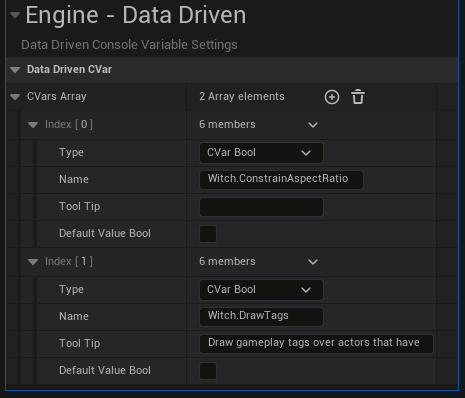
Unreal Scoop: Data-Driven CVars
If you use UE5, you might have noticed there’s a new-ish feature called Data-Driven Console Variables, and you might also have noticed that nothing comes up when you Google this. There’s not much to it, but in the interests of having something come up when you Google this, here’s what I’ve figured out about data-driven cvars.
Production Is a Compiler Input - The Phoenix Architecture
Signals and Threads
Stephen Dolan works on Jane Street’s Tools and Compilers team where he focuses on the OCaml compiler. In this episode, Stephen and Ron take a trip down memory lane, discussing how to manage computer memory efficiently and safely. They consider trade-offs between reference counting and garbage collection, the surprising gains achieved by prefetching, and how new language features like local allocation and unboxed types could give OCaml users more control over their memory.

Boundaries
This talk is about using simple values (as opposed to complex objects) not just for holding data, but also as the boundaries between components and subsystems. It moves through many topics: functional programming; mutability's relationship to OO; isolated unit testing with and without test doubles; and concurrency, to name some. The "Functional Core, Imperative Shell" screencast mentioned at the end is available as part of season 4 of the DAS catalog.
Protocol Buffers - OpenStreetMap Wiki
Protocol Buffers (Protobuf) is a data format developed by Google as a more efficient alternative to XML.
Release v0.5.0 · saxenauts/syke
Syke 0.5.0 is the release where the memory agent becomes a real local system. Pi is now the runtime. Observe is now a deterministic sensor boundary. The memory contract is explicit end to end: even...
Tiles version 0.4.18 Alpha 22 has been released. Tiles now supports the Vulkan backend, enabling GPU acceleration beyond NVIDIA across vendors on Linux, with fixes for MTP speculative decoding, Linux tool calls, and an occasional OAuth callback failure during ATproto login. Release notes ↗

Shared chat session by @tiles.run | Tiles
chat.tiles.run

