Abstract Age differences in monetary decisions may emerge because younger and older adults perceive the value of outcomes differently. Yet, age‐differential effects of monetary rewards on decisions are not well understood. Most laboratory studies on aging and decision making have used scenarios in which rewards were merely hypothetical (decisions did not have any real consequences) or in which only small amounts of money were at stake. In the current study, we compared younger adults' (20–29 years) and older adults' (61–82 years) decisions in probabilistic choice problems with real or hypothetical rewards. Decision‐contingent rewards were in a typical range of previous studies (gains of up to ~4.25 USD) or substantially scaled up (gains of up to ~85 USD per participant). Reward type (real vs. hypothetical) affected decision quality, including value maximization, switching between options, and dominance violations (choices of an option that was inferior to another option in all respects). Decision quality was markedly better with real than hypothetical rewards in older adults and correlated with numeracy in both age groups. However, we found no evidence that reward type affected people's risk preferences. Overall, the findings portray a fairly positive picture regarding the use of hypothetical scenarios to assess preferences: With carefully prepared instructions, people from different age groups indicate preferences in hypothetical scenarios that match their decisions with real and much higher rewards. One advantage of using real rewards is that they help to reduce decision noise.
Behavioral Impediments to Valuing Annuities: Complexity and Choice Bracketing
Abstract This paper examines two behavioral factors that diminish people's ability to value a lifetime income stream or annuity, drawing on a randomized experiment with about 4,000 adults in a U.S. nationally representative sample. We find that increasing the complexity of the annuity choice reduces respondents' ability to value the annuity, measured by the difference between the sell and buy values they assign to the annuity. When we limit narrow choice bracketing by inducing people to think first about how quickly or slowly to spend down assets in retirement, their ability to value an annuity increases.
Choice Bracketing
When making many choices, a person can broadly bracket them by assessing the consequences of all of them taken together, or narrowly bracket them by making each choice in isolation. We integrate research conducted in a wide range of decision contexts which shows that choice bracketing is an important determinant of behavior. Because broad bracketing allows people to take into account all the consequences of their actions, it generally leads to choices that yield higher utility. The evidence that we review, however, shows that people often fail to bracket broadly when it would be feasible for them to do so. In addition to documenting the diverse effects of bracketing, we also discuss factors that determine whether people bracket narrowly or broadly. We conclude with a discussion of normative aspects of bracketing and argue that there are some situations in which narrower bracketing results in superior decision making.

Young children would rather explore than get rewards
Young children will pass up rewards they know they can collect to explore other options, a new study suggests. Researchers found that when adults and 4- to 5-year-old children played a game where certain choices earned them rewards, both adults and children quickly learned what choices would give them the biggest returns. But while adults ...

Life insurance, loss aversion, and temporal orientation: a field experiment and replication with young adults
Young individuals rarely seek information about life insurance—a product that offers long-term benefits that might not motivate a desire to act now. Framing life insurance messaging as a gain in the present (e.g., “ensure your loved ones are protected today”) is thought to motivate younger individuals to seek information about insurance policies. A field experiment with a large life insurance issuer and a pre-registered experiment reveal that loss aversion and temporal orientation frames influences whether individuals aged 25–49 years shop for life insurance. Specifically, the results suggest that the superiority of gain frames over loss frames requires positioning the benefits well in the future, despite the need to act now. This study thus also contextualizes the realities and practical difficulty of framing financial products in ways that might interest a potentially vulnerable population.
The Preference Survey Module: A Validated Instrument for Measuring Risk, Time, and Social Preferences
Incentivized choice experiments are a key approach to measuring preferences in economics but are also costly. Survey measures are a low-cost alternative but can suffer from additional forms of measurement error due to their hypothetical nature. This paper seeks to leverage the strengths of both approaches by proposing a new survey module on risk aversion, time discounting, trust, altruism, positive and negative reciprocity, in which survey items are selected based on ability to predict choices in corresponding, incentivized experiments. The methodology and results provided in the paper can also potentially provide a model for researchers who have specific requirements and want to design their own modules. This paper was accepted by Yan Chen, behavioral economics and decision analysis. Funding: The project received funding from the European Research Council under the European Union’s Seventh Framework Programme (FP7-2007-2013) [Grant 209214]. A. Falk and T. Dohmen acknowledge funding from the Deutsche Forschungsgemeinschaft (German Research Foundation) [Grant CRC TR 224 (Project A01)] and Germany’s Excellence Strategy [Grant EXC 2126/1-390838866]. Supplemental Material: Data and the online appendices are available at https://doi.org/10.1287/mnsc.2022.4455 .

How Field Experiments in Economics Can Complement Psychological Research on Judgment Biases
This review summarizes results of field experiments examining individual behaviors across several market settings—from open-air markets to rideshare markets to tax-compliance markets—where people sort themselves into market roles wherein they make consequential decisions. Using three distinct examples from my own research on the endowment effect, left-digit bias, and omission bias, I showcase how field experiments can help researchers understand mediators, heterogeneity, and causal moderation involved in judgment biases in the field. In this manner, the review highlights that economic field experiments can serve an invaluable intellectual role alongside traditional laboratory research.

The persistence of cognitive biases in financial decisions across economic groups
While economic inequality continues to rise within countries, efforts to address it have been largely ineffective, particularly those involving behavioral approaches. It is often implied but not tested that choice patterns among low-income individuals may be a factor impeding behavioral interventions aimed at improving upward economic mobility. To test this, we assessed rates of ten cognitive biases across nearly 5000 participants from 27 countries. Our analyses were primarily focused on 1458 individuals that were either low-income adults or individuals who grew up in disadvantaged households but had above-average financial well-being as adults, known as positive deviants. Using discrete and complex models, we find evidence of no differences within or between groups or countries. We therefore conclude that choices impeded by cognitive biases alone cannot explain why some individuals do not experience upward economic mobility. Policies must combine both behavioral and structural interventions to improve financial well-being across populations.

The Effects of Financial Incentives in Experiments: A Review and Capital-Labor-Production Framework
We review 74 experiments with no, low, or high performance-based financial incentives. The modal result has no effect on mean performance (though variance is usually reduced by higher payment). Higher incentive does improve performance often, typically judgment tasks that are responsive to better effort. Incentives also reduce “presentation” effects (e.g., generosity and risk-seeking). Incentive effects are comparable to effects of other variables, particularly “cognitive capital” and task “production” demands, and interact with those variables, so a narrow-minded focus on incentives alone is misguided. We also note that no replicated study has made rationality violations disappear purely by raising incentives.
Characterizing the causes, dynamics, and consequences of choice deferral
The fact that people often avoid making decisions is well known, and past research has helped to identify some of the conditions and reasons for doing so. For instance, people may forgo choices between bad options because they prefer not to end up with one of those options. It is much less clear when and why people avoid choosing in cases where they eventually will have to make a given decision. To study such instances of choice deferral, we presented participants with a series of choices, and for each choice they were allowed to either choose immediately or defer the decision until later in the experiment. Across six experiments and three choice domains (choices among consumer goods, artwork, and political candidates), we find that the strongest predictor of choice deferral is the overall value of a given set of options, with relative value (i.e., how hard it is to identify the best option) counterintuitively playing a smaller role. We show that the influence of overall value on choice deferral can be accounted for by a dynamic decision model according to which participants appraise the option set relative to a criterion before deciding whether to choose or defer, comparing this to a previous model whereby participants make such a decision based on a predetermined decision time limit. We further reveal that the influence of overall value on choice deferral is determined by how congruent options are with a given choice goal (choose-best or choose-worst) rather than simply how bad those options are. Collectively, our findings shed new light on how people decide to put off the inevitable.
Mindful Judgment and Decision Making
A full range of psychological processes has been put into play to explain judgment and choice phenomena. Complementing work on attention, information integration, and learning, decision research over the past 10 years has also examined the effects of goals, mental representation, and memory processes. In addition to deliberative processes, automatic processes have gotten closer attention, and the emotions revolution has put affective processes on a footing equal to cognitive ones. Psychological process models provide natural predictions about individual differences and lifespan changes and integrate across judgment and decision making (JDM) phenomena. “Mindful” JDM research leverages our knowledge about psychological processes into causal explanations for important judgment and choice regularities, emphasizing the adaptive use of an abundance of processing alternatives. Such explanations supplement and support existing mathematical descriptions of phenomena such as loss aversion or hyperbolic discounting. Unlike such descriptions, they also provide entry points for interventions designed to help people overcome judgments or choices considered undesirable.

Context-Dependent Drivers of Discretionary Debt Decisions: Explaining Willingness to Borrow for Experiential Purchases
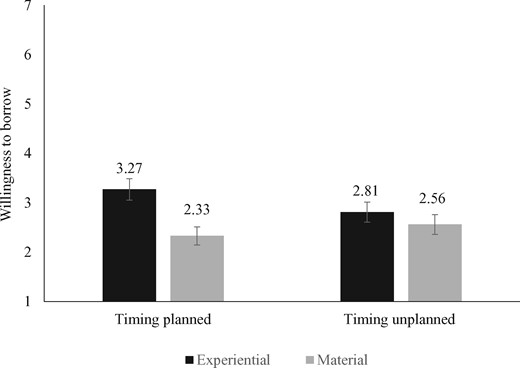
Abstract Mental accounting research suggests that consumers prefer borrowing for longer-lasting purchases in order to receive benefits from the purchases as they pay for them. In contrast, two sets of archival data and five lab studies show that consumers are more willing to borrow for experiential versus material purchases, even though experiential purchases tend to have a shorter physical duration. Further, framing the same purchase as more experiential than material increases willingness to borrow. This effect occurs because purchase timing is more important for experiential purchases—a function of consumers’ aversion to missing out on planned consumption. Thus, we moderate the proposed effect by varying whether the borrowing decision impacts planned consumption. Other differences between material and experiential purchases, such as scarcity or expected happiness, cannot similarly explain our results. Moreover, our conceptualization allows us to reconcile the apparent contradiction between the previous and current research by examining the relative impact of purchase-timing importance and payment-benefit duration matching in different contexts (i.e., “purchasing” and “source-of-funding” decisions).
A Mega-Replication of the Effect of Cash Versus Card Payment on Pain of Paying: Magnitude, Behavioral Outcomes, and Moderators
Abstract We revisit the widely accepted finding that paying with cash is more painful than paying with card by conducting the first systematic mega-replication (including 13 large-scale preregistered replications; a total of 32,371 participants, 65 products, and 57 price points ranging from $1.09 to $400). The aggregate evidence reveals four insights: (1) leveraging a broad set of established paradigms, we replicate the finding that paying with cash is more psychologically painful than paying with card, even among today’s consumers who own multiple cards, digital wallets, and virtual currencies; (2) comparing two outcome variables—amount spent and willingness-to-pay (WTP), we find a more reliable and larger overall direct effect of payment method on amount spent than on WTP; (3) these direct effects of payment method on outcome variables are mediated by pain of paying; (4) the mode-of-payment effect on pain of paying (and thereby on outcome variables) is moderated by individual differences, particularly the relative frequency of using cash versus card. We outline actionable guidance and future directions for researchers and practitioners interested in examining mode-of-payment effects, and discuss the value of and suitable approaches for future theory-driven large-scale replications.

Small Probabilistic Discounts Stimulate Spending: Pain of Paying in Price Promotions
AbstractWe find that small probabilistic price promotions effectively stimulate demand, even more so than comparable fixed price promotions (e.g., “1% chance it’s free” vs. “1% off,” respectively), because they more effectively reduce the pain of paying. In three field experiments at a grocer, we exogenously and endogenously manipulated the salience of pain of paying via elicitation timing (e.g., at entrance or checkout) and payment method (i.e., cash/debit cards or credit cards). This modulated the attractiveness of probabilistic discounts and their ability to stimulate spending. Shoppers paying with cash or debit cards, for example, spent 54% more if they received a 1% probabilistic discount than a 1% fixed discount (experiment 2). A fourth experiment showed that consumers’ sensitivity to pain of paying modulates the greater comparative efficacy of small probabilistic than fixed discounts. More broadly, the results elucidate a novel affective route through which price promotions stimulate demand––pain of paying.

Payment Rewards and Credit Card Debt: Experimental Evidence
We report on a controlled laboratory experiment in which participants make consumption, saving, and credit card repayment decisions when credit card purchases e

Complexity and biases
We examine experimentally how complexity affects decision-making, when individuals choose among different products with varying benefits and costs. We find that complexity in costs leads to choosing a high-benefit product, with high costs and overall lower payoffs. In contrast, when complexity is in the benefits of the product, we cannot reject the hypothesis of random mistakes. We also examine the role of heterogeneous complexity. We find that individuals still (mistakenly) choose the high-benefit but costly product, even if cheaper and simple products are available. Our results suggest that salience is a main driver of choices under different forms of complexity.

The Realization Effect: Risk-Taking after Realized versus Paper Losses
Understanding how prior outcomes affect risk attitudes is critical for the study of choice under uncertainty. A large literature documents the significant influence of prior losses on risk attitudes. The findings appear contradictory: some studies find greater risk-taking after a loss, whereas others show the opposite—that people take on less risk. I reconcile these seemingly inconsistent findings by distinguishing between realized versus paper losses. Using new and existing data, I replicate prior findings and demonstrate that following a realized loss, individuals avoid risk; if the same loss is not realized, a paper loss, individuals take on greater risk.