


Data integration is a key issue for any integrated set of software tools. A typical CASE environment, for instance, offers tools for the manipulation of requirements and software design documents, and it provides more or less sophisticated assistance for keeping these documents in a consistent state. Up to now, almost all data consistency observing or preserving integration tools are hand-crafted due to the lack of generic implementation frameworks and the absence of adequate specification formalisms. Triple graph grammars are intended to fill this gap and to support the specification of interdependencies between graph-like data structures on a very high level. Furthermore, they are the fundamentals of a new machinery for the production of batch-oriented as well as incrementally working data integration tools.
A Categorical Unification for Multi-Model Data: Part I Categorical Model and Normal Forms
Modern database systems face a significant challenge in effectively handling the Variety of data. The primary objective of this paper is to establish a unified data model and theoretical framework for multi-model data management. To achieve this, we present a categorical framework to unify three types of structured or semi-structured data: relation, XML, and graph-structured data. Utilizing the language of category theory, our framework offers a sound formal abstraction for representing these diverse data types. We extend the Entity-Relationship (ER) diagram with enriched semantic constraints, incorporating categorical ingredients such as pullback, pushout and limit. Furthermore, we develop a categorical normal form theory which is applied to category data to reduce redundancy and facilitate data maintenance. Those normal forms are applicable to relation, XML and graph data simultaneously, thereby eliminating the need for ad-hoc, model-specific definitions as found in separated normal form theories before. Finally, we discuss the connections between this new normal form framework and Boyce-Codd normal form, fourth normal form, and XML normal form.

GraphQL
GraphQL is a query language designed to build client applications by providing an intuitive and flexible syntax and system for describing their data requirements and interactions.
Eventual Interoperability – Pieter Colpaert
A pragmatic approach to interoperability: model your data richly for your own needs, then allow the eventual creation of one‑to‑many alignments.

GraphRAG: A Practitioner's Guide to 6 Advanced Architectural Patterns
Beyond basic graph retrieval: six production-oriented architectures for combining semantic search, knowledge graphs, and LLM reasoning.
A relational model of data for large shared data banks
Future users of large data banks must be protected from having to know how the data is organized in the machine (the internal representation). A prompting service which supplies such information is not a satisfactory solution. Activities of users at terminals and most application programs should remain unaffected when the internal representation of data is changed and even when some aspects of the external representation are changed. Changes in data representation will often be needed as a result of changes in query, update, and report traffic and natural growth in the types of stored information. Existing noninferential, formatted data systems provide users with tree-structured files or slightly more general network models of the data. In Section 1, inadequacies of these models are discussed. A model based on n -ary relations, a normal form for data base relations, and the concept of a universal data sublanguage are introduced. In Section 2, certain operations on relations (other than logical inference) are discussed and applied to the problems of redundancy and consistency in the user's model.
Semantic Data Modeling, Graph Query, and SQL, Together at Last?
Our teams advance the state of the art through research, systems engineering, and collaboration across Google.
Semble Multi-User Graph Explorer
protolab
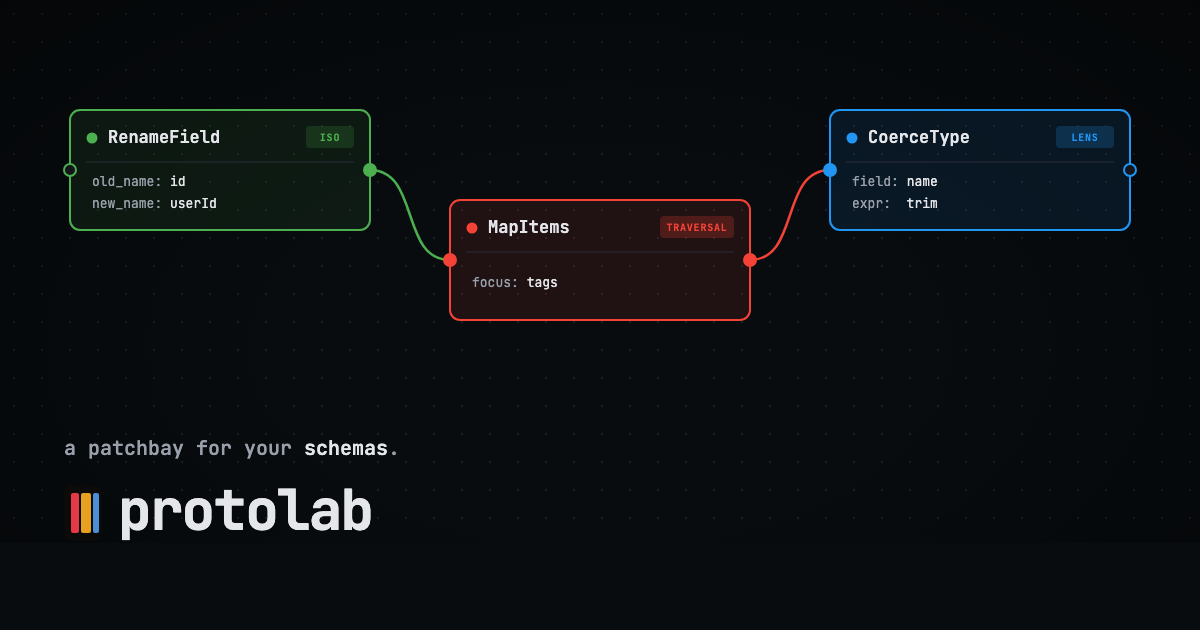
A patchbay for your schemas. Bidirectional data transformations, drawn as circuits.
protolab
A patchbay for your schemas. Bidirectional data transformations, drawn as circuits.
Dgraph Documentation
The only open, complete graph database used at terabyte-scale to power real-time use cases
Semantics and complexity of SPARQL
SPARQL is the standard language for querying RDF data. In this article, we address systematically the formal study of the database aspects of SPARQL, concentrating in its graph pattern matching facility. We provide a compositional semantics for the core part of SPARQL, and study the complexity of the evaluation of several fragments of the language. Among other complexity results, we show that the evaluation of general SPARQL patterns is PSPACE-complete. We identify a large class of SPARQL patterns, defined by imposing a simple and natural syntactic restriction, where the query evaluation problem can be solved more efficiently. This restriction gives rise to the class of well-designed patterns. We show that the evaluation problem is coNP-complete for well-designed patterns. Moreover, we provide several rewriting rules for well-designed patterns whose application may have a considerable impact in the cost of evaluating SPARQL queries.
Knowledge Graphs
In this article, we provide a comprehensive introduction to knowledge graphs, which have recently garnered significant attention from both industry and academia in scenarios that require exploiting diverse, dynamic, large-scale collections of data. After some opening remarks, we motivate and contrast various graph-based data models, as well as languages used to query and validate knowledge graphs. We explain how knowledge can be represented and extracted using a combination of deductive and inductive techniques. We conclude with high-level future research directions for knowledge graphs.
Conflict-Free Replicated Data Types
Replicating data under Eventual Consistency (EC) allows any replica to accept updates without remote synchronisation. This ensures performance and scalability in large-scale distributed systems (e.g., clouds). However, published EC approaches are ad-hoc and error-prone. Under a formal Strong Eventual Consistency (SEC) model, we study sufficient conditions for convergence. A data type that satisfies these conditions is called a Conflict-free Replicated Data Type (CRDT). Replicas of any CRDT are guaranteed to converge in a self-stabilising manner, despite any number of failures. This paper formalises two popular approaches (state- and operation-based) and their relevant sufficient conditions. We study a number of useful CRDTs, such as sets with clean semantics, supporting both add and remove operations, and consider in depth the more complex Graph data type. CRDT types can be composed to develop large-scale distributed applications, and have interesting theoretical properties.
An Algebraic Approach to Bi-directional Updating
In many occasions would one encounter the task of maintaining the consistency of two pieces of structured data that are related by some transform — synchronising bookmarks in different web browsers, the source and the view in an editor, or views in databases, to name a few. This paper proposes a formal model of such tasks, basing on a programming language allowing injective functions only. The programmer designs the transformation as if she is writing a functional program, while the synchronisation behaviour is automatically derived by algebraic reasoning. The main advantage is being able to deal with duplication and structural changes. The result will be integrated to our structure XML editor in the Programmable Structured Document project.
DevReal: Simple Knowledge Graphs with Outlines, neo4j, and Modal, Cameron Pfiffer