


The GRACE International Meeting on Bidirectional Transformations was held in December 2008 near Tokyo, Japan. The meeting brought together researchers and practitioners from a variety of sub-disciplines of computer science to share research efforts and help create a new community. In this report, we survey the state of the art and summarize the technical presentations delivered at the meeting. We also describe some insights gathered from our discussions and introduce a new effort to establish a benchmark for bidirectional transformations.
Bidirectional model transformations in QVT: semantic issues and open questions
We consider the OMG’s queries, views and transformations standard as applied to the specification of bidirectional transformations between models. We discuss what is meant by bidirectional transformations, and the model-driven development scenarios in which they are needed. We analyse the fundamental requirements on tools which support such transformations, and discuss some semantic issues which arise. In particular, we show that any transformation language sufficient to the needs of model-driven development would have to be able to express non-bijective transformations. We argue that a considerable amount of basic research is needed before suitable tools will be fully realisable, and suggest directions for this future research.

Bidirectionalization for free! (Pearl) | Proceedings of the 36th annual ACM SIGPLAN-SIGACT symposium on Principles of programming languages
A bidirectional transformation consists of a function get that takes a source (document or value) to a view and a function put that takes an updated view and the original source back to an updated source, governed by certain consistency conditions ...

From State- to Delta-Based Bidirectional Model Transformations: the Asymmetric Case.
Journal of Object Technology
Bidirectional Programming Languages
The need to edit source data through a view arises in a host of applications across many different areas of computing. Unfortunately, few existing systems provide support for updatable views. In practice, when they are needed, updatable views are usually implemented using two separate programs: one that computes the view from the source and another that handles updates. This rudimentary design is tedious for programmers, difficult to reason about, and a nightmare to maintain. This dissertation presents bidirectional programming languages, which provide an elegant and effective mechanism for describing updatable views. Unlike programs written in an ordinary language, which only work in one direction, programs in a bidirectional language can be run both forwards and backwards: from left to right, they describe functions that map sources to views, and from right to left, they describe functions that map updated views back to updated sources. Besides eliminating redundancy, these languages can be designed to ensure correctness, guaranteeing by construction that the two functions work well together. Starting from the foundations, we define a general semantic space of well-behaved bidirectional transformations called lenses. Then, building on this foundation, we describe a particular language for defining lenses on strings with syntax based on the familiar regular operators (union, concatenation, and Kleene star). We present extensions to the basic framework that address the subtle complications that arise when lenses are used to manipulate, data containing unimportant details, ordered data, and confidential data.
Combinators for bidirectional tree transformations: A linguistic approach to the view-update problem: ACM Transactions on Programming Languages and Systems: Vol 29, No 3
We propose a novel approach to the view-update problem for tree-structured data: a domain-specific programming language in which all expressions denote bidirectional transformations on trees. In one direction, these transformations---dubbed lenses---map ...

protolab
A patchbay for your schemas. Bidirectional data transformations, drawn as circuits.
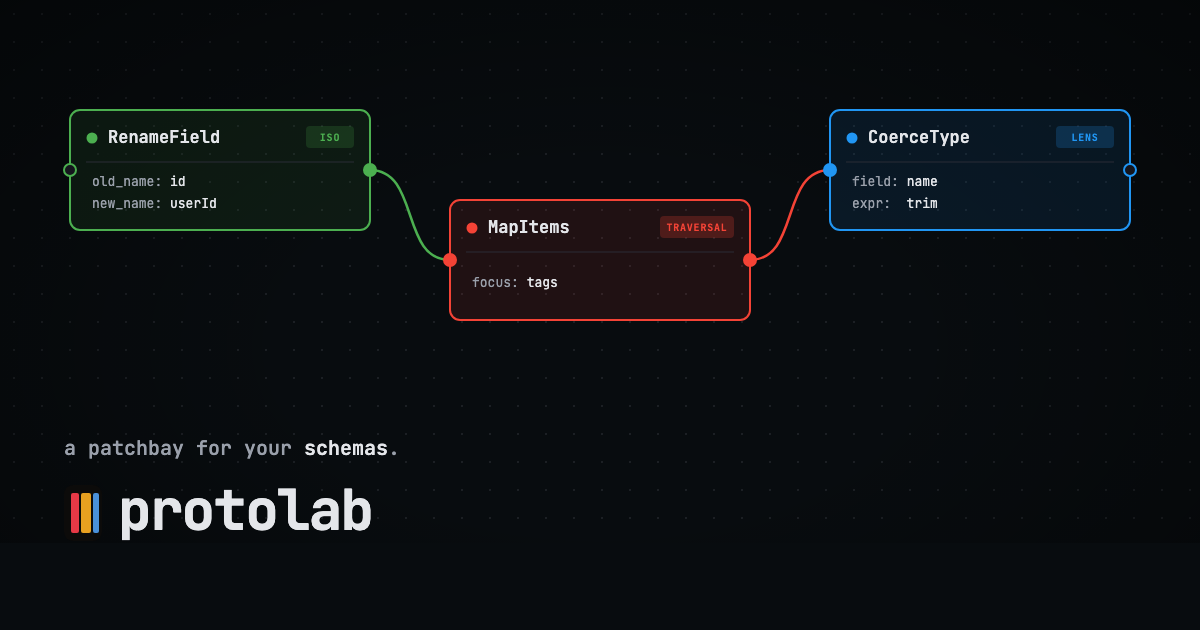
protolab
A patchbay for your schemas. Bidirectional data transformations, drawn as circuits.
R. S. Doiel, Software Engineer/Analyst — Robert's ramblings
By R. S. Doiel, 2026-02-21 (revised: 2026-03-03, epilogue added 2026-03-27)
Peter van Hardenberg - Ink and Switch, Automerge
The Next Two Years of Software Engineering
Exploring five critical questions shaping software engineering through 2026, with contrasting scenarios for each. These lenses help prepare for the evolving ...
How Open Protocols Are a Key Part of Regenerative Technology - Identity Woman
TLDR Infographic: What does it actually take for digital technology to be regenerative? The question matters because most of the digital tools being adopted right now in bioregional movements, community organizing, regenerative finance, and the broader systemic-change ecosystem are being chosen without anyone asking it carefully. The slide decks are beautiful. The intentions are sincere. […]

Incomplete Contracting and AI Alignment
As part of the Digital Library's transition to Open Access, new features for researchers are available in the Premium Edition. Click here to learn more.

How agents are transforming work
A new OpenAI research paper shows how AI agents are transforming work, enabling longer, more complex tasks and expanding productivity across roles.

What we can’t measure about AI – yet | Aeon Essays
The costs of transformative innovations are immediately clear: it’s the longterm gains that are hardest to understand

There are two theories-of-change emerging: displace vs. integrate They are by no means mutually exclusive, but much more effort has gone into spinning up brand new atproto apps with the goal to displace existing apps than has gone into embedding the protocol into every nook and cranny of the web.

patak
adding social features to our websites will accelerate atproto adoption faster than building pure atproto apps
Systems Finance

Multiple fields recognizing that finance must change in order to transform or transition various technical social systems.
TransCap Initiative

What is system-level investing?

TWIST - Investing for systems change

The Owning Impact Project | MIT Sloan Sustainability Initiative | MIT Sloan
FEST
