


Transformations and semantic analysis for source-to-source transformations such as refactorings are most effectively implemented using an abstract representation of the source code. An intrinsic limitation of transformation techniques based on abstract syntax trees is the loss of layout, i.e. comments and whitespace. This is especially relevant in the context of refactorings, which produce source code for human consumption. In this paper, we present an algorithm for fully automatic source code reconstruction for source-to-source transformations. The algorithm preserves the layout and comments of the unaffected parts and reconstructs the indentation of the affected parts, using a set of clearly defined heuristic rules to handle comments.
An Algebraic Approach to Bi-directional Updating
In many occasions would one encounter the task of maintaining the consistency of two pieces of structured data that are related by some transform — synchronising bookmarks in different web browsers, the source and the view in an editor, or views in databases, to name a few. This paper proposes a formal model of such tasks, basing on a programming language allowing injective functions only. The programmer designs the transformation as if she is writing a functional program, while the synchronisation behaviour is automatically derived by algebraic reasoning. The main advantage is being able to deal with duplication and structural changes. The result will be integrated to our structure XML editor in the Programmable Structured Document project.
Agent READMEs: An Empirical Study of Context Files for Agentic Coding
Agentic coding tools receive goals written in natural language, break them down into specific tasks, and write or execute code with minimal human intervention. Central to this process are agent context files (e.g., AGENTS.md and CLAUDE.md) that provide persistent, project-level instructions. In this paper, we conduct the first large-scale empirical study of 2,303 agent context files from 1,925 repositories to characterize their structure, maintenance, and content. We find that these files are not static documentation but complex, difficultto-read artifacts that evolve like configuration code through frequent, small additions. Our content analysis of 16 instruction types shows that developers prioritize functional context, such as test procedures (75.9%), implementation details (70.8%), and architecture (68.1%). We also identify a significant gap: non-functional requirements such as security (14.8%) and performance (14.5%) are rarely specified. These findings indicate that while developers use context files to make agents functional, they provide few guardrails to ensure that agent-written code is secure or performant, highlighting the need for improved tools and practices.

Sourcegraph — Code Understanding, Oversight and Evolution
Give humans and agents complete context to understand, oversee, and evolve the world's largest, most complex codebases.
Introduction - Tree-sitter
Tree-sitter is a parser generator tool and an incremental parsing library. It can build a concrete syntax tree for a source file and efficiently update the syntax tree as the source file is edited. Tree-sitter aims to be:
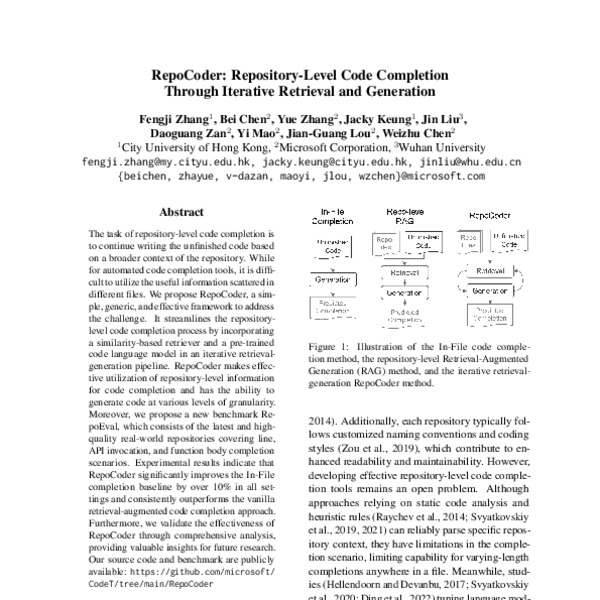
RepoCoder: Repository-Level Code Completion Through Iterative Retrieval and Generation
The task of repository-level code completion is to continue writing the unfinished code based on a broader context of the repository. While for automated code completion tools, it is difficult to utilize the useful information scattered in different files. We propose RepoCoder, a simple, generic, and effective framework to address the challenge. It streamlines the repository-level code completion process by incorporating a similarity-based retriever and a pre-trained code language model in an iterative retrieval-generation pipeline. RepoCoder makes effective utilization of repository-level information for code completion and has the ability to generate code at various levels of granularity. Moreover, we propose a new benchmark RepoBench, which consists of the latest and high-quality real-world repositories covering line, API invocation, and function body completion scenarios. Experimental results indicate that RepoCoder significantly improves the In-File completion baseline by over 10% in all settings and consistently outperforms the vanilla retrieval-augmented code completion approach. Furthermore, we validate the effectiveness of RepoCoder through comprehensive analysis, providing valuable insights for future research. Our source code and benchmark will be publicly available after the paper review.
Retrieval-Augmented Code Generation: A Survey with Focus on Repository-Level Approaches
Recent advancements in large language models (LLMs) have substantially improved automated code generation. While function-level and file-level generation have achieved promising results, real-world software development typically requires reasoning across entire repositories. This gives rise to the challenging task of Repository-Level Code Generation (RLCG), where models must capture long-range dependencies, ensure global semantic consistency, and generate coherent code spanning multiple files or modules. To address these challenges, Retrieval-Augmented Generation (RAG) has emerged as a powerful paradigm that integrates external retrieval mechanisms with LLMs, enhancing context-awareness and scalability. In this survey, we provide a comprehensive review of research on Retrieval-Augmented Code Generation (RACG), with an emphasis on repository-level approaches. We categorize existing work along several dimensions, including generation strategies, retrieval modalities, model architectures, training paradigms, and evaluation protocols. Furthermore, we summarize widely used datasets and benchmarks, analyze current limitations, and outline key challenges and opportunities for future research. Our goal is to establish a unified analytical framework for understanding this rapidly evolving field and to inspire continued progress in AI-powered software engineering.
Combinators for bidirectional tree transformations: A linguistic approach to the view-update problem: ACM Transactions on Programming Languages and Systems: Vol 29, No 3
We propose a novel approach to the view-update problem for tree-structured data: a domain-specific programming language in which all expressions denote bidirectional transformations on trees. In one direction, these transformations---dubbed lenses---map ...

Varv: Reprogrammable Interactive Software as a Declarative Data Structure
This summary was generated using automated tools and was not authored or reviewed by the article's author(s). It is provided to support discovery, help readers assess relevance, and assist readers from adjacent research areas in understanding the work. It is intended to complement the author-supplied abstract, which remains the primary summary of the paper. The full article remains the authoritative version of record. Click here to learn more.

Cody - Sourcegraph docs
Documentation for Sourcegraph, the code intelligence platform.
Reverse-engineering Claude's generative UI - then building it for the terminal
Extracting Anthropic's design system from a conversation export and rebuilding generative UI for the terminal.
Bidirectional Programming Languages
The need to edit source data through a view arises in a host of applications across many different areas of computing. Unfortunately, few existing systems provide support for updatable views. In practice, when they are needed, updatable views are usually implemented using two separate programs: one that computes the view from the source and another that handles updates. This rudimentary design is tedious for programmers, difficult to reason about, and a nightmare to maintain. This dissertation presents bidirectional programming languages, which provide an elegant and effective mechanism for describing updatable views. Unlike programs written in an ordinary language, which only work in one direction, programs in a bidirectional language can be run both forwards and backwards: from left to right, they describe functions that map sources to views, and from right to left, they describe functions that map updated views back to updated sources. Besides eliminating redundancy, these languages can be designed to ensure correctness, guaranteeing by construction that the two functions work well together. Starting from the foundations, we define a general semantic space of well-behaved bidirectional transformations called lenses. Then, building on this foundation, we describe a particular language for defining lenses on strings with syntax based on the familiar regular operators (union, concatenation, and Kleene star). We present extensions to the basic framework that address the subtle complications that arise when lenses are used to manipulate, data containing unimportant details, ordered data, and confidential data.
A Categorical Theory of Patches
When working with distant collaborators on the same documents, one often uses a version control system, which is a program tracking the history of files and helping importing modifications brought by others as patches. The implementation of such a system requires to handle lots of situations depending on the operations performed by users on files, and it is thus difficult to ensure that all the corner cases have been correctly addressed. Here, instead of verifying the implementation of such a system, we adopt a complementary approach: we introduce a theoretical model, which is defined abstractly by the universal property that it should satisfy, and work out a concrete description of it. We begin by defining a category of files and patches, where the operation of merging the effect of two coinitial patches is defined by pushout. Since two patches can be incompatible, such a pushout does not necessarily exist in the category, which raises the question of which is the correct category to represent and manipulate files in conflicting state. We provide an answer by investigating the free completion of the category of files under finite colimits, and give an explicit description of this category: its objects are finite sets labeled by lines equipped with a transitive relation and morphisms are partial functions respecting labeling and relations.
Docs as Code: The Best Guide for Technical Writers
Recently, my work has involved writing a lot of documentation and. Doing this has introduced me to...

Common Sense Refactoring of a Messy React Component | Alex Kondov
One thing I've learned from all the consulting I've done is that rewrites rarely lead to anything good. Almost in all cases, when you have an application runnin