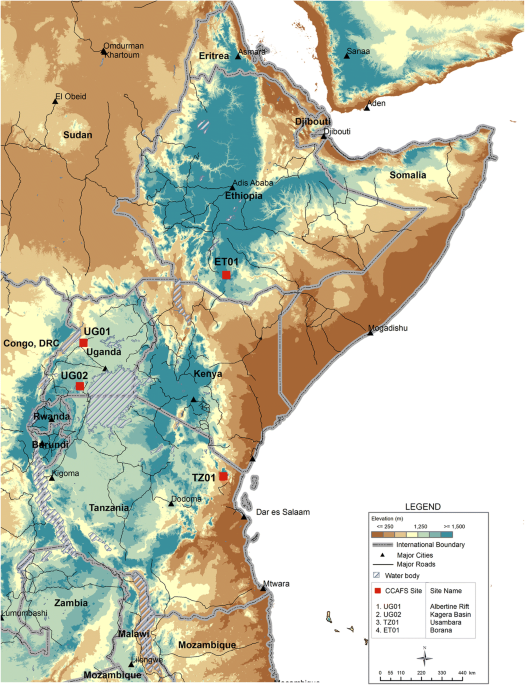
Climate information and agro-advisory services are crucial in helping smallholder farmers and pastoralists in East Africa manage climate-related risks and adapt to climate change. However, significant gaps exist in provision of climate information that effectively addresses the needs of farmers and pastoralists. Most farmers and pastoralists, therefore, rely on indigenous knowledge (IK), where local indicators and experiences are used to observe and forecast weather conditions. While IK-based forecasting is inbuilt and established in many communities in East Africa, coordinated research and systematic documentation of IK for weather forecasting, including accuracy and reliability of IK is largely lacking. This paper documents and synthesizes existing IK for weather forecasting in East Africa using case studies from Ethiopia, Tanzania, and Uganda. The results show that farmers and pastoralists use a combination of meteorological, biological, and astrological indicators to forecast local weather conditions. IK weather forecasting is, therefore, crucial in supporting efforts to improve access to climate information in East Africa, especially in resource-poor and vulnerable communities. The paper draws valuable lessons on how farmers and pastoralists in East Africa use IK weather forecasts for making crop and livestock production decisions and demonstrates that the trust and willingness to apply scientific forecasts by farmers and pastoralists is likely to increase when integrated with IK. Therefore, a systematic documentation of IK, and a framework for integrating IK and scientific weather forecasting from national meteorological agencies can improve accuracy, uptake, and use of weather forecasts.
Indigenous Knowledge Systems and Indicators of Rain: Evidence from Rwenzori Region, Western Uganda
This study investigated the abiotic and biotic environmental indicators used among pastoralists and arable farmers to predict the onset and cessation of rain as well as to make short-term and seasonal forecasts in the Rwenzori region of Western Uganda. We used a mixed-methods approach that included surveys of 907 households, focus group discussions, and key informant interviews. The results indicate that resident birds such as white-browed coucals and turacos and migrant birds such as eagles and swallows were important indicators of the onset of rains. Butterflies were an important indicator for the cessation of rains, and red ants were an indicator for the onset of rains. Among the abiotic indicators, winds, clouds, earthquakes, and cloud formation on Mount Rwenzori were important indicators. Behavior of cattle at the onset of rains was important among the pastoralists, and flowering of coffee plants was important among the arable farmers. The behavior of the biotic indicators was driven by the availability of food, water, or other necessities. An attempt to explain the phenology underlying the behavior of biotic indicators and the meteorological science underlying some of the abiotic indicators is made. Although biotic environmental indicators are rudimentary and their accuracy is influenced by external factors such as climate change, they provide climate information within the locality of the farmers. Our results suggest that the indicators used in indigenous forecasting could be incorporated in national meteorological systems in a bid to improve the accuracy of rainfall forecasts and their use among farmers and pastoralists in rural Africa.
The Old Farmer’s Almanac: Gardening, Weather, Moon, Calendar
The Old Farmer’s Almanac is your trusted source for long range weather forecasts, moon phases, full moon dates and times, gardening tips, sunrise and sunset times, Best Days, tide charts, home remedies, folklore, and more. All from the oldest continuously-published and best-selling farmers’ almanac in North America.
About the Network
About the network Our vision is for a thriving and resilient food production system across BC. Since 2017, the BC Agricultural Climate Action Research Network (ACARN) has been working to make climate research more accessible and useful for the agricultural sector. By connecting people across disciplines and regions, we help ensure that climate solutions are […]
Assessing nature's contributions to people
Recognizing culture, and diverse sources of knowledge, can improve assessments , A major challenge today and into the future is to maintain or enhance beneficial contributions of nature to a good quality of life for all people. This is among the key motivations of the Intergovernmental Science-Policy Platform on Biodiversity and Ecosystem Services (IPBES), a joint global effort by governments, academia, and civil society to assess and promote knowledge of Earth's biodiversity and ecosystems and their contribution to human societies in order to inform policy formulation. One of the more recent key elements of the IPBES conceptual framework ( 1 ) is the notion of nature's contributions to people (NCP), which builds on the ecosystem service concept popularized by the Millennium Ecosystem Assessment (MA) ( 2 ). But as we detail below, NCP as defined and put into practice in IPBES differs from earlier work in several important ways. First, the NCP approach recognizes the central and pervasive role that culture plays in defining all links between people and nature. Second, use of NCP elevates, emphasizes, and operationalizes the role of indigenous and local knowledge in understanding nature's contribution to people.

Cold Climate Syntropic Agriculture — Propagate
Syntropic farming has taken hold in Brazil and the tropics, but today we ask: How can we apply these concepts to cold climates?

“Two‐Eyed Seeing”: An Indigenous framework to transform fisheries research and management
Abstract Increasingly, fisheries researchers and managers seek or are compelled to “bridge” Indigenous knowledge systems with Western scientific approaches to understanding and governing fisheries. Here, we move beyond the all‐too‐common narrative about integrating or incorporating (too often used as euphemisms for assimilating) other knowledge systems into Western science, instead of building an ethic of knowledge coexistence and complementarity in knowledge generation using Two‐Eyed Seeing as a guiding framework. Two‐Eyed Seeing ( Etuaptmumk in Mi’kmaw) embraces “learning to see from one eye with the strengths of Indigenous knowledges and ways of knowing, and from the other eye with the strengths of mainstream knowledges and ways of knowing, and to use both these eyes together, for the benefit of all,” as envisaged by Elder Dr. Albert Marshall. In this paper, we examine the notion of knowledge dichotomies and imperatives for knowledge coexistence and draw parallels between Two‐Eyed Seeing and other analogous Indigenous frameworks from around the world. It is set apart from other Indigenous frameworks in its explicit action imperative—central to Two‐Eyed Seeing is the notion that knowledge transforms the holder and that the holder bears a responsibility to act on that knowledge. We explore its operationalization through three Canadian aquatic and fisheries case‐studies that co‐develop questions, document and mobilize knowledge, and co‐produce insights and decisions. We argue that Two‐Eyed Seeing provides a pathway to a plural coexistence, where time‐tested Indigenous knowledge systems can be paired with, not subsumed by, Western scientific insights for an equitable and sustainable future.

A social-ecological framework for analyzing and designing integrated crop–livestock systems from farm to territory levels
Integrated crop–livestock systems are often considered a promising way to address agricultural sustainability issues. Many authors claim that complementarities and synergies between crops and livestock can improve nutrient cycling and delivery of ecosystem services (ES) in agricultural systems. They have analyzed effects of interactions at the farm level and affirmed the potential advantage of developing crop–livestock interactions at the territory level. However, potential benefits of developing synergies beyond the farm level have not been clearly identified. Thus, we developed a conceptual framework that can be used to analyze, design and perform integrated assessment of crop–livestock systems at the territory level. To address crop–livestock interaction issues, we define it as a social-ecological system called the territorial crop–livestock system (TCLS). The ecological system is represented as three interacting components, crops, grasslands and animals, allowing description of various land uses and their potential effects on nutrient cycling and ES. The social system, represented as farmers interacting with natural-resource managers and agro-food chain actors, determines land use and the nature and intensity of ES delivered. We highlight the importance of coordination and learning among actors to support implementation of complex adaptive systems such as TCLSs. We illustrate the expressive power of our conceptual framework through development of a generic typology of crop–livestock systems. Then we show how our conceptual framework can be used as an intermediary object with stakeholders in participatory design approaches. We illustrate this process by representing four archetypal TCLSs. We provide an example of the design approach implemented in Southwestern France to address severe recurrent water shortages, which includes analysis of land use in the current crop–livestock system and the associated key metabolic and ES issues, identification of options for change and multi-criteria analysis of these options. We conclude that this framework shows great potential to support development of sustainable farming systems at the territory level.
Atmospheric doesn’t have to be an app · Applied Meteorology
You can just build features into the websites you've already got!
Canada's National Observer (@nationalobserver.com)
Canada's National Observer delivers vital reporting on the defining crisis of our time: climate change. Through rigorous investigation and compelling storytelling, we expose the forces shaping Canada's climate future. www.nationalobserver.com/subscribe

Correcting climate ‘misperceptions’ may not boost climate action - Carbon Brief
Most people "underestimate" general support for climate change and "overestimate" actual, real-world climate action.
AIA Forecaster: Technical Report
Forecasting is a universal problem. Any system that makes informed judgments about what may happen in the future relies on at least some degree of forecasting. In agriculture, this takes the form of predicting future crop yields and food system resilience (5; 44; 33). In biotechnology and medicine, clinical trials are carefully designed to help researchers predict the impact of newly developed treatments (37; 7). Elsewhere in biology, AlphaFold can be viewed as a form of forecasting protein folding structure under uncertainty (19). In academia, grant funding is a form of forecasting which scientific discoveries will be made conditional on funding (48). Climate and environmental science models local and long-term weather trends, which are of universal importance (42; 35; 12). In political science, forecasting election outcomes and the impact of policy decisions are an essential component of political calculus (17; 53; 10). Militaries make use of forecasting for threat assessment and conflict predictions (58; 36). Forecasting is the very heartbeat of financial firms, which use it to estimate future economic conditions in an uncertain world (49). Wherever there is uncertainty about the future, there is forecasting.
Visualising Climate 2026 — Conference
A global conference on climate data visualization, storytelling, and science. Bologna, Italy • 4–6 November 2026.

Reforming the products and processes of the IPCC to enhance its relevance
The Intergovernmental Panel on Climate Change (IPCC) assesses the scientific knowledge on climate change at five to seven year intervals. Exponential growth of the scientific literature has increased the workload for participants and the length of assessment reports. This paper proposes changes to the IPCC’s products and processes to enable it to better meet the needs of its audiences while reducing the growing burden imposed on authors and other participants.

What you can do with AT Protocol - Applied Meteorology
Years of centralized platforms have limited our thinking about what's possible on the web.
What you can do with AT Protocol - Applied Meteorology
Years of centralized platforms have limited our thinking about what's possible on the web.
Offering experience, intelligence, and wisdom for climate action
A Necessary Response: The Climate Action Handbook for Urbanists is an impassioned and technically useful guide to taking action at the community level.