Financial industry data indicate that consumers increasingly prefer debit cards over credit cards, especially as a means of enforcing financial self-discipline. Given prior research suggesting that credit cards act as spending facilitating stimuli, this move toward reduced credit card use would appear to be in the right direction. Ironically, however, the same logos that were implicated in facilitating spending with credit cards are the logos that appear on debit cards. In what should serve as an eye-opener to consumers, it is found that exposure to debit card logos does result in an increased willingness to spend, similar to credit cards.
Credit Cards as Spending Facilitating Stimuli: A Conditioning Interpretation
Abstract. Four experiments and one study were conducted to test the hypothesis that stimuli associated with spending can elicit spending responses. In all
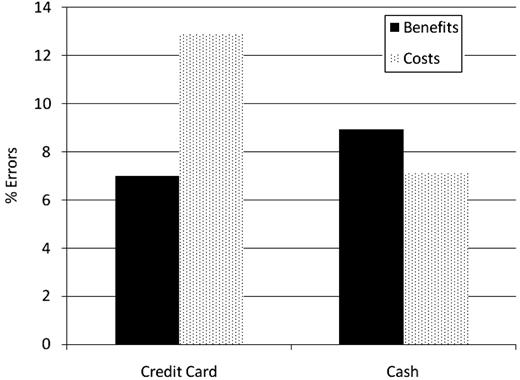
Do Payment Mechanisms Change the Way Consumers Perceive Products?
Abstract. Do payment mechanisms change the way consumers perceive products? We argue that consumers for whom credit cards (cash) have been primed focus mor
Purchase Justifiability Drives Payment Choice: Consumers Pay with Card to Remember and Cash to Forget
AbstractAlthough consumers often have multiple payment methods at their fingertips, such as cash and credit/debit cards, prior research is silent on how consumers choose between them. We home in on a key element of purchase—purchase justifiability—that affects how consumers choose to pay. Analysis of 118,042 real-world purchases and six experiments reveals that when consumers are motivated to forget (vs. remember) a purchase because they see it as difficult (vs. easy) to justify, they have an increased preference to pay with cash (vs. card) because cards create a “paper/electronic trail” that aids memory retrieval. These payment preferences are strongest among consumers most likely to recall/track their card spending, and manifest only when card expenses are trackable. We reconcile our results with the classic effect of payment method on pain of paying and discuss implications for merchants and for financial institutions designing payment methods of the future.

Cash versus Debit Card: The Role of Budget Control
Due to the financial crisis, an increasing number of households face financial problems. This may lead to an increasing need for monitoring spending and budgets. We demonstrate that both cash and the debit card are perceived as helpful in this respect. We show that, on average, consumers responsible for financial decision making within a household find cash and the debit card equally helpful for monitoring their household finances. Individuals differ in major respects, however. In particular, low earners and the liquidity‐constrained prefer cash as a budgeting tool. Finally, we present evidence that at an aggregated level, such preferences strongly affect consumer payment behavior. These findings suggest that the substitution of cash by cards may slow down because of the financial crisis.

Rewards and Misperceived Spending: Experimental Evidence from Credit Cards
Using proprietary data, a survey, and an experiment with a major bank in China, this paper studies how credit card rewards affect perceived and actual consumer

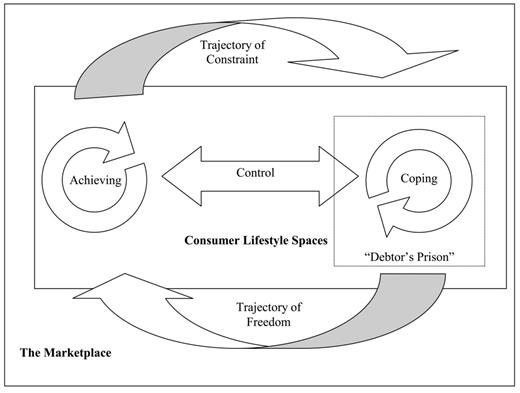
Credit Cards as Lifestyle Facilitators
Abstract. Credit cards are an increasingly essential technology, but they carry with them the paradoxical capacity to propel consumers along lifestyle traj
Always Leave Home Without It: A Further Investigation of the Credit-Card Effect on Willingness to Pay
In studies involving genuine transactions of potentially high value we show that willingness-to-pay can be increased when customers are instructed to use a credit card rather than cash. The effect may be large (up to 100%) and it appears unlikely that it arises due solely to liquidity constraints. In addition to demonstrating the effect, we provide a methodology for detecting it, and our findings suggest a source of variance to test alternative explanations.
Consumer Rationality and Credit Cards
Borrowing on credit cards at high interest rates might appear irrational. However, even low transactions costs can make credit cards attractive relative to bank loans. Credit cards also provide liquidity services by allowing consumers to avoid some of the opportunity costs of holding money. The effect of alternative interest rates on the demand for card debits can explain why credit card interest rates only partially reflect changes in the cost of funds. Credit card interest rates that are inflexible relative to the cost of funds are not inconsistent with a competitive equilibrium that yields zero profits for the marginal entrant.
Timing to the Statement: Understanding Fluctuations in Consumer Credit Use
We show that consumers spend 15% more per day in the first week following the receipt of a credit card statement than in the days just prior to the statement. This increase in spending includes both an increase in the likelihood that they use the credit card in the first weeks following their statement and an increase in transaction amount on days they use the credit card. In contrast to the effect on credit card spending, debit card spending is unaffected by credit card statement issuance, suggesting that consumers are not simply switching among modes of payment. Our estimates are based on exogenous variation from bank-assigned statement dates. We propose and test several alternative explanations to this spending puzzle: optimization of the free float, salience effect of the credit card statement, mental accounting, liquidity constraints, and automatic payments. We find that the consumers most apt to spend early in the credit card cycle tend to be those who do not revolve balances and are not close to their credit limit. Thus, this paper documents a puzzle with mixed support for several alternative explanations. This paper was accepted by David Simchi-Levi, finance.

The Impact of Credit Cards on Spending: A Field Experiment
In a field experiment, we measure the impact of payment with credit card as compared with cash on insurance company employees' spending on lunch in a cafeteria.
Leave Home without it? The Effects of Credit Card Debt and Available Credit on Spending
This research examines how credit card debt affects consumer spending. In five experimental and field studies, the authors demonstrate that outstanding credit card debt increases spending for consumers with high self-control. They also show that this effect can be eliminated by increasing the available credit on the credit card. Thus, when the available credit is low, consumers with greater self-control increase spending, but when the available credit is high, they reduce spending. The results extend the literature on goal violation and self-control and offer insights into consumer decision making and consumption patterns under conditions of debt.

When Motivation is against Debtors' Best Interest: The Illusion of Goal Progress in Credit Card Debt Repayment
The authors explore the illusion of goal progress by consumers who own multiple credit cards and pay off their debt balances to facilitate the achievement of their subgoal rather than the superordinate goal of being debt-free. The first experiment shows that debtors use their savings toward the credit card debt they can pay off entirely or substantially, even if it is associated with the smallest balance and the lowest annual percentage rate rather than toward the debt with the highest annual percentage rate. The second experiment reveals that when the income available to pay down the debt is in the form of effortless money (i.e., windfall or reward money) as opposed to hard-earned savings, the tendency to allocate money toward the smallest credit card debt is exacerbated. However, people tend to pay their debt more rationally when the number of debt accounts increases. Finally, the third experiment shows that credit card debt repayment decisions depend on the nature of the debt (hedonic vs. utilitarian) and the timing of consumption benefits (past vs. future). The article concludes with a discussion of managerial and public policy implications.
The Red, the Black, and the Plastic: Paying Down Credit Card Debt for Hotels, Not Sofas
Using transaction data from a sample of 1.8 million credit card accounts, we provide the first field test of a major prediction of Prelec and Loewenstein’s theory of mental accounting: that consumers will pay off expenditure on transient forms of consumption more quickly than expenditure on durables. According to the theory, this is because the pain of paying can be offset by the future anticipated pleasure of consumption only when money is spent on consumption that endures over time. Consistent with this prediction, we found that repayment of debt incurred for nondurable goods is an absolute 10% more likely than repayment of debt incurred for durable goods. The strength of this relationship is comparable to an increment in 15 percentage points in the credit card annualized percentage rate. Our results have not only managerial implications for the structuring of financial transactions (e.g., that credit card customers should be given the option of paying off specific purchases) but also more general implications for exploiting variations in the pain of paying in incentive schemes aimed at customers and employees. This paper was accepted by Yan Chen, behavioral economics.
Differences in Consumer Purchase Behavior by Credit Card Payment System
Abstract. A conceptualization of the relationships between alternative payment systems and various environmental and behavioral variables, which may serve
Managing Mental Accounts: Payment Cards and Consumption Expenditures
Does mental accounting matter for total consumption expenditures? We exploit a unique setting in which individuals exogenously received a new credit card, without requesting one. Using random variation in the time of receipt we show that individuals temporarily increase total consumption expenditure by making purchases with the new card without reducing spending on the others. We do not observe a corresponding increase in indebtedness. Total consumption expenditure rises even for the least liquidity-constrained individuals. The evidence is consistent with consumers treating methods of payment as nonfungible budget categories, as suggested by models of mental accounting and narrow bracketing.

Payment Depreciation: the Behavioral Effects of Temporally Separating Payments From Consumption
Abstract. Research suggests that individuals mentally track the costs and benefits of a consumer transaction for the purpose of reconciling those costs and