We estimate a two-stage Heckman selection model of credit card adoption and use with a unique dataset that combines administrative data from the Equifax credit bureau and self-reported data from a representative survey of consumers. Higher-income consumers carry higher credit card balances, but they tend to repay those balances each month. Credit card revolvers have lower income and are less educated. Revolvers are twice as likely to use debit cards as credit cards for payments, but they carry much higher balances on their credit cards. The high cost of paying off credit card debt likely exacerbates existing inequalities in disposable income. Unlike the mortgage market, we find no evidence for lenders’ cutoff between subprime and prime consumers in the credit card market.
Revolving versus Convenience Use of Credit Cards: Evidence from U.S. Credit Bureau Data
Credit card payments and revolving debt are important for consumer theory but a key data source — credit bureau records — does not distinguish between current charges and revolving debt from the previous month. We develop a theory-based econometric methodology informed by survey evidence to estimate the likelihood a consumer is revolving each quarter. We validate our approach using a new survey linked to credit bureau data. For likely revolvers: (1) 100 percent of an increase in credit becomes an increase in debt eventually; (2) credit limit changes are half as salient as debt changes; and (3) revolving status is extremely persistent.
A Debt Puzzle
Over 60% of US households with credit cards are currently borrowing – i.e., paying interest – on those cards. We attempt to reconcile the high rate of credit card borrowing with observed levels of life cycle wealth accumulation. We simulate a lifecycle model with five properties that create demand for credit card borrowing. First, the calibrated labor income path slopes upward early in life. Second, income has transitory shocks. Third, consumers invest actively in an illiquid asset, which is sufficiently illiquid that it can not be used to smooth transitory income shocks. Fourth, consumers may declare bankruptcy, reducing the effective cost of credit card borrowing. Fifth, households have relatively more dependents early in the life-cycle. Our calibrated model predicts that 20% of the population will borrow on their credit card at any point in time, far less than the observed rate of over 60%. We identify a resolution to this puzzle: hyperbolic time preferences. Simulated hyperbolic consumers borrow actively in the revolving credit card market and accumulate relatively large stocks of illiquid wealth, matching observed data.

Present-Biased Preferences and Credit Card Borrowing
Some individuals borrow extensively on their credit cards. This paper tests whether present-biased time preferences correlate with credit card borrowing. In a field study, we elicit individual time preferences with incentivized choice experiments, and match resulting time preference measures to individual credit reports and annual tax returns. The results indicate that present-biased individuals are more likely to have credit card debt, and to have significantly higher amounts of credit card debt, controlling for disposable income, other socio-demographics, and credit constraints. (JEL D12, D14, D91)
The Credit Card Debt Puzzle: The Role of Preferences, Credit Access Risk, and Financial Literacy
Abstract. We use the 1979 National Longitudinal Survey of Youth to revisit what is termed the credit card debt puzzle: why consumers simultaneously co-hold high-interest credit card debt and low-interest assets that could be used to pay down this debt. Relative to individuals with no credit card debt but positive liquid assets, borrower-savers have very different perceptions of future credit access risk and use credit cards for precautionary motives. Moreover, changing perceptions about credit access risk are essential for predicting transitions among the two groups. Preferences and the composition of financial portfolios also play a role in these transitions.
Credit Card Debt Puzzles and Debt Revolvers for Self Control
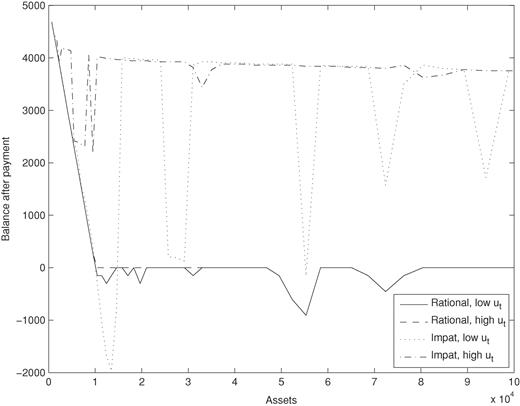
Abstract Most US credit card holders revolve high-interest debt, often with substantial liquid and retirement assets. We model separation of accounting from shopping allowed by credit cards, in a rational, dynamic game. When the shopper is more impatient than the accountant, selling assets to repay debt is not necessarily optimal, as the shopper can restore debt. Modest relative impatience generates asset-debt co-existence and target utilization rates, matching incidence and median assets of debt revolvers with substantial assets. Empirical evidence is consistent with a role for spending control considerations, after allowing for standard determinants of credit card debt.
Explaining adoption and use of payment instruments by US consumers
Motivated by recent policy intervention into payments markets, we develop and estimate a structural model of adoption and use of payment instruments by U.S. consumers. Our structural model differentiates between the adoption and use of payment instruments. We evaluate substitution among payment instruments and welfare implications. Cash is the most significant substitute to debit cards in retail settings, whereas checks are the most significant in bill‐pay settings. Furthermore, low income consumers lose proportionally more than high income consumers when debit cards become more expensive, whereas the reverse is true when credit cards do.

Overconfidence and the Credit Card Debt Puzzle
This article investigates the credit card debt puzzle. Simultaneously holding credit card debt and liquid assets is puzzling given the sizeable difference between interest rates of debt and assets. However, this behavior is common—about 31% of households in the 2016 Survey of Consumer Finances. The cost of co-holding may be justified if consumers anticipate future restrictions in credit or if they need to maintain liquidity. Other existing explanations for co-holding include impulsive spending and low financial literacy. This research reveals a new explanation for the credit card debt puzzle: consumers’ overconfidence of their financial knowledge. Using a Coarsened Exact Matching method, we found that overconfident consumers were 20%–40% more likely to co-hold credit card debt and liquid assets.
Do Nudges Reduce Borrowing and Consumer Confusion in the Credit Card Market?
We study nudges that turn out to have precise null effects in reducing long‐run credit card debt. We test nudges across two field experiments covering 183,441 UK cardholders. Our first experiment studies nudges added to monthly credit card statements. Our second experiment studies letters and email nudges (separate from monthly statements) sent to cardholders who signed up to automatically pay the minimum required payment. In a follow‐up survey to our second experiment, we find that 96% of respondents underestimate the time it would take to fully repay a debt if the cardholder made only the minimum required payment. The nudges reduce this confusion, but underestimation remains overwhelmingly common.

Timing to the Statement: Understanding Fluctuations in Consumer Credit Use
We show that consumers spend 15% more per day in the first week following the receipt of a credit card statement than in the days just prior to the statement. This increase in spending includes both an increase in the likelihood that they use the credit card in the first weeks following their statement and an increase in transaction amount on days they use the credit card. In contrast to the effect on credit card spending, debit card spending is unaffected by credit card statement issuance, suggesting that consumers are not simply switching among modes of payment. Our estimates are based on exogenous variation from bank-assigned statement dates. We propose and test several alternative explanations to this spending puzzle: optimization of the free float, salience effect of the credit card statement, mental accounting, liquidity constraints, and automatic payments. We find that the consumers most apt to spend early in the credit card cycle tend to be those who do not revolve balances and are not close to their credit limit. Thus, this paper documents a puzzle with mixed support for several alternative explanations. This paper was accepted by David Simchi-Levi, finance.

Do Liquidity Constraints and Interest Rates Matter for Consumer Behavior? Evidence from Credit Card Data
Abstract. This paper utilizes a unique data set of credit card accounts to analyze how people respond to credit supply. Increases in credit limits generate
On shifting consumers from high‐interest to low‐interest debt
Abstract In the United States, many consumers are increasingly accumulating debt, much of which is harmful and expensive. Prior research has devoted a great deal of attention to understanding why consumers generally get into debt and the strategies they can use to repay existing debts. While this work has furthered the agenda of helping consumers reduce or eliminate their overall debt balances, it has failed to emphasize the fact that for many consumers, debt may be unavoidable. This article aims to promote research that addresses not only overall debt reduction but also the need for consumers to shift from more to less costly types of debt. By shedding light on the psychological reasons why consumers may naturally gravitate toward more costly forms of debt when less costly ones may be available, we offer a novel perspective on why consumers get into and stay in debt longer than they should. This new angle has the potential to spur on further research into the ways consumers can use debt more effectively and less expensively in service of the overarching goal of debt reduction.

Household Debt: Facts, Puzzles, Theories, and Policies
Borrowing decisions affect most households, with large stakes and implications for research subfields as varied as macroeconomics and industrial organization. I review theoretical and empirical work on household debt: its prevalence, level, growth, and composition, as well as various measures of consumer choice and market (in)efficiency, elasticities, and prices, including new evidence on how borrowing heterogeneity affects the distribution of the opportunity cost of consumption. I also discuss opportunities and challenges in policy evaluation. A key takeaway is that puzzles abound, and I highlight numerous avenues for further research.

Cash versus Debit Card: The Role of Budget Control
Due to the financial crisis, an increasing number of households face financial problems. This may lead to an increasing need for monitoring spending and budgets. We demonstrate that both cash and the debit card are perceived as helpful in this respect. We show that, on average, consumers responsible for financial decision making within a household find cash and the debit card equally helpful for monitoring their household finances. Individuals differ in major respects, however. In particular, low earners and the liquidity‐constrained prefer cash as a budgeting tool. Finally, we present evidence that at an aggregated level, such preferences strongly affect consumer payment behavior. These findings suggest that the substitution of cash by cards may slow down because of the financial crisis.

Household Need for Liquidity and the Credit Card Debt Puzzle
Abstract. In the 2001 U.S. Survey of Consumer Finances, 27% of households report simultaneously revolving significant credit card debt and holding sizeable
Leave Home without it? The Effects of Credit Card Debt and Available Credit on Spending
This research examines how credit card debt affects consumer spending. In five experimental and field studies, the authors demonstrate that outstanding credit card debt increases spending for consumers with high self-control. They also show that this effect can be eliminated by increasing the available credit on the credit card. Thus, when the available credit is low, consumers with greater self-control increase spending, but when the available credit is high, they reduce spending. The results extend the literature on goal violation and self-control and offer insights into consumer decision making and consumption patterns under conditions of debt.

Borrowing on the Wrong Credit Card? Evidence from Mexico
We establish new facts about the way consumers allocate debt among their credit cards using data for a representative sample of cardholders in Mexico. We find that relative prices are weak predictors of the allocation of debt, purchases, and payments. Consumers allocate a large fraction of their debt to high-interest cards, incurring a cost of 31 percent above the minimum. Using an experiment, we find that consumers do not substitute in the price margin, although they respond to salient temporary low-interest offers. We conclude that limited attention and mental accounting best rationalize our results and discuss implications for the market.