

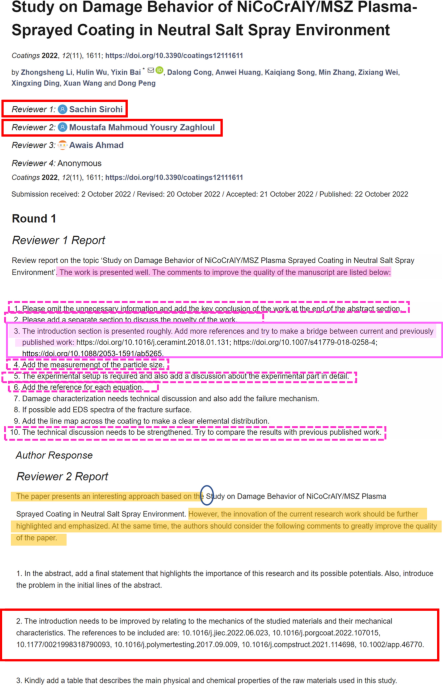
Review mills sum up a new category of reviewer misconduct that flies in the face of reviewer ethics and integrity. A pattern of generic, vague, and repeated affirmations (identical or very similar boilerplate phrasing) is noted in the analysis of 263 review reports, regardless of the scientific content of the papers under review, coupled with coercive citation (perhaps among the main reasons for such behavior), which when combined produce fake reviews. The misconduct associated with review mills is unlike mere plagiarism (self-plagiarism) of reviewer comments. It is important to quantify the problem and to take urgent measures: (a) to identify the review millers; (b) to rectify the published literature; and (c) to determine procedures for journals and publishers on procedures to counter this new type of misconduct.
Policies Permitting LLM Use for Polishing Peer Reviews Are Currently Not Enforceable
A number of scientific conferences and journals have recently enacted policies that prohibit LLM usage by peer reviewers, except for polishing, paraphrasing, and grammar correction of otherwise human-written reviews. But, are these policies enforceable? To answer this question, we assemble a dataset of peer reviews simulating multiple levels of human-AI collaboration, and evaluate five state-of-the-art detectors, including two commercial systems. Our analysis shows that all detectors misclassify a non-trivial fraction of LLM-polished reviews as AI-generated, thereby risking false accusations of academic misconduct. We further investigate whether peer-review-specific signals, including access to the paper manuscript and the constrained domain of scientific writing, can be leveraged to improve detection. While incorporating such signals yields measurable gains in some settings, we identify limitations in each approach and find that none meets the accuracy standards required for identifying AI use in peer reviews. Importantly, our results suggest that recent public estimates of AI use in peer reviews through the use of AI-text detectors should be interpreted with caution, as current detectors misclassify mixed reviews (collaborative human-AI outputs) as fully AI generated, potentially overstating the extent of policy violations.

So maybe now we can agree that having an unchecked research integrity militia who unfortunately has the ear of the press and increasingly that of the the publishers, but who fiercely rejects any… | Ioana A. Cristea
So maybe now we can agree that having an unchecked research integrity militia who unfortunately has the ear of the press and increasingly that of the the publishers, but who fiercely rejects any minimal ethics or code of conduct, is a (growing) problem? Also, that 1. problems have to be investigated before deciding they are are legitimate and serious; 2. this investigation is not social media, blogs and the press; 3. this investigation should not be on the front page of journals and Retraction Watch; 4. there are degrees of seriousness and some things can just be corrected or are simply not very consequential (no, it's not a house of bricks where we have to check every brick, that's a dumb analogy), so being absolutely hysterical and overdramatic about any lie, inaccuracy or mistake is purposeful at worse and should be ignored at best and 5. it is not only unnecessary, but harmful, to also go into other, non-academic things the person did or does to complete "investigations" that you (press, sleuth, blogger, etc) do not have the tools and information to do completely and accurately (this fixation would be called harassment in the before times). Others will justly write about what the institutions did or did not do, but what I want to say is that we really should end it with the blank credit we give to any and all allegations that come from the establish research integrity truth fighters.

Reformation of science publishing: the Stockholm Declaration
Science relies on integrity and trustworthiness. But scientists under career pressure are lured to purchase fake publications from ‘paper mills’ that use AI-generated data, text and image fabrication. The number of low-quality or fraudulent publications is rising to hundreds of thousands per year, which—if unchecked—will damage the scientific and economic progress of our societies. The result is editor and reviewer fatigue, irreproducible experiments, misguided experiments, disinformation and escalating costs that devour funding from taxpayers intended for research. It is high time to reevaluate current publishing models and outline a global plan to stop this unhealthy development. A conference was therefore organized by the Royal Swedish Academy of Sciences to draft an action plan with specific recommendations, as follows. (i) Academia should resume control of publishing using non-profit publishing models (e.g. diamond open-access). (ii) Adjust incentive systems to merit quality, not quantity, in a reputation economy where the gaming of publication numbers and citation metrics distorts the perception of academic excellence. (iii) Implement mechanisms to prevent and detect fake publications and fraud which are independent of publishers. (iv) Draft and implement legislations, regulations and policies to increase publishing quality and integrity. This is a call to action for universities, academies, science organizations and funders to unite and join this effort.

Post-publication critique at top-ranked journals across scientific disciplines: a cross-sectional assessment of policies and practice
Journals exert considerable control over letters, commentaries and online comments that criticize prior research (post-publication critique). We assessed policies (Study One) and practice (Study Two) related to post-publication critique at 15 top-ranked journals in each of 22 scientific disciplines ( N = 330 journals). Two-hundred and seven (63%) journals accepted post-publication critique and often imposed limits on length (median 1000, interquartile range (IQR) 500–1200 words) and time-to-submit (median 12, IQR 4–26 weeks). The most restrictive limits were 175 words and two weeks; some policies imposed no limits. Of 2066 randomly sampled research articles published in 2018 by journals accepting post-publication critique, 39 (1.9%, 95% confidence interval [1.4, 2.6]) were linked to at least one post-publication critique (there were 58 post-publication critiques in total). Of the 58 post-publication critiques, 44 received an author reply, of which 41 asserted that original conclusions were unchanged. Clinical Medicine had the most active culture of post-publication critique: all journals accepted post-publication critique and published the most post-publication critique overall, but also imposed the strictest limits on length (median 400, IQR 400–550 words) and time-to-submit (median 4, IQR 4–6 weeks). Our findings suggest that top-ranked academic journals often pose serious barriers to the cultivation, documentation and dissemination of post-publication critique.

Definition of REVIEW
an act or process of carefully looking at or examining the quality, condition, etc., of something or someone; revision… See the full definition

OpenAI’s Egregious Pattern of Misconduct
Nine troubling new reports in seven days
The Peer Review Crisis Demands Radical Reform: Why Reviewers Should Become Paid Professional Referees
The peer review system, fundamental to scientific quality control, faces a significant crisis. As journal editors, we often need to send up to 35 invitations just to secure two reviewers, confronting daily the collapse of voluntary participation. This reflects a critical imbalance: while publication pressure intensifies, willingness to evaluate diminishes, creating "literature elephantiasis", i.e., an overwhelming proliferation of papers exceeding human processing capacity. Current compensation models, relying on token recognition and database access, fail to incentivize quality engagement and may encourage ethically problematic practices like excessive self-citation. The unchecked infiltration of artificial intelligence into peer review, with minimal enforcement, further undermines system integrity. We propose transforming peer reviewers into professional referees, modeled on sports officiating. This radical solution involves formal training and certification for reviewers, equipping them to assess scientific merit, methodology, and ethics comprehensively. Like sports referees supported by assistants, scientific referees would collaborate with specialists - including statisticians, methodology experts, and reference checkers - ensuring thorough evaluation while distributing workload effectively. Funding would come from publishers or research funders, recognizing peer review as an essential, compensated component of the research lifecycle. Implementation faces challenges including publisher resistance and funding allocation, which we address through phased transition strategies. This professionalization addresses current inequities where conscientious scientists shoulder disproportionate reviewing burdens while others contribute minimally. Professional reviewers would view evaluation as valued career development rather than unwelcome obligation. Critics citing independence concerns overlook the sports analogy: referees maintain impartiality through professional standards despite league compensation. Quality scientific evaluation requires dedicated expertise, adequate training, and fair remuneration. Science deserves better than a system dependent on goodwill and guilt - it needs professional referees now.

Fabricated citations: an audit across 2·5 million biomedical papers
Scientific literature depends on the integrity of its references. Each reference implicitly asserts that a verifiable source exists and supports the claims being made. When references point to non-existent studies, readers, reviewers, and policy makers are unable to evaluate the evidence.

Fabricated citations: an audit across 2·5 million biomedical papers
Scientific literature depends on the integrity of its references. Each reference implicitly asserts that a verifiable source exists and supports the claims being made. When references point to non-existent studies, readers, reviewers, and policy makers are unable to evaluate the evidence.
New IOP Publishing tool detects duplicate peer reviews in push against reviewer fraud - IOP Publishing
IOP Publishing (IOPP) has developed a machine-learning powered tool to help detect duplicate peer review reports, addressing a growing threat to research integrity in scholarly publishing. Duplicate peer reviews (where the same reviewer report is sent for multiple submissions) are problematic because they fail to provide a unique and critical assessment of a manuscript, making the peer […]
A Delphi survey on attitudes to serious research misconduct: Exploring convergence vs. polarization of views of research “sleuths” and research integrity experts
Research fraud is often seen as a rare event, but evidence from self-report surveys indicates that fabrication and falsification of data are common enough to be a problem. This study assessed attit...

Science should be machine-readable - Marginal REVOLUTION
One of the leading tasks of our time: We develop a machine-automated approach for extracting results from papers, which we assess via a comprehensive review of the entire eLife corpus. Our method facilitates a direct comparison of machine and peer review, and sheds light on key challenges that must be overcome in order to facilitate […]

Verification Handbook | DataJournalism.com
This book equips journalists with the knowledge to investigate on disinformation and media manipulation.

Illicit Use of AI by Philosophers Refereeing for Journals - Daily Nous
In 2024, a study found that “7–17% of the sentences in the reviews [of computer science manuscripts] were written by LLMs”. It was only a […]
