

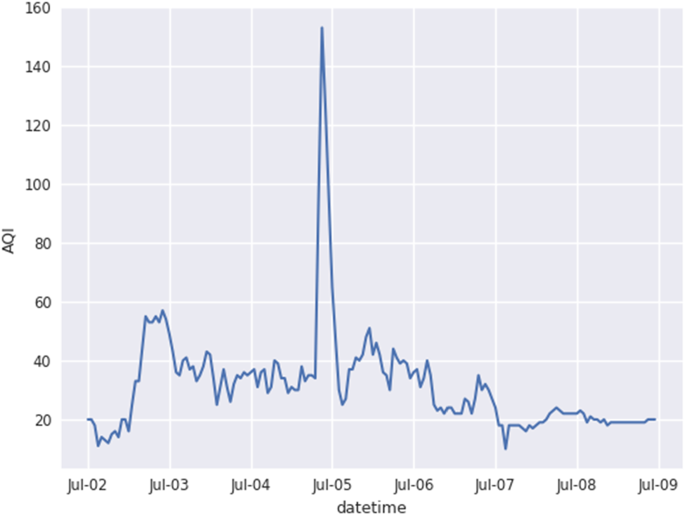
Computational notebooks are becoming a popular method to introduce mathematics, data, and scientific computing concepts to secondary students. Advocates argue computational notebooks encourage transparency and reproducibility in student work and can enable more personalized investigations of publicly available civic and scientific datasets. However, little is known about how teachers navigate these complex artifacts, let alone how they might support their students in doing so. In this paper, we investigate six pre-service and two in-service K-12 teachers’ sensemaking during a structured clinical think-aloud interview as they engaged with a computational notebook that examines disruptions in local air quality. The notebook presented a common event (annual fireworks) and an extreme event that impacted human health, during which the skies above the greater metropolitan San Francisco Bay region in California, USA turned orange due to wildfire pollution (“Orange Skies Day”, Sept 9, 2020). We examine the ideas that participants engaged as they interacted with the notebooks, and identify three ways in which they interacted with code in the notebook: to make sense of the scientific phenomenon (all participants), to make sense of the available data (6 out of 8 participants), and/or integrate these two dimensions (4 out of 8 participants). We present examples of each of these three forms of sensemaking, highlight their similarities and distinguishing features, and discuss implications for teacher education.
Keynote: Bridging Gaps with Code: Transforming K12 Education with Jupyter Everywhere - I. Martinez
Callysto: Bringing Jupyter and Computational Thinking to the K-12 Curriculum
Cybera and the Pacific Institute for Mathematical Sciences are participating in the new national CanCode program, to develop coding and digital skills from kindergarten to grade 12. With the launch of the Callysto project, we are creating tools and frameworks that help teachers bring computational thinking into their math, science, social sciences, and humanities courses - giving students the analytical skills needed to comprehend the digital world. Leveraging the Jupyter 'All-in-One' Science Platform to put friendly yet powerful compute tools in classroom settings, we are creating showcase modules and workshop training for K-12 teachers to incorporate data and computing into the broad curriculum. At this presentation, you will learn about how Callysto will: Bring computational thinking to classrooms through K-12 teacher training Create opportunities to participate in free workshop training sessions and content creation Help K-12 teachers gain public recognition for participating in this educational training project Note: This presentation is related to our 2017 BCNET presentation on "Bringing The Thunder: Deploying Jupyter Notebooks For Research, Education, And Innovation." View Slidedeck
Understanding the Data in K-12 Data Science · Issue 6.2, Spring 2024
Our increasingly data-driven world is amplifying the need for everyone to develop foundational data literacy skills. In response, a growing number of K-12 data science curricula are being designed to introduce all students to data. These curricula define what data science is at the high school level and directly shape how students are introduced to and understand the discipline. Ensuring these curricula are effective, engaging, and, most critically, equitable is of paramount importance. This article presents a qualitative analysis of four curricula, focusing on the data used to introduce learners to the field of data science. The analysis uses a series of analytical lenses to evaluate the 296 distinct data sets used across the curricula and identifies trends and best practices in data set selection. The analysis includes using data collected from high school students about their interests and experiences with data to understand if and how contemporary data science curricula are tapping into students’ lived experiences to situate data science learning experiences. The findings show that the curricula use relatively recent and small data sets covering a range of topics and that learner involvement in data set selection is limited. Further, the analysis reveals gaps between the data sets used and students' self-reported interests. This work highlights the importance of data set selection, especially as it relates to supporting learners from historically excluded populations in technology fields. Finally, this article provides practical implications to assess existing curricula and advances our understanding of how to situate the field of data science in the interests, ideas, and values of today’s students.

3 Powerful Takeaways from the National Workshop on Data Science Education
As the field flourishes, there is much we can do to benefit its countless students.

Developing Competencies for the Future of Data and Computing: The Role of K-12
Skills in computing and data are critical for students to thrive in a data-driven world. While efforts to expand learning in these areas have grown, opportunities to participate are unevenly distributed and lack coherence across grades and subjects. Our new report identifies seven shared competencies for data and computing and how they align with existing STEM standards and classroom practice. Through addressing curriculum, teacher preparation, professional learning, technology access, assessment, and system-level coordination, the report calls for sustained, coordinated action to ensure that all students have meaningful opportunities to develop literacy in data and computing.

How can citizen science reduce psychological distance to science? Insights from three projects in contested environmental contexts
Citizen science (CS) is a participatory mode of knowledge production, enabling non-scientific actors to contribute to and sometimes contest scientific agendas and interpretations, making it a way to bridge science and society. This paper examines how that potential unfolds by analysing the individual perspectives of citizen scientists through the lens of Psychological Distance to Science (PSYDISC). Drawing on three case studies of contested environmental CS, we identify which contextual aspects of CS shape citizen scientists' experiences of social, spatial, temporal, or hypothetical distance to relevant science, and how these experiences may relate to trust. Our findings underscore the role of science communication as both a channel for dissemination, and as a constitutive element of participatory research; crucial for reducing psychological distance and enabling socially robust knowledge production, especially in contested, policy-relevant science settings.
Integrating Data Literacy Into K–12 Education · Issue 7.2, Spring 2025
In a world increasingly driven by data, the ability to understand, interpret, and make use of data has assumed a fundamental role. Yet despite its importance, data literacy remains conspicuously absent from the U.S. K–12 educational landscape. This article explores the obstacles in integrating data literacy into the educational system and proposes a multipronged approach to address these challenges.We contend that successful implementation of K–12 data literacy education necessitates comprehensive teacher preparation and professional development coupled with the integration of data literacy within curricula. Furthermore, the creation of suitable tools and data sets specifically tailored for K–12 learning is paramount. Finally, school and district leaders must champion the cause of data literacy, allocating resources and nurturing a culture that recognizes its value.Drawing inspiration from the success of large-scale initiatives such as the Moore-Sloan Data Science Environments and the National Writing Project, we present the components and conditions essential for successful advancement of data literacy education. The article concludes with a call to action inviting constituents from across various roles to unite in the endeavor of building a future where data literacy is recognized as a fundamental skill. We underscore that the widespread implementation of data literacy within K–12 education will demand sustained investment, customized local implementation, and the concerted efforts of multiple disciplines and stakeholder groups. By confronting these challenges head-on and harnessing the strategies outlined in this article, we can strive to ensure that all students are armed with the data literacy skills necessary to navigate an increasingly data-driven world.

A first introduction to data science education in secondary schools: Teaching and learning about data exploration with <span style="font-variant:small-caps;">CODAP</span> using survey data
Abstract In this paper, we will describe an introduction to Data Science for secondary school students. We will report on the design and implementation of an introductory unit on “Data and data detectives with CODAP” in which secondary school students used the online tool CODAP to explore real and meaningful survey data on leisure time activities and media use (so‐called JIM‐PB data) in a statistical project setting as a starting point for data science. The JIM‐PB data set served as a valuable data set that offered meaningful and exciting opportunities for data exploration for secondary school students, and CODAP proved to be a valuable tool for the first explorations of this data.

Collaboratory at Columbia: An Aspen Grove of Data Science Education · Issue 3.4, Fall 2021
Many universities recognize the rapidly growing impact of data science in all fields of study and the professions and seek to embed this expertise widely across their educational offerings. There is often broad interest in developing new data science curricula, with some universities even allocating funds toward this purpose. Yet, it is often unclear what resources are needed for effective data science education, and how resources ought to be prioritized. Although university leadership might be aware of a growing number of successful data science acceleration programs and pedagogical models, many of which are either general purpose or specific to a particular discipline, there remains a lack of clarity about how these models might address their own specific needs. This article presents the Collaboratory Program at Columbia University (termed “the Collaboratory”), which is both a set of “data science in context” educational approaches, as well as a meta-model for an accelerator program that allows different institutions to respond flexibly to their own disciplinary heterogeneity in terms of data science educational needs. The novelty of the Collaboratory lies in its crowd-sourcing approach to creating new data science pedagogy and its ability to kindle transdisciplinary collaboration in doing so. By offering seed funding, it fosters proactive efforts to embed data science “in context” into more traditional domains through a cohort of compelling, transdisciplinary, crowd-sourced data science education proposals each year. Collaboratory educational offerings are required to be developed through a partnership between two faculty members, a data scientist and a domain expert from another field, or a larger team with complementary expertise. Over the past 5 years, the Collaboratory has supported the development of a wide spectrum of data science pedagogical models spread across more than 40 academic departments, centers, institutes, and professional schools at Columbia University. As a result, the Collaboratory has to date served the learning needs of more than 4,000 students. Furthermore, it has cultivated a thriving ecosystem that includes a funding mechanism and a community-support structure that all contribute to its agility and success. Here, we offer our experience and best practices in developing and managing the Collaboratory, which, we hope, will contribute to a blueprint for data science education leaders everywhere.

Managing scientific knowledge for policy on the ATmosphere - Mathew's newsletter
Two types of Atmosphere toolkit are needed if ATScience is to help scientists do science and better communicate it to other audiences: one serving the researchers and their teams, the other focused on aggregation and synthesis.
Interleaving Computational and Inferential Thinking: Data Science for Undergraduates at Berkeley · Issue 3.2, Spring 2021
The undergraduate data science curriculum at the University of California, Berkeley is anchored in five new courses that emphasize computational thinking, inferential thinking, and the perspective gained by working on real-world problems. We believe that interleaving these elements within our core courses is essential to preparing students to engage in data-driven inquiry at the scale that contemporary scientific and industrial applications demand. This new curriculum is already reshaping the undergraduate experience at Berkeley, where these courses have become some of the most popular on campus and have led to a surging interest in a new undergraduate major and minor program in data science.

Data Annotations as Pedagogical Hints: From Subjective Labels to Critical Thinking
Machine learning courses often use pre-labeled datasets, hiding the subjectivity of human annotation. This creates students with an overly trusting view of AI data and models, undervaluing interpretive diversity. We investigated whether manual data annotation tasks teach students about subjective labeling. Study Design: An annotation activity was implemented at two universities: Fontys (Netherlands) and IT University Copenhagen (Denmark). Students annotated skin lesion images for hair coverage on a 3-point scale. Surveys were collected from 43 participants measuring their understanding of annotation ambiguity, data quality, bias, fairness, implementation barriers, and pedagogical effectiveness. Key Findings: Self-reported familiarity with course content increased substantially across all concepts. Most students recognised that personal interpretation affects annotations. Students rated the activity as more effective than traditional lectures for understanding bias. Participants were motivated to learn more. Main Drawbacks: Emotional unease from viewing medical images was the primary issue. Many students still requested clearer guidelines to reduce disagreement, suggesting they hadn't internalised that disagreement from different perspectives is a learning feature, not a bug. Recommendations for Future Iterations: Ensure sufficient interpretive ambiguity in materials. Reduce repetitive annotation workload. Mitigate emotional unease from sensitive content. Explicitly frame disagreement as a learning opportunity rather than a problem to solve. Manual data annotations effectively teach students that human judgment shapes model behavior and that disagreement reflects domain complexity, not just noise.

Foundations of Data Science for Students in Grades K-12
On September 13 and 14, 2022, the Board on Science Education at the National Academies of Sciences, Engineering, and Medicine held a workshop entitled Foundations of Data Science for Students in Grades K–12. Speakers and participants explored the rapidly growing field of K-12 data science education, by surveying the current landscape, surfacing what is known, and identifying what is needed to support student learning, develop curriculum and tools, and prepare educators. To support these conversations, four papers were commissioned and discussed during the workshop. This publication summarizes the presentations and discussion of the workshop.
The new way we’ll do science
Papers should become human-readable views over a graph of data, tools, results, and certificates.

Bringing Computational Thinking to non-STEM Undergraduates through an Integrated Notebook Application
Computational thinking courses are no longer exclusive to engineering and computer science students in higher education but have become a requirement in other fields, as well as for students in secondary, primary, and even early childhood education. Computational notebooks, such as Jupyter, are popular solutions to develop the programming skills typically introduced in these courses. However, these solutions often require technical infrastructure and lack support for rich educational experiences that integrate discussion, active feedback, and learning analytics. In this paper, we introduce a web application designed to address these challenges. We present blended learning scenarios supported by this application and evaluate them in an eight-week computational thinking course comprising 67 students pursuing a Bachelor in Business and Economics. We include in our results the impact of the disruption caused by the COVID-19 pandemic, which forced a move from blended to online distance learning for the second half of our evaluation.
A taxonomy of ATmosphere applications
Last week I spent an energizing, educational, occasionally infuriating week in Vancouver around the ATmosphereConf, a community event gathering developers, investors, data scientists, the odd academic