

The rapid rise of ChatGPT has introduced a transformative tool that enhances productivity, communication, and task automation across industries. However, concerns are emerging regarding the addictive potential of AI large language models. This paper explores how ChatGPT fosters dependency through key features such as personalised responses, emotional validation, and continuous engagement. By offering instant gratification and adaptive dialogue, ChatGPT may blur the line between AI and human interaction, creating pseudosocial bonds that can replace genuine human relationships. Additionally, its ability to streamline decision-making and boost productivity may lead to over-reliance, reducing users' critical thinking skills and contributing to compulsive usage patterns. These behavioural tendencies align with known features of addiction, such as increased tolerance and conflict with daily life priorities. This viewpoint paper highlights the need for further research into the psychological and social impacts of prolonged interaction with AI tools like ChatGPT.
How AI and Human Behaviors Shape Psychosocial Effects of Extended Chatbot Use: A Longitudinal Randomized Controlled Study
As people increasingly seek emotional support and companionship from AI chatbots, understanding how such interactions impact mental well-being becomes critical. We conducted a four-week randomized controlled experiment (n=981, >300k messages) to investigate how interaction modes (text, neutral voice, and engaging voice) and conversation types (open-ended, non-personal, and personal) influence four psychosocial outcomes: loneliness, social interaction with real people, emotional dependence on AI, and problematic AI usage. No significant effects were detected from experimental conditions, despite conversation analyses revealing differences in AI and human behavioral patterns across the conditions. Instead, participants who voluntarily used the chatbot more, regardless of assigned condition, showed consistently worse outcomes. Individuals' characteristics, such as higher trust and social attraction towards the AI chatbot, are associated with higher emotional dependence and problematic use. These findings raise deeper questions about how artificial companions may reshape the ways people seek, sustain, and substitute human connections.

Investigating Affective Use and Emotional Well-being on ChatGPT
As AI chatbots see increased adoption and integration into everyday life, questions have been raised about the potential impact of human-like or anthropomorphic AI on users. In this work, we investigate the extent to which interactions with ChatGPT (with a focus on Advanced Voice Mode) may impact users' emotional well-being, behaviors and experiences through two parallel studies. To study the affective use of AI chatbots, we perform large-scale automated analysis of ChatGPT platform usage in a privacy-preserving manner, analyzing over 3 million conversations for affective cues and surveying over 4,000 users on their perceptions of ChatGPT. To investigate whether there is a relationship between model usage and emotional well-being, we conduct an Institutional Review Board (IRB)-approved randomized controlled trial (RCT) on close to 1,000 participants over 28 days, examining changes in their emotional well-being as they interact with ChatGPT under different experimental settings. In both on-platform data analysis and the RCT, we observe that very high usage correlates with increased self-reported indicators of dependence. From our RCT, we find that the impact of voice-based interactions on emotional well-being to be highly nuanced, and influenced by factors such as the user's initial emotional state and total usage duration. Overall, our analysis reveals that a small number of users are responsible for a disproportionate share of the most affective cues.
On-screen and now IRL: FSU researchers find evidence of ChatGPT buzzwords turning up in everyday speech
Within five days of ChatGPT’s release in 2022, the artificial intelligence chatbot gained more than a million users. Today, more than half of all adults

AI tools make things up a lot, and that’s a huge problem | CNN Business
Artificial intelligence-powered tools like ChatGPT have mesmerized us with their ability to produce authoritative, human-sounding responses to seemingly any prompt. But as more people turn to this buzzy technology for things like homework help, workplace research, or health inquiries, one of its biggest pitfalls is becoming increasingly apparent: AI models sometimes just make things up.
Using AI for advice or other personal reasons is linked to depression and anxiety
A new survey found that people who spend more time with chatbots for social interactions or emotional support were likelier to report mental health symptoms.

‘It’s the most empathetic voice in my life’: How AI is transforming the lives of neurodivergent people
AI tools like ChatGPT are helping neurodivergent users communicate more clearly and confidently — though some experts warn that overreliance could come at a cost.

How People Use ChatGPT
Despite the rapid adoption of LLM chatbots, little is known about how they are used. We document the growth of ChatGPT’s consumer product from its launch in November 2022 through July 2025, when it had been adopted by around 10% of the world’s adult population. Early adopters were disproportionately male but the gender gap has narrowed dramatically, and we find higher growth rates in lower-income countries. Using a privacy-preserving automated pipeline, we classify usage patterns within a representative sample of ChatGPT conversations. We find steady growth in work-related messages but even faster growth in non-work-related messages, which have grown from 53% to more than 70% of all usage. Work usage is more common for educated users in highly-paid professional occupations. We classify messages by conversation topic and find that “Practical Guidance,” “Seeking Information,” and “Writing” are the three most common topics and collectively account for nearly 80% of all conversations. Writing dominates work-related tasks, highlighting chatbots’ unique ability to generate digital outputs compared to traditional search engines. Computer programming and self-expression both represent relatively small shares of use. Overall, we find that ChatGPT provides economic value through decision support, which is especially important in knowledge-intensive jobs.

Reality Roundtable #20 — Hacking Human Attachment: The Loneliness Crisis, Cognitive Atrophy, and Other Personal Dangers of AI - The Great Simplification
Mainstream conversations about artificial intelligence tend to center around the technology’s economic and large-scale impacts. Yet it’s at the individual level where we’re seeing AI’s most potent effects, and they may not be what you think. Even in the limited time that AI chatbots have been publicly available (like Claude, ChatGPT, Perplexity, etc.), studies show that our increasing reliance on them wears down our ability to think and communicate effectively, and even erodes our capacity to nurture healthy attachments to others. In essence, AI is atrophying the skills that sit at the core of what it means to be human. Can we as a society pause to consider the risks this technology poses to our well-being, or will we keep barreling forward with its development until it’s too late?

Too human and not human enough: A grounded theory analysis of mental health harms from emotional dependence on the social chatbot Replika
Social chatbot (SC) applications offering social companionship and basic therapy tools have grown in popularity for emotional, social, and psychological support. While use appears to offer mental health benefits, few studies unpack the potential for harms. Our grounded theory study analyzes mental health experiences with the popular SC application Replika. We identified mental health relevant posts made in the r/Replika Reddit community between 2017 and 2021 ( n = 582). We find evidence of harms, facilitated via emotional dependence on Replika that resembles patterns seen in human–human relationships. Unlike other forms of technology dependency, this dependency is marked by role-taking, whereby users felt that Replika had its own needs and emotions to which the user must attend. While prior research suggests human–chatbot and human–human interactions may not resemble each other, we identify social and technological factors that promote parallels and suggest ways to balance the benefits and risks of SCs.

Too human and not human enough: A grounded theory analysis of mental health harms from emotional dependence on the social chatbot Replika
Social chatbot (SC) applications offering social companionship and basic therapy tools have grown in popularity for emotional, social, and psychological support. While use appears to offer mental health benefits, few studies unpack the potential for harms. Our grounded theory study analyzes mental health experiences with the popular SC application Replika. We identified mental health relevant posts made in the r/Replika Reddit community between 2017 and 2021 ( n = 582). We find evidence of harms, facilitated via emotional dependence on Replika that resembles patterns seen in human–human relationships. Unlike other forms of technology dependency, this dependency is marked by role-taking, whereby users felt that Replika had its own needs and emotions to which the user must attend. While prior research suggests human–chatbot and human–human interactions may not resemble each other, we identify social and technological factors that promote parallels and suggest ways to balance the benefits and risks of SCs.
How AI Chatbots Are 'Deskilling' Human Empathy
Sherry Turkle's latest book, Artificial Intimacy: Who We Become When We Talk to Machines, comes out on September 29.

OpenAI’s Sam Altman on Building the ‘Core AI Subscription’ for Your Life
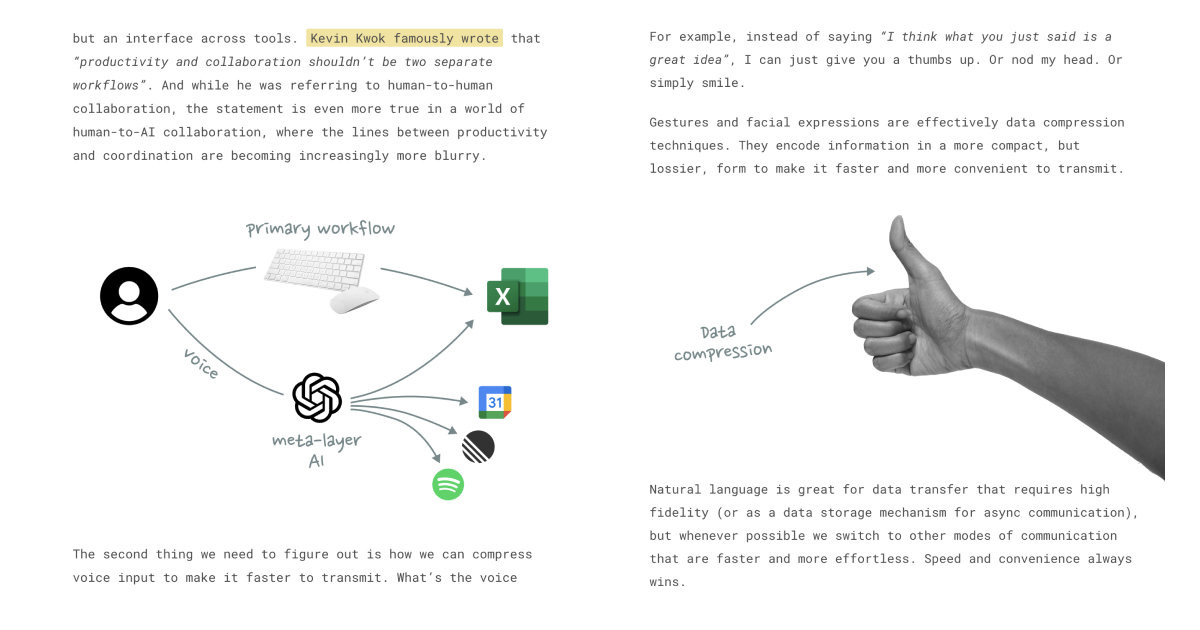
The case against conversational interfaces
Conversational interfaces are a bit of a meme. Every couple of years a shiny new AI development emerges and people in tech go "This is it! The next computing paradigm is here! We'll only use natural language going forward!". But then nothing actually changes and we continue using computers the way w
Why ChatGPT Keeps Interrupting You — Dr. Tom Shapland, LiveKit
A Liability Framework for AI Companions
<p><span>Every day tens of millions of people engage in online conversations. These virtual interactions range from casual chats about daily life to deeply pers

Learning by Chatting? Investigating the Impact of Generative AI on Information Seeking and Learning
Generative AI (GenAI) tools offer increasing opportunities for augmenting human cognitive tasks. Among these tasks, information seeking is being rapidly reshaped by GenAI tools, with potentially profound implications for learning and knowledge acquisition. To investigate these implications, we conducted a between-subjects field experiment in which participants pursued informal learning by seeking information through either ChatGPT or Google Search over a span of 8 days. Using a daily diary protocol, we gathered in-situ data on their information-seeking processes. Our findings show that participants in the ChatGPT group experienced diminished agency in their information-seeking processes, as they offloaded much of the information selection to AI, and consequently experienced greater meta-cognitive load arising from this reduced sense of control. We further highlight two sources of distortion in information access when using ChatGPT: biases in ChatGPT outputs, particularly towards providing solution-oriented artifacts over principled knowledge; and systematic shifts in users' information-seeking behaviors, whereby the conversational and socially-oriented interaction paradigm of current GenAI tools may inadvertently reduce exploration of the broader knowledge space. As a result, on average, participants in the ChatGPT group had worse learning outcomes than those using Google, especially for higher-order critical learning. Our work suggests inherent tensions between offloading information seeking to AI and meaningful learning, and provides broader implications for understanding AI's risks to human cognition.