The strength model of self-control purports to explain why brief cognitive response inhibition tasks impair subsequent isometric handgrip endurance. A…
It’s the Effort That Counts: The Effect of Self-Control on Goal Progress Perceptions
Does the amount of self-control consumers must exert to choose a goal-consistent action influence their perceptions of goal progress? For example, if you choose to go to the gym when one of your favorite TV shows is on (vs. when nothing interesting is on TV), do you perceive that you have made a differential amount of progress toward your goal, despite completing the exact same workout? In eight studies (N = 7,515), the authors demonstrate that consumers perceive that they have made more progress on their goals when more (vs. less) self-control is required to choose to complete an identical goal-consistent task. This is because when consumers exert more (vs. less) self-control to choose a goal-consistent task over the goal-inconsistent alternatives, they infer higher commitment to the goal. The higher inferred commitment, in turn, leads consumers to perceive that future goal pursuit will be easier. The authors demonstrate this effect across a variety of tasks and means of exerting self-control, as well as with both hypothetical scenarios and real-behavior studies.

Cognitive Offloading
If you have ever tilted your head to perceive a rotated image, or programmed a smartphone to remind you of an upcoming appointment, you have engaged in cognitive offloading: the use of physical action to alter the information processing requirements of a task so as to reduce cognitive demand. Despite the ubiquity of this type of behavior, it has only recently become the target of systematic investigation in and of itself. We review research from several domains that focuses on two main questions: (i) what mechanisms trigger cognitive offloading, and (ii) what are the cognitive consequences of this behavior? We offer a novel metacognitive framework that integrates results from diverse domains and suggests avenues for future research.
Mobile phone short video use negatively impacts attention functions: an EEG study
The pervasive nature of short-form video platforms has seamlessly integrated into daily routines, yet it is important to recognize their potential adverse effects on both physical and mental health. Prior research has identified a detrimental impact of excessive short-form video consumption on attentional behavior, but the underlying neural mechanisms remain unexplored. In the current study, we aimed to investigate the effect of short-form video use on attentional functions, measured through the Attention Network Test (ANT). A total of 48 participants, consisting of 35 females and 13 males, with a mean age of 21.8 years, were recruited. The Mobile Phone Short Video Addiction Tendency Questionnaire (MPSVATQ) and self-control scale (SCS) were conducted to assess the short video usage behavior and self-control ability. Electroencephalogram (EEG) data were recorded during the completion of the ANT task. The correlation analysis showed a significant negative relationship between MPSVATQ and theta power index reflecting the executive control in the prefrontal region (r = -0.395, p = 0.007), this result was not observed by using theta power index of the resting-state EEG data. Furthermore, a significant negative correlation was identified between MPSVATQ and SCS outcomes (r = -0.320, p = 0.026). These results suggest that an increased tendency towards mobile phone short video addiction could negatively impact self-control and diminish executive control within the realm of attentional functions. This study sheds light on the adverse consequences stemming from short video consumption and underscores the importance of developing interventions to mitigate short video addiction.

AI Assistance Reduces Persistence and Hurts Independent Performance
People often optimize for long-term goals in collaboration: A mentor or companion doesn't just answer questions, but also scaffolds learning, tracks progress, and prioritizes the other person's growth over immediate results. In contrast, current AI systems are fundamentally short-sighted collaborators - optimized for providing instant and complete responses, without ever saying no (unless for safety reasons). What are the consequences of this dynamic? Here, through a series of randomized controlled trials on human-AI interactions (N = 1,222), we provide causal evidence for two key consequences of AI assistance: reduced persistence and impairment of unassisted performance. Across a variety of tasks, including mathematical reasoning and reading comprehension, we find that although AI assistance improves performance in the short-term, people perform significantly worse without AI and are more likely to give up. Notably, these effects emerge after only brief interactions with AI (approximately 10 minutes). These findings are particularly concerning because persistence is foundational to skill acquisition and is one of the strongest predictors of long-term learning. We posit that persistence is reduced because AI conditions people to expect immediate answers, thereby denying them the experience of working through challenges on their own. These results suggest the need for AI model development to prioritize scaffolding long-term competence alongside immediate task completion.

AI Assistance Reduces Persistence and Hurts Independent Performance
People often optimize for long-term goals in collaboration: A mentor or companion doesn't just answer questions, but also scaffolds learning, tracks progress, and prioritizes the other person's growth over immediate results. In contrast, current AI systems are fundamentally short-sighted collaborators - optimized for providing instant and complete responses, without ever saying no (unless for safety reasons). What are the consequences of this dynamic? Here, through a series of randomized controlled trials on human-AI interactions (N = 1,222), we provide causal evidence for two key consequences of AI assistance: reduced persistence and impairment of unassisted performance. Across a variety of tasks, including mathematical reasoning and reading comprehension, we find that although AI assistance improves performance in the short-term, people perform significantly worse without AI and are more likely to give up. Notably, these effects emerge after only brief interactions with AI (approximately 10 minutes). These findings are particularly concerning because persistence is foundational to skill acquisition and is one of the strongest predictors of long-term learning. We posit that persistence is reduced because AI conditions people to expect immediate answers, thereby denying them the experience of working through challenges on their own. These results suggest the need for AI model development to prioritize scaffolding long-term competence alongside immediate task completion.
Opinion | There’s a Good Reason You Can’t Concentrate
Just as we changed our thinking around physical fitness, we need to change our attitude toward cognitive fitness.

Cognitive Surrender
Cognitive offloading is delegating to the AI and still owning the answer. Cognitive surrender is when the AI's output quietly becomes your output and there i...
Metacognitive Myopia: A Major Obstacle on the Way to Rationality
The notion of metacognitive myopia refers to a conspicuous weakness of the quality control of memory and reasoning processes. Although people are often remarkably sensitive even to complex samples of information when making evaluative judgments and decisions, their uncritical and naive tendency to take the validity of sampled information for granted constitutes a major obstacle to rational behavior. After illustrating this phenomenon with reference to prominent biases (base-rate neglect, misattribution, perseverance), we decompose metacognitive myopia into two distinct but intertwined functions, monitoring and control. We offer explanations for why effectively monitoring the biases resulting from information sampling in an uncertain world is so difficult and why the control function is severely restricted by the lack of volitional control over mental actions. Because of these and other difficulties, metacognitive myopia constitutes a major obstacle to rational judgment and decision making.
Laziness Does Not Exist
Psychological research is clear: when people procrastinate, there's usually a good reason

Generative artificial intelligence reliance and executive function attenuation: Behavioral evidence of cognitive offload in high-use adults.
Stimming and Emotional Regulation:
The Essential Role of Rhythmic Self-Modulation

How to stop procrastinating by using the Fogg Behavior Model - Part 2.
In the previous post we covered the B J Fogg model of behavior: Behavior = Motivation * Ability * Prompt
Resistance Is Futile. To Change Habits, Try Replacement Instead. (Published 2018)
An inconvenient bit of neuroscience: The more you try not to think about a bad habit, the harder it gets to resist. So think about something else.

Physical healing as a function of perceived time
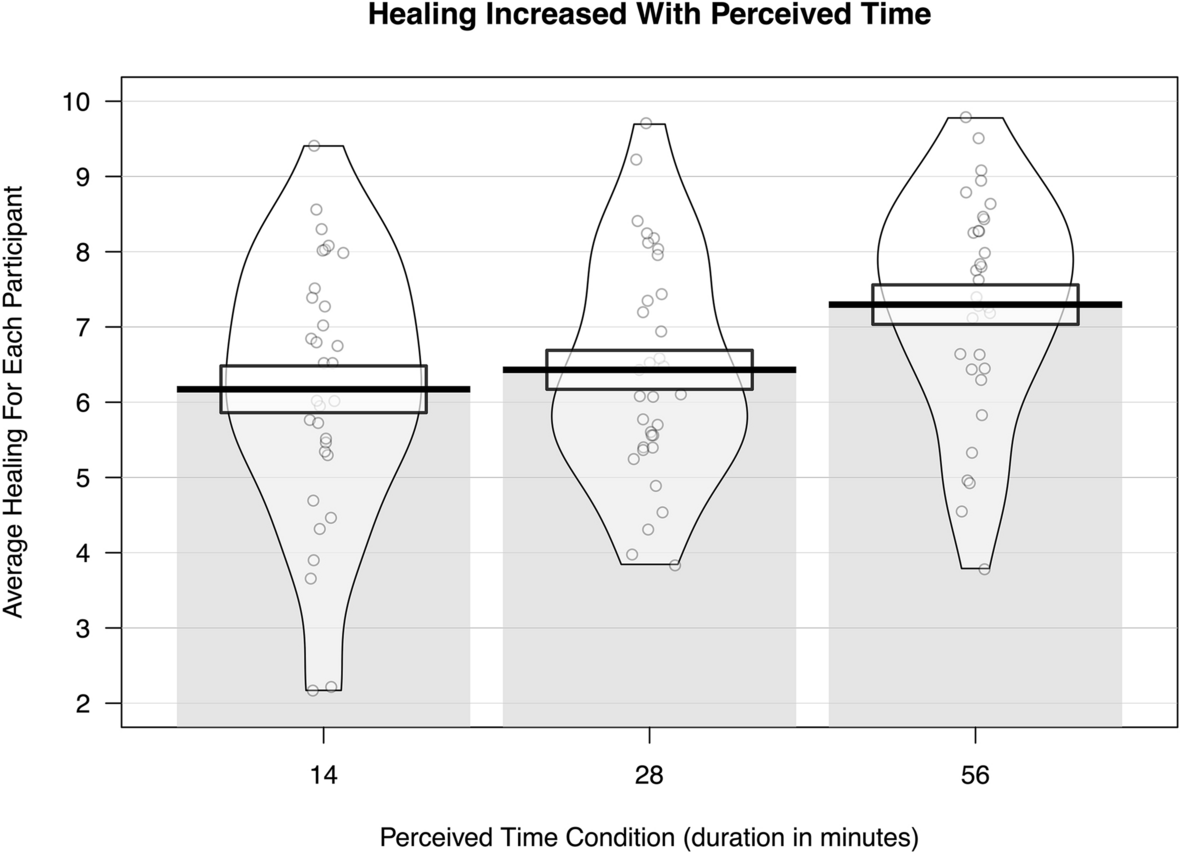
In this study we wounded study participants following a standardized procedure and manipulated perceived time to test whether perceived time affected the rate of healing. We measured the amount of healing that occurred across three conditions using a within-subjects design: Slow Time (half as fast as clock time), Normal Time (clock time), and Fast Time (twice as fast as clock time). Based on the theory of mind–body unity—which posits simultaneous and bidirectional influences of mind on body and body on mind—we hypothesized that wounds would heal faster or slower when perceived time was manipulated to be experienced as longer or shorter respectively. Although the actual elapsed time was 28 min in all three conditions, significantly more healing was observed in the Normal Time condition compared to the Slow Time condition, in the Fast Time condition compared to the Normal Time condition, and in the Fast Time condition compared to the Slow Time condition. These results support the hypothesis that the effect of time on physical healing is directly affected by one’s psychological experience of time, independent of the actual elapsed time.
Cognitive Load | Laws of UX
The amount of mental resources needed to understand and interact with an interface.

Deficient executive control in transformer attention
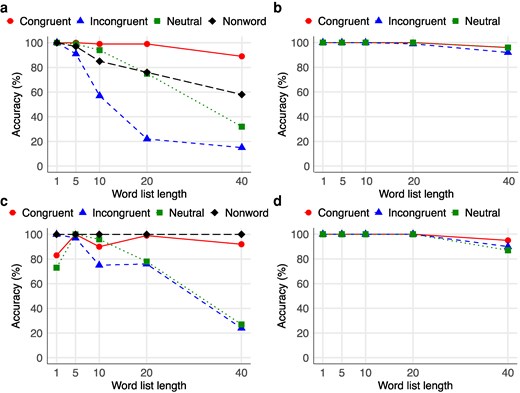
Abstract Although transformers in large language models (LLMs) effectively implement a self-attention mechanism that has revolutionized natural language processing, they lack an explicit architecture for the executive control of attention found in humans, which is essential for resolving conflicts and selecting relevant information in the presence of competing computations and is critical for adaptive behavior. To investigate the impact of this limitation in LLMs, we employed the classic color Stroop task, widely regarded as the gold standard, to test the executive control of attention in these models. Our results revealed a typical conflict effect of underperformance in terms of accuracy in the incongruent condition (e.g. naming the color of the word RED in blue) compared with the congruent condition (e.g. naming the color of the word RED in red), in short word lists, similar to human performance. However, as the length of the word lists increased, performance on the incongruent condition degraded toward near-total performance collapse, even as accuracy in the congruent condition remained excellent, and word reading (e.g. reading the word RED [in red] or RED [in blue], ignoring the color) was near-perfect. These findings demonstrate that transformer attention mechanisms are fundamentally limited in their capacity for conflict resolution across extended contexts, and a failure to up-regulate control adaptively under rising interference. We suggest that incorporating executive control mechanisms akin to those in biological attention is crucial for achieving artificial general intelligence.