Cognitive diversity, reflected in variations of language, perspective, and reasoning, is essential to creativity and collective intelligence. This diversity is rich and grounded in culture, history, and individual experience. Yet, as large language models (LLMs) become deeply embedded in people’s lives, they risk standardizing language and reasoning. We synthesize evidence across linguistics, psychology, cognitive science, and computer science to show how LLMs reflect and reinforce dominant styles while marginalizing alternative voices and reasoning strategies. We examine how their design and widespread use contribute to this effect by mirroring patterns in their training data and amplifying convergence as all people increasingly rely on the same models across contexts. Unchecked, this homogenization risks flattening the cognitive landscapes that drive collective intelligence and adaptability.
The homogenizing effect of large language models on human expression and thought
Cognitive diversity, reflected in variations of language, perspective, and reasoning, is essential to creativity and collective intelligence. This diversity is rich and grounded in culture, history, and individual experience. Yet, as large language models (LLMs) become deeply embedded in people’s lives, they risk standardizing language and reasoning. We synthesize evidence across linguistics, psychology, cognitive science, and computer science to show how LLMs reflect and reinforce dominant styles while marginalizing alternative voices and reasoning strategies. We examine how their design and widespread use contribute to this effect by mirroring patterns in their training data and amplifying convergence as all people increasingly rely on the same models across contexts. Unchecked, this homogenization risks flattening the cognitive landscapes that drive collective intelligence and adaptability.
The homogenizing effect of large language models on human expression and thought
AbstractCognitive diversity, reflected in variations of language, perspective, and reasoning, is essential to creativity and collective intelligence. This diversity is rich and grounded in culture, history, and individual experience. Yet, as large language models (LLMs) become deeply embedded in people's lives, they risk standardizing language and reasoning. We synthesize evidence across linguistics, psychology, cognitive science, and computer science to show how LLMs reflect and reinforce dominant styles while marginalizing alternative voices and reasoning strategies. We examine how their design and widespread use contribute to this effect by mirroring patterns in their training data and amplifying convergence as all people increasingly rely on the same models across contexts. Unchecked, this homogenization risks flattening the cognitive landscapes that drive collective intelligence and adaptability.
The shrinking landscape of linguistic diversity in the age of large language models
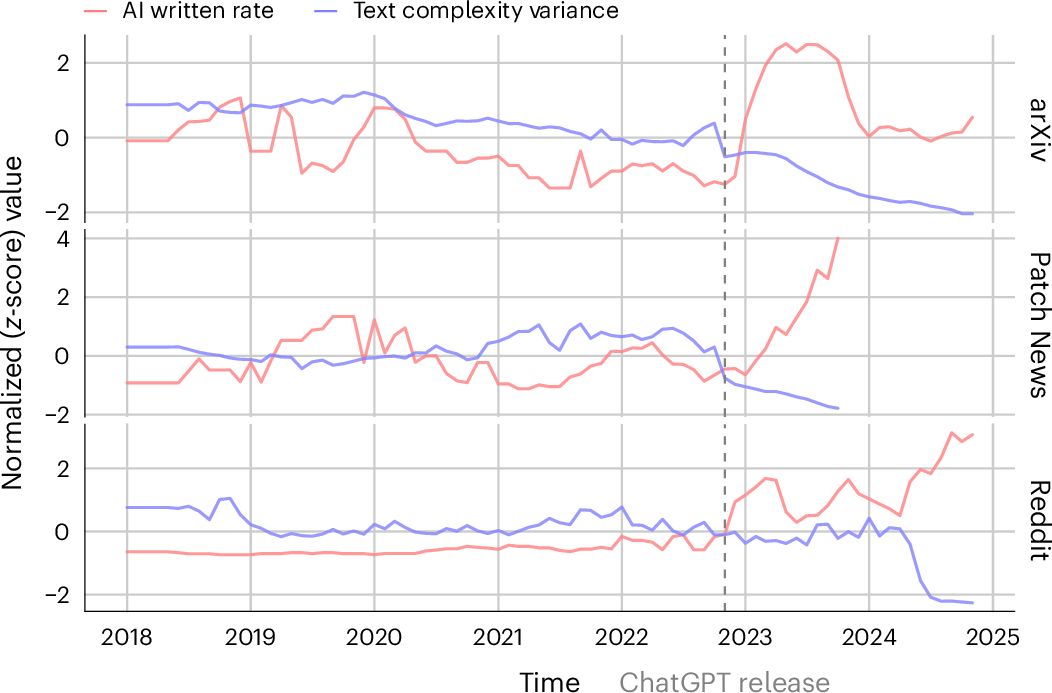
Language is far more than a communication tool; it encodes a wealth of information about a person’s identity, psychological state and social context, providing valuable insights for diverse fields including psychology, marketing and healthcare. Across three studies spanning seven datasets in different domains and over 880,000 texts, we show that the widespread adoption of large language models (LLMs) as writing assistants is linked to declines in linguistic diversity, interfering with the societal and psychological insights language provides. While core content is retained when LLMs polish and rewrite texts, LLMs also homogenize writing styles, reducing writing-complexity variance by a statistically significant 21–50% across datasets and models (P ≤ 0.05), and amplify patterns associated with dominant characteristics while suppressing others, emphasizing conformity over individuality. These trends hold across different LLMs, prompts and contexts, with potential implications for diagnostic processes, personalization efforts, hiring assessments and cultural preservation.
Artificial Hivemind: The Open-Ended Homogeneity of Language Models (and Beyond)
Language models (LMs) often struggle to generate diverse, human-like creative content, raising concerns about the long-term homogenization of human thought through repeated exposure to similar outputs. Yet scalable methods for evaluating LM output diversity remain limited, especially beyond narrow tasks such as random number or name generation, or beyond repeated sampling from a single model. We introduce Infinity-Chat, a large-scale dataset of 26K diverse, real-world, open-ended user queries that admit a wide range of plausible answers with no single ground truth. We introduce the first comprehensive taxonomy for characterizing the full spectrum of open-ended prompts posed to LMs, comprising 6 top-level categories (e.g., brainstorm & ideation) that further breaks down to 17 subcategories. Using Infinity-Chat, we present a large-scale study of mode collapse in LMs, revealing a pronounced Artificial Hivemind effect in open-ended generation of LMs, characterized by (1) intra-model repetition, where a single model consistently generates similar responses, and more so (2) inter-model homogeneity, where different models produce strikingly similar outputs. Infinity-Chat also includes 31,250 human annotations, across absolute ratings and pairwise preferences, with 25 independent human annotations per example. This enables studying collective and individual-specific human preferences in response to open-ended queries. Our findings show that LMs, reward models, and LM judges are less well calibrated to human ratings on model generations that elicit differing idiosyncratic annotator preferences, despite maintaining comparable overall quality. Overall, INFINITY-CHAT presents the first large-scale resource for systematically studying real-world open-ended queries to LMs, revealing critical insights to guide future research for mitigating long-term AI safety risks posed by the Artificial Hivemind.

Measuring Combinatorial Creativity in Large Language Models and Humans
Combinatorial creativity, the process of combining familiar ideas in unfamiliar ways, is one of the foremost engines of scientific, technological, and artistic progress. This work introduces Kombine, an LLM benchmark for combinatorial creativity tasking models to discover surprising, original, and useful associations, analogies, and blends between unrelated entities, and to use those analogies and blends to invent novel concepts by re-combining the parts of existing ones. In a large-scale study across 35 LLMs, we find that: (1) LLMs are 10-16 percentage points better at discovering associations and analogies than blends, and (2) exhibit an abstraction bottleneck on blending, in which even frontier LLMs struggle to find a shared abstraction between inputs and instantiate a coherent blended space. (3) LLMs also exhibit inventive homogeneity, in which one in five concepts invented for a given item reuses properties invented by another model. Moreover, (4) models are $14\times$ more likely to reuse other invented properties on blends than analogies, and (5) models from the same provider are $2.3\times$ more likely to reuse properties than those from different providers. Next, in a comparative study involving 75 humans on the same tasks, we find that (6) humans score below nearly every LLM on each task and (7) both humans and LLMs find blending most difficult, but association is easier than analogy for LLMs, while analogy is easier than association for humans. Lastly, (8) humans and LLMs access distinct regions of semantic space on each task, suggesting that combinatorial creativity could benefit from systematic human-AI collaboration to enhance conceptual diversity. In summary, we provide a framework to assess progress towards LLMs, AI systems, and human-AI collaborations more broadly, that can elicit combinatorial creativity in a setting relevant to scientific and technological innovation.
What and Whose Knowledge? Measuring Epistemic Diversity in Large Language Models
Large language models (LLMs) are increasingly used as primary knowledge sources, yet their epistemic diversity - defined as the diversity of real-world claims in their outputs - has never been measured. Low epistemic diversity would pose a risk of knowledge collapse as homogeneous LLMs mediate a shrinking in the range of accessible information over time. The dominant paradigm is that overall LLM diversity is low, but this is always with respect to a single point in time, with no reference baseline or consideration for variation across countries. We address this gap in knowledge by performing the first systematic study of epistemic diversity in LLMs across time and cultural context, testing 27 LLMs on 155 topics covering 12 countries, resulting in 1.7M responses and 70M individual claims. We find that epistemic diversity has increased substantially over the past three years, a positive counter to recent diversity pessimism. However, despite progress, we find that every system is less diverse than a search baseline. This gap is not uniform: RAG can improve diversity, while large models are counterintuitively less diverse than smaller ones. Moreover, LLM parametric knowledge systematically reflects English over local-language knowledge for country specific topics. Together, these results demonstrate that while progress on epistemic diversity is tangible, it is insufficient and unevenly distributed.
The Philosophy of Language Models
ABSTRACT The success of large language models (LLMs) across many domains of AI research has generated intense debate. Some attribute their impressive performance on complex tasks to human‐like linguistic and cognitive capacities, whereas others ascribe it to shallow pattern matching. These disputes stem from deep‐seated philosophical disagreements about the nature of language and cognition. We provide an opinionated survey of these disagreements across core topics in the philosophy of mind and language, including syntactic competence, compositionality, linguistic meaning, representation, attitudes, reasoning, agency, and consciousness. We contend that progress on these issues requires not only clarity about background philosophical commitments but also, in many cases, close engagement with emerging empirical evidence.

Reasoning Models Generate Societies of Thought
Large language models have achieved remarkable capabilities across domains, yet mechanisms underlying sophisticated reasoning remain elusive. Recent reasoning models outperform comparable instruction-tuned models on complex cognitive tasks, attributed to extended computation through longer chains of thought. Here we show that enhanced reasoning emerges not from extended computation alone, but from simulating multi-agent-like interactions -- a society of thought -- which enables diversification and debate among internal cognitive perspectives characterized by distinct personality traits and domain expertise. Through quantitative analysis and mechanistic interpretability methods applied to reasoning traces, we find that reasoning models like DeepSeek-R1 and QwQ-32B exhibit much greater perspective diversity than instruction-tuned models, activating broader conflict between heterogeneous personality- and expertise-related features during reasoning. This multi-agent structure manifests in conversational behaviors, including question-answering, perspective shifts, and the reconciliation of conflicting views, and in socio-emotional roles that characterize sharp back-and-forth conversations, together accounting for the accuracy advantage in reasoning tasks. Controlled reinforcement learning experiments reveal that base models increase conversational behaviors when rewarded solely for reasoning accuracy, and fine-tuning models with conversational scaffolding accelerates reasoning improvement over base models. These findings indicate that the social organization of thought enables effective exploration of solution spaces. We suggest that reasoning models establish a computational parallel to collective intelligence in human groups, where diversity enables superior problem-solving when systematically structured, which suggests new opportunities for agent organization to harness the wisdom of crowds.
Mapping the Mind of a Large Language Model
We have identified how millions of concepts are represented inside Claude Sonnet, one of our deployed large language models. This is the first ever detailed look inside a modern, production-grade large language model.

Out of One, Many: Using Language Models to Simulate Human Samples
We propose and explore the possibility that language models can be studied as effective proxies for specific human subpopulations in social science research. Practical and research applications of artificial intelligence tools have sometimes been limited by problematic biases (such as racism or sexism), which are often treated as uniform properties of the models. We show that the “algorithmic bias” within one such tool—the GPT-3 language model—is instead both fine-grained and demographically correlated, meaning that proper conditioning will cause it to accurately emulate response distributions from a wide variety of human subgroups. We term this property algorithmic fidelity and explore its extent in GPT-3. We create “silicon samples” by conditioning the model on thousands of sociodemographic backstories from real human participants in multiple large surveys conducted in the United States. We then compare the silicon and human samples to demonstrate that the information contained in GPT-3 goes far beyond surface similarity. It is nuanced, multifaceted, and reflects the complex interplay between ideas, attitudes, and sociocultural context that characterize human attitudes. We suggest that language models with sufficient algorithmic fidelity thus constitute a novel and powerful tool to advance understanding of humans and society across a variety of disciplines.
Covert Racism in AI: How Language Models Are Reinforcing Outdated Stereotypes | Stanford HAI
Despite advancements in AI, new research reveals that large language models continue to perpetuate harmful racial biases, particularly against speakers of African American English.

How large language models can reshape collective intelligence
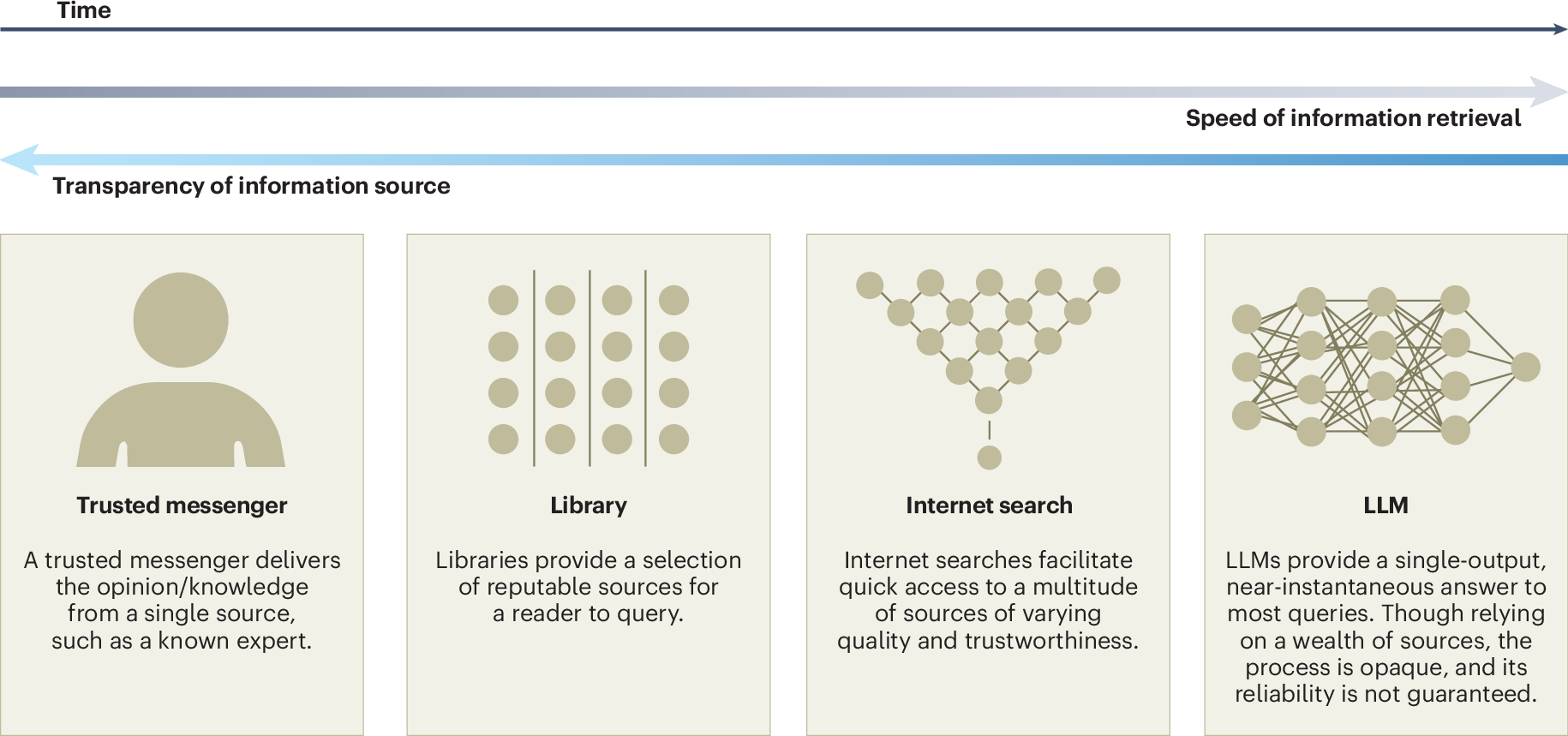
Collective intelligence underpins the success of groups, organizations, markets and societies. Through distributed cognition and coordination, collectives can achieve outcomes that exceed the capabilities of individuals—even experts—resulting in improved accuracy and novel capabilities. Often, collective intelligence is supported by information technology, such as online prediction markets that elicit the ‘wisdom of crowds’, online forums that structure collective deliberation or digital platforms that crowdsource knowledge from the public. Large language models, however, are transforming how information is aggregated, accessed and transmitted online. Here we focus on the unique opportunities and challenges this transformation poses for collective intelligence. We bring together interdisciplinary perspectives from industry and academia to identify potential benefits, risks, policy-relevant considerations and open research questions, culminating in a call for a closer examination of how large language models affect humans’ ability to collectively tackle complex problems.
How large language models can reshape collective intelligence
Collective intelligence underpins the success of groups, organizations, markets and societies. Through distributed cognition and coordination, collectives can achieve outcomes that exceed the capabilities of individuals—even experts—resulting in improved accuracy and novel capabilities. Often, collective intelligence is supported by information technology, such as online prediction markets that elicit the ‘wisdom of crowds’, online forums that structure collective deliberation or digital platforms that crowdsource knowledge from the public. Large language models, however, are transforming how information is aggregated, accessed and transmitted online. Here we focus on the unique opportunities and challenges this transformation poses for collective intelligence. We bring together interdisciplinary perspectives from industry and academia to identify potential benefits, risks, policy-relevant considerations and open research questions, culminating in a call for a closer examination of how large language models affect humans’ ability to collectively tackle complex problems.
Can LLMs Faithfully Enact Superforecaster Personas?
Superforecasters are people that make forecasts that are statistically better than the average person; they offer an interesting testbed for persona modelling. In this preliminary work, we investigate whether large language models (LLMs) can faithfully model superforecaster-like personas making similar forecasts and generating similar rationales behind the forecasts. When we compare LLM-generated responses to the ground truth responses of superforecasters, we find that few-shot prompting generates numerically closer forecasts than instruction-prompting baselines. We also measure the similarity of generated and real rationales, finding that the rationales generated based on examples are judged more similar to those of superforecasters than instruction-prompting baselines. However, an analysis of the reasoning patterns in the rationales shows significant differences between human and LLM forecasters, pointing to a gap between stylistic imitation and deep reasoning similarity. These preliminary results raise several interesting questions about how getting superforecaster-like behaviour from LLMs actually works, and open new avenues to explore for improving the forecasting behaviour of LLMs.
The Hitchhiker's Guide to Monoculture
Large language models (LLMs) often produce homogeneous outputs, raising concerns that AI coding assistants may lead to convergence in the software artifacts that developers create. Whether this occurs in practice is unclear because developers interactively prompt, evaluate, modify, and reject model outputs, and because outputs vary with prompt and repository context. I examine code homogenization using Kaggle contest submissions from 2019 to mid-2026. I first document widespread convergence toward the random seed value 42, consistent with LLMs reinforcing a longstanding convention in programming culture. I then study homogenization more broadly, at two levels of aggregation and abstraction. At the submission level, I measure the average pairwise similarity of submissions within contests. At the contest level, I measure the conceptual span of submitted code, motivating distinct measures for each: TF-IDF representations, which capture surface syntax, and Voyage 3 code embeddings, which capture code intent and semantics. The results demonstrate substantial syntactic homogenization at both the individual and collective levels: individual submissions have become more alike in literal syntax and code structure, while the latent dimensionality of syntactic variation has narrowed. In contrast, I find little evidence of semantic homogenization, individually and collectively. Average semantic distance remains essentially flat, and the contest-level latent dimensional span of semantic approaches remains stable. These findings suggest that AI coding assistants are certainly standardizing implementation details, yet they have not yet produced evidence of homogenization in the approaches and problem-solving strategies coders employ.
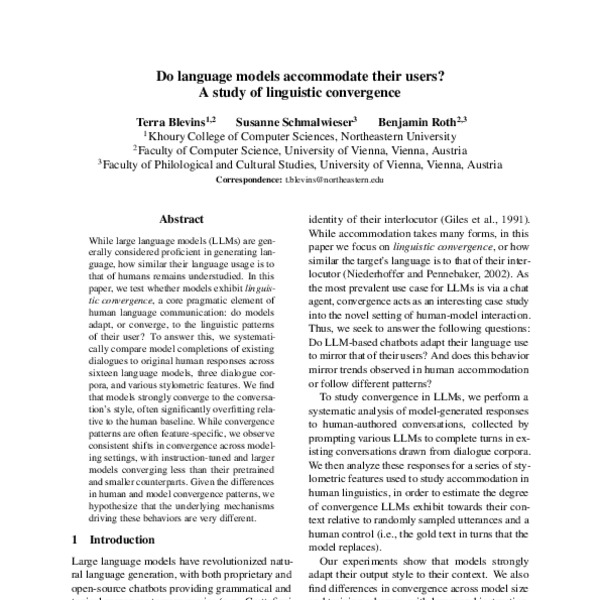
Do language models accommodate their users? A study of linguistic convergence
While large language models (LLMs) are generally considered proficient in generating language, how similar their language usage is to that of humans remains understudied. In this paper, we test whether models exhibit linguistic convergence, a core pragmatic element of human language communication: do models adapt, or converge, to the linguistic patterns of their user? To answer this, we systematically compare model completions of existing dialogues to original human responses across sixteen language models, three dialogue corpora, and various stylometric features. We find that models strongly converge to the conversation's style, often significantly overfitting relative to the human baseline. While convergence patterns are often feature-specific, we observe consistent shifts in convergence across modeling settings, with instruction-tuned and larger models converging less than their pretrained and smaller counterparts. Given the differences in human and model convergence patterns, we hypothesize that the underlying mechanisms driving these behaviors are very different.