

Recent research suggests that the method of making a payment can influence the willingness to pay and consumption behavior. In this manuscript, we argue that payment mechanisms differ from each other along the dimensions of transparency, and that the degree of transparency correlates positively with the pain of paying using the mechanism, and negatively with consumption and spending. We replicate previous experimental results using quasi-experiments from the field, and find that the lower the payment transparency, the greater is the consumption. However, this effect is weak for products whose consumption rates are inflexible.
Do Payment Mechanisms Change the Way Consumers Perceive Products?
Abstract. Do payment mechanisms change the way consumers perceive products? We argue that consumers for whom credit cards (cash) have been primed focus mor
Improving Customer Compatibility with Tradeoff Transparency
Through a large-scale field experiment with 393,036 customers considering opening a credit card account with a nationwide retail bank, we investigate how providing transparency into an offering’s tradeoffs affects subsequent rates of customer acquisition and long-run engagement. Although we find tradeoff transparency to have an insignificant effect on acquisition rates, customers who were shown each offering’s tradeoffs selected different products than those who were not. Moreover, prospective customers who experienced transparency and subsequently chose to open an account went on to exhibit higher-quality service relationships over time. Monthly spending was 9.9% higher and cancellation rates were 20.5% lower among those who experienced transparency into each offering’s tradeoffs. Increased product use and retention accrued disproportionately to customers with prior category experience: more-experienced customers who were provided transparency spent 19.2% more on a monthly basis and were 33.7% less likely to defect after nine months. Importantly, we find that these gains in engagement and retention do not come at the expense of customers’ financial well-being: the probability of making late payments was reduced among customers who experienced transparency. We further find that the positive effects of tradeoff transparency on engagement and retention were attenuated in the presence of a promotion that provided financial incentives to choose particular offerings. Taken together, these results suggest that providing transparency into an offering’s tradeoffs may be an effective strategy for informing customer choices, leading to better outcomes for customers and firms alike. This paper was accepted by Vishal Gaur, operations management. Funding: Funding for this research, apart from the costs Commonwealth Bank of Australia internally incurred to support the experiment, was provided by Harvard Business School. R. W. Buell has received compensation from Commonwealth Bank of Australia in the past for executive education teaching. Supplemental Material: The online appendix and data files are available at https://doi.org/10.1287/mnsc.2024.4985 .

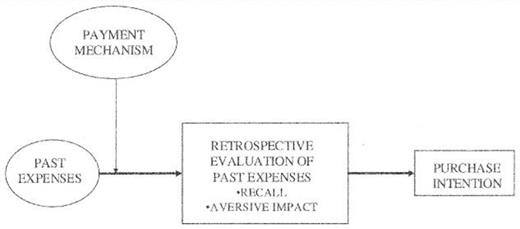
Effects of Payment Mechanism on Spending Behavior: The Role of Rehearsal and Immediacy of Payments
Abstract. Past expenses have been shown to influence future spending behavior by depleting available budgets. However, a prerequisite for this relationship
Unwillingness to pay for privacy: A field experiment
We measure willingness to pay for privacy in a field experiment. Participants bought at most one DVD from one of two competing online stores. One store consistently required more sensitive personal data than the other, but otherwise the stores were identical. In one treatment, DVDs were one Euro cheaper at the store requesting more personal information, and almost all buyers chose the cheaper store. Surprisingly, in the second treatment when prices were identical, participants bought from both shops equally often.
Always Leave Home Without It: A Further Investigation of the Credit-Card Effect on Willingness to Pay
In studies involving genuine transactions of potentially high value we show that willingness-to-pay can be increased when customers are instructed to use a credit card rather than cash. The effect may be large (up to 100%) and it appears unlikely that it arises due solely to liquidity constraints. In addition to demonstrating the effect, we provide a methodology for detecting it, and our findings suggest a source of variance to test alternative explanations.
Payment Depreciation: the Behavioral Effects of Temporally Separating Payments From Consumption
Abstract. Research suggests that individuals mentally track the costs and benefits of a consumer transaction for the purpose of reconciling those costs and
“Repayment-by-Purchase” Increases Consumer Debt Repayment
This article tests the effect of a novel credit card payment format—repayment-by-purchase—on consumers’ payments toward credit card debt. In contrast to typical balance repayment, where consumers make repayments relative to a total amount owed, repayment-by-purchase prompts consumers to select items (e.g., a Starbucks coffee) or categories of purchase (e.g., restaurant and café purchases) and to make payments toward their related debt. A field experiment first suggests that customers who opted into repayment-by-purchase paid 12.18% more toward their statement balance than a control group. Subsequently, five lab experiments show that consumers repaying-by-purchase increase repayment by an average of 22.47% over typical balance repayment. Process evidence suggests that these differences may be driven by repayment-by-purchase's power to increase purchase salience, which in turns increases perceptions of progress toward reducing debt. Consistent with this theory, the effect of repayment-by-purchase on bill repayment emerges regardless of whether consumers repay durable versus nondurable goods, and for specific items or categories of purchases, as long as the bill uses labels that are concrete enough to raise past purchase salience.

Explaining adoption and use of payment instruments by US consumers
Motivated by recent policy intervention into payments markets, we develop and estimate a structural model of adoption and use of payment instruments by U.S. consumers. Our structural model differentiates between the adoption and use of payment instruments. We evaluate substitution among payment instruments and welfare implications. Cash is the most significant substitute to debit cards in retail settings, whereas checks are the most significant in bill‐pay settings. Furthermore, low income consumers lose proportionally more than high income consumers when debit cards become more expensive, whereas the reverse is true when credit cards do.

Differences in Consumer Purchase Behavior by Credit Card Payment System
Abstract. A conceptualization of the relationships between alternative payment systems and various environmental and behavioral variables, which may serve
Rewards and Misperceived Spending: Experimental Evidence from Credit Cards
Using proprietary data, a survey, and an experiment with a major bank in China, this paper studies how credit card rewards affect perceived and actual consumer

Monopoly money: The effect of payment coupling and form on spending behavior.
Cut me some slack! How perceptions of financial slack influence pain of payment
Abstract Consumers often experience pain of payment, a tug of negative affect that holds back their spending. While the literature has long viewed pain of payment as self‐regulatory in nature, it has left the dynamics of self‐regulation that lead to the pain of paying largely unaddressed. In self‐regulation, affect arises when people move away from a goal they hold. Thus, understanding the specific goals that people consider when making a payment can help us better predict when pain of payment will arise. We propose that people have a goal to maintain financial slack, and that violating this goal contributes to pain of payment. Thus, people experience more pain of payment when the goal to maintain financial slack is stronger or when it is particularly salient that a purchase entails losing financial slack. Critically, subjective changes in financial slack are not equivalent to objective changes in wealth, altering pain of payment for economically equivalent trades. This research contributes to the existing literature by identifying a novel antecedent to the pain of payment. It additionally expands our understanding of people's preferences between payment systems. Finally, it offers guidance to practitioners who wish to minimize pain of payment among their consumers.

What else can your payment card do? Multifunctionality of payment modes can reduce payment transparency
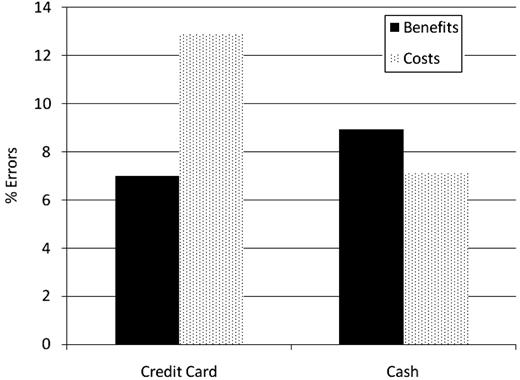
Payment modes (e.g., cash vs. credit card) vary in the transparency of the outflow of money. Smartcards (multifunctional cards), which bundle payment with non-payment functions (e.g., loyalty programs, identification, and other information functions), have become an increasingly popular payment mode. This shift toward multifunctionality in payment modes is assumed to reduce payment transparency and consequently to decrease consumers’ recall accuracy of past expenditures. We employ a field study to examine recall accuracy for recent purchases with cash, a single-function card, and a multifunctional card. We find that recall accuracy is lower when using a single- or a multifunction card than cash. We also find that it is not the multifunctionality of the card that results in a higher recall error but the individual usage patterns: A higher usage frequency of the non-payment functions results in a higher recall error.
Small Probabilistic Discounts Stimulate Spending: Pain of Paying in Price Promotions
AbstractWe find that small probabilistic price promotions effectively stimulate demand, even more so than comparable fixed price promotions (e.g., “1% chance it’s free” vs. “1% off,” respectively), because they more effectively reduce the pain of paying. In three field experiments at a grocer, we exogenously and endogenously manipulated the salience of pain of paying via elicitation timing (e.g., at entrance or checkout) and payment method (i.e., cash/debit cards or credit cards). This modulated the attractiveness of probabilistic discounts and their ability to stimulate spending. Shoppers paying with cash or debit cards, for example, spent 54% more if they received a 1% probabilistic discount than a 1% fixed discount (experiment 2). A fourth experiment showed that consumers’ sensitivity to pain of paying modulates the greater comparative efficacy of small probabilistic than fixed discounts. More broadly, the results elucidate a novel affective route through which price promotions stimulate demand––pain of paying.

A Mega-Replication of the Effect of Cash Versus Card Payment on Pain of Paying: Magnitude, Behavioral Outcomes, and Moderators
Abstract We revisit the widely accepted finding that paying with cash is more painful than paying with card by conducting the first systematic mega-replication (including 13 large-scale preregistered replications; a total of 32,371 participants, 65 products, and 57 price points ranging from $1.09 to $400). The aggregate evidence reveals four insights: (1) leveraging a broad set of established paradigms, we replicate the finding that paying with cash is more psychologically painful than paying with card, even among today’s consumers who own multiple cards, digital wallets, and virtual currencies; (2) comparing two outcome variables—amount spent and willingness-to-pay (WTP), we find a more reliable and larger overall direct effect of payment method on amount spent than on WTP; (3) these direct effects of payment method on outcome variables are mediated by pain of paying; (4) the mode-of-payment effect on pain of paying (and thereby on outcome variables) is moderated by individual differences, particularly the relative frequency of using cash versus card. We outline actionable guidance and future directions for researchers and practitioners interested in examining mode-of-payment effects, and discuss the value of and suitable approaches for future theory-driven large-scale replications.

Minimum Payments Alter Debt Repayment Strategies Across Multiple Cards
U.S. households currently hold $770 billion in credit card debt, often managing repayments across multiple accounts. The authors investigate how minimum payment requirements (i.e., the requirement to allocate at least some money to each account with a balance) alter consumers’ allocation strategies across multiple accounts. Across four experiments, they find that minimum payment requirements cause consumers to increase dispersion (i.e., spread their repayments more evenly) across accounts. The authors term this change in strategy “the dispersion effect of minimum payments” and provide evidence that it can be costly for consumers. They find that the effect is partially driven by the tendency for consumers to interpret minimum payment requirements as recommendations to pay more than the minimum amount. While the presence of the minimum payment requirement is unlikely to change, the authors propose that marketers and policy makers can influence the effects of minimum payments on dispersion by altering the way that information is displayed to consumers. Specifically, they investigate five distinct information displays and find that choice of display can either exaggerate or minimize dispersion and corresponding costs. They discuss implications for consumers, policy makers, and firms, with a particular focus on ways to improve consumer financial well-being.