

Tightwads and spendthrifts: An interdisciplinary review
Consumers rely on a “pain of paying” to help deter their spending. While this is beneficial for some consumers, others experience levels of pain that create problems. “Tightwads” experience too much pain when considering spending and therefore spend less than they would ideally like to spend. By contrast, “spendthrifts” experience too little pain and therefore spend more than they would ideally like to spend. Neither are happy with how they handle money. In the decade since the tightwad‐spendthrift construct was introduced, much has been learned about what it is and is not (e.g., frugality, greed), what contextual factors are likely to reduce its importance, how it plays a role within romantic relationships, and when it might first emerge in childhood. This paper reviews the wide range of interdisciplinary research relevant to the tightwad‐spendthrift construct and proposes several directions for new research.

Knowing When to Spend: Unintended Financial Consequences of Earmarking to Encourage Savings
Maintaining savings is an important financial goal. Yet there are times when savings should be spent, such as when people face unavoidable costs, and spending their savings allows them to avoid high interest rate debt. Existing behavioral research has focused on consumer decisions between savings and discretionary spending and has proposed interventions to promote savings in these contexts. However, when spending is not discretionary, such interventions could risk exacerbating a pattern found in economic research in which people borrow high interest rate debt while maintaining savings that earn low levels of interest. To examine how mental accounting interacts with considerations of personal responsibility and guilt to contribute to this pattern, this article explores whether people spend their savings when they need money most: during emergencies. Six studies reveal that people's tendency to preserve savings by borrowing from a high interest rate credit option varies as a function of the savings’ intended use. Paradoxically, people are most likely to turn to high interest rate credit with the belief that doing so is the responsible option.

Tightwads and Spendthrifts
Abstract. Consumers often behave differently than they would ideally like to behave. We propose that an anticipatory pain of paying drives “tightwads” to s
Savers and Borrowers: Strategies of Personal Financial Management
Saving and borrowing are traditionally and stereotypically thought of as opposites, with different motivations and consequences. Through a questionnaire survey of economic position, practices, and attitudes, the present paper examined the relation between saving and borrowing among British respondents. While saving and borrowing were found to be determined by different economic, social, and psychological factors, they did not describe mutually exclusive strategies of financial management. Saving regularly could also be distinguished from having savings. In all, six strategies were identified (combining saving or not saving, borrowing or not borrowing, and having or not having savings). Each combination was found to have specific discriminating characteristics. Savers and borrowers were found to have different psychological motivations, seeing debt either as a failure or as a normal part of everyday life. Many people retained savings or carried on saving at the same time as having debts: they were found to feel more in control and optimistic about their financial position than those who had debts but no savings. A further group had neither debts nor savings: they adopted an inflexible approach to financial management. Each group of people with different financial management strategies was illustrated by a case study.
Earmarking and Partitioning: Increasing Saving by Low-Income Households
This research examines the effects of earmarking money on savings by low-income consumers. In particular, the authors test two interventions that are designed to enhance the effects of earmarking: (1) using a visual reminder of the savings goal and (2) dividing the earmarked money into two parts. Consistent with prior research suggesting that partitioning increases self-control, people save more when earmarked money is partitioned into two accounts than when it is pooled into one account. In addition, the presence of the visual reminder increases the savings rate. The authors conclude with implications for consumer welfare and directions for further research.
Malleable Mental Accounting: The Effect of Flexibility on the Justification of Attractive Spending and Consumption Decisions
Mental accounts are often characterized as self‐control devices that consumers employ to prevent excess spending and consumption. However, under certain conditions of ambiguity, the mental accounting process is malleable; that is, consumers have flexibility in assigning expenses to different mental accounts. We demonstrate how consumers flexibly classify expenses, or construct accounts, to justify spending. An expense that can be assigned to more than one account (i.e., an ambiguous expense) is more likely to be incurred than an unambiguous expense that is constrained either by existing budgets or by previously constructed accounts. We explore the justification processes that underlie these results and their implications for mental accounts as self‐control devices.

Consumer Financial Decision Making: Where We’ve Been and Where We’re Going
When making purchasing decisions, consumers consider their available budget and determine what payment method they will use as well as how they will finance the purchase. Consumers must also plan for long-term consumption by considering short- and long-term savings objectives, taking into account how they will invest money saved, as well as how they will borrow needed money and repay outstanding loans. This issue of the Journal of Association of Consumer Research explores financial decision making, which we define as the accumulation and use of resources across time, as reflected by consumers’ behavior and choices.

Co-holding behaviour: unlocking the puzzle
This article seeks to explain why households decide to simultaneously hold both credit and savings products. Beyond the arguments of ignorance or behavioural biases commonly used in the literature,...

The Exception Is the Rule: Underestimating and Overspending on Exceptional Expenses
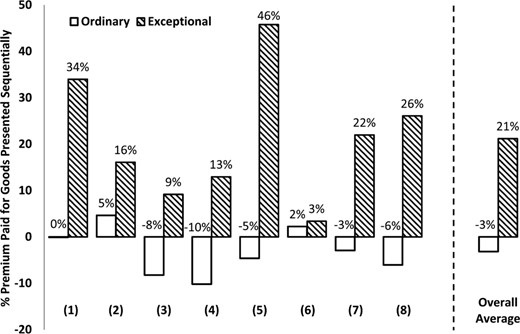
Abstract Purchases fall along a continuum from ordinary (common or frequent) to exceptional (unusual or infrequent), with many of the largest expenses (e.g., electronics, celebrations) being the most exceptional. Across seven studies, we show that, while people are fairly adept at budgeting and predicting how much they will spend on ordinary items, they both underestimate their spending on exceptional purchases overall and overspend on each individual purchase. Based on the principles of mental accounting and choice bracketing, we show that this discrepancy arises in part because consumers categorize exceptional expenses too narrowly, construing each as a unique occurrence and consequently overspending across a series of discretely exceptional expenses. We conclude by proposing an intervention that diminishes this tendency by helping consumers consider their spending on exceptional items as part of a larger set of purchases.
Temporal Reframing and Participation in a Savings Program: A Field Experiment
This study explores whether framing savings in more or less granular formats can increase sign-ups for a recurring deposit program in a FinTech environment. , A growing number of American workers are now freelancers and thus, responsible for their own retirement savings, yet they face psychological hurdles that hamper them from saving enough money for the long term. Although prior theory-derived interventions have been successful in addressing some of these obstacles, encouraging participation in saving programs is a challenging endeavor for policy makers and consumers alike. In a field setting, we test whether framing savings in more or less granular formats (for example, saving daily versus monthly) can encourage continued saving behavior through increasing the take up of a recurring deposit program. Among thousands of new users of a financial technology app, we find that framing deposits in daily amounts as opposed to monthly amounts quadruples the number of consumers who enroll. Furthermore, framing deposits in more granular terms reduced the participation gap between lower- and higher-income consumers: three times as many consumers in the highest rather than lowest income bracket participated in the program when it was framed as a $150 monthly deposit, but this difference in participation was eliminated when deposits were framed as $5 per day.

Consumers’ Mental Representation of Expenditures: Implications for Spending and Saving Decisions
People’s mental representation of expenditures is crucial to how they budget. We propose that much like how people represent natural kinds (e.g., animals and pl

Consumers’ Mental Representation of Expenditures: Implications for Spending and Savings Decisions
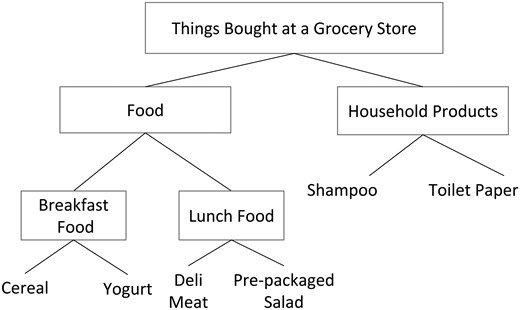
Abstract People’s mental representation of expenditures is crucial to their budgeting. This article proposes that much like how they represent natural kinds (e.g., animals and plants), people represent expenditures in a hierarchical taxonomy. Seven studies, supported by six norming studies and three pilots, revealed that expenditures are represented hierarchically. We first recover people’s mental representations using a successive pile-sort method that asks people to form hierarchies of categories with common expenditures (e.g., rent, dining out, etc.). The pile-sort reveals consensus in people’s representations of expenditures and that these representations are relatively stable over time. Further, people’s adjustment in their spending behavior can be predicted by the distance between items in their representation. Specifically, when people overspent on an item, they spontaneously adjust spending more on taxonomically closer items. We examine this spontaneous adjustment behavior using both laboratory studies and field data with 6.5 million grocery shopping trips over 12 years. The findings highlight the connection between mental representation and consumer behavior, and they emphasize the importance of studying concepts and categories in the context of consumption.
Cash versus Debit Card: The Role of Budget Control
Due to the financial crisis, an increasing number of households face financial problems. This may lead to an increasing need for monitoring spending and budgets. We demonstrate that both cash and the debit card are perceived as helpful in this respect. We show that, on average, consumers responsible for financial decision making within a household find cash and the debit card equally helpful for monitoring their household finances. Individuals differ in major respects, however. In particular, low earners and the liquidity‐constrained prefer cash as a budgeting tool. Finally, we present evidence that at an aggregated level, such preferences strongly affect consumer payment behavior. These findings suggest that the substitution of cash by cards may slow down because of the financial crisis.

What Would You Do with $500? Spending Responses to Gains, Losses, News, and Loans
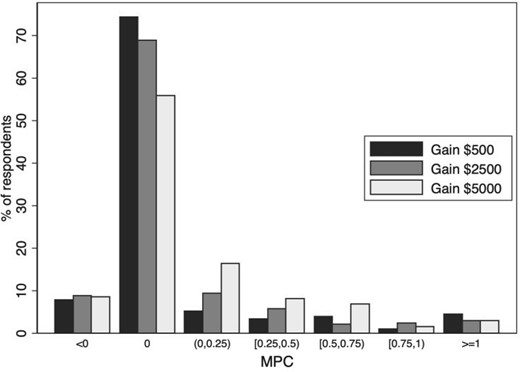
Abstract We use survey questions about spending in hypothetical scenarios to investigate features of propensities to consume that are useful for distinguishing between consumption theories. We find that (1) responses to unanticipated gains are vastly heterogeneous (either zero or substantially positive); (2) responses increase in the size of the gain, driven by the extensive margin of spending adjustments; (3) responses to losses are much larger and more widespread than responses to gains; and (4) even those with large responses to gains do not respond to news about future gains. These four findings suggest that limited access to disposable resources, and frictions in adjusting consumption, are important determinants of consumption behaviour. We also find that (5) households do not respond to the offer of a one-year interest-free loan, suggesting that this is not a consequence of short-term credit constraints; and (6) people do cut spending in response to news about future losses, suggesting that neither is this a consequence of myopia. A calibrated precautionary savings model with utility costs of changing consumption, and a sufficient fraction of low-wealth households, can account for these features of propensities to consume on both the extensive and intensive margins.
In-Store Spending Dynamics: How Budgets Invert Relative-Spending Patterns
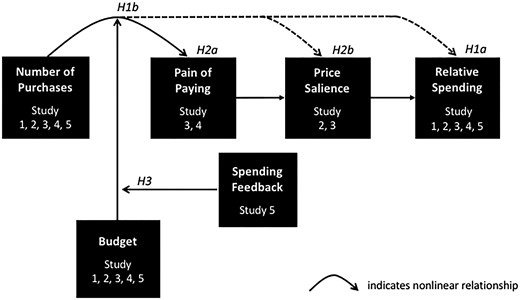
Abstract The authors conduct four controlled lab experiments and one field study in a brick-and-mortar grocery store to demonstrate that relative spending—the price of the purchased item relative to the mean price of the product category—evolves nonlinearly and distinctly for budget and nonbudget shoppers. While the relative spending of budget shoppers evolves in a concave manner, the relative spending of nonbudget shoppers evolves inversely in a convex manner. Thus, budget (nonbudget) shoppers spend relatively more (less) in the middle than at the beginning and toward the end of their shopping trip. Mediation analyses confirm that the pain of paying experienced while shopping drives price salience, which then drives relative spending. Moreover, manipulating shoppers’ pain of paying, by altering the opportunity costs associated with their spending or drawing shoppers’ attention to their spending via real-time spending feedback, is shown to influence these spending patterns. The research offers theoretical contributions to the in-store decision-making, budgeting, and pain-of-paying literature and has important implications for marketing and promotion strategies in retail and mobile technology environments, as it suggests when a shopper may be more sensitive to price-related factors.
Misunderstanding Savings Growth: Implications for Retirement Savings Behavior
People systematically underestimate exponential growth. This article illustrates this phenomenon, its implications, and some potential interventions in the context of saving for retirement, where savings grow exponentially over long periods of time. Experiment 1 shows that a majority of participants expect savings over 40 years to grow linearly rather than exponentially, leading them to grossly underestimate their account balance at retirement. Experiment 2 demonstrates that this misunderstanding leads to underestimates of the cost of waiting to save, which makes putting off saving more attractive than it should be. Finally, Experiments 3–5 show that highlighting the exponential growth of savings motivates both college students and employees to save more for retirement. Making clear to employees the exponential growth of savings before they make crucial decisions about how much to save may be a simple and effective means of increasing retirement savings.