

Computer-Mediated Communication, Social Media, and Mental Health: A Conceptual and Empirical Meta-Review
Computer-mediated communication (CMC), and specifically social media, may affect the mental health (MH) and well-being of its users, for better or worse. Research on this topic has accumulated rapidly, accompanied by controversial public debate and numerous systematic reviews and meta-analyses. Yet, a higher-level integration of the multiple disparate conceptual and operational approaches to CMC and MH and individual review findings is desperately needed. To this end, we first develop two organizing frameworks that systematize conceptual and operational approaches to CMC and MH. Based on these frameworks, we integrate the literature through a meta-review of 34 reviews and a content analysis of 594 publications. Meta-analytic evidence, overall, suggests a small negative association between social media use and MH. However, effects are complex and depend on the CMC and MH indicators investigated. Based on our conceptual review and the evidence synthesis, we devise an agenda for future research in this interdisciplinary field.

A Statistical Interrogation of “The Case for Causality, Part 1” by Rausch and Haidt – Matthew B. Jané
I don’t know anything about the literature on social media and mental health so my focus on this post is to interrogate the statistical approach taken by the article written by Zach Rausch and Jonathon Haidt (link here) and to some extent the original meta-analysis by Ferguson.

The Impact of Social Media on Adolescent Mental Health: A Meta-Analysis
Introduction: The proliferation of social media has raised significant concerns about its potential effects on the mental health of adolescents. This meta-analysis aims to provide a comprehensive assessment of the existing research on the relationship between social media use and various mental health outcomes in adolescents. Methods: A systematic search of electronic databases (PubMed, PsycINFO, Scopus, Web of Science) from January 2018 to June 2024 was conducted to identify relevant studies. Studies were included if they examined the association between social media use and mental health outcomes in adolescents (aged 10-19) and reported quantitative data. Effect sizes were calculated and pooled using random-effects models. Results: A total of 45 studies (N = 153,285 adolescents) met the inclusion criteria. The meta-analysis revealed small but significant associations between increased social media use and increased depressive symptoms (r = 0.12), anxiety (r = 0.10), and loneliness (r = 0.15). Furthermore, a significant negative association was found between social media use and self-esteem (r = -0.08). The analysis also identified several moderators of these effects, including gender, age, and type of social media platform. Conclusion: The findings of this meta-analysis suggest that increased social media use is associated with a range of negative mental health outcomes in adolescents. However, the effects are small, and the relationship is complex, with several moderating factors. Further research is needed to understand the mechanisms underlying these associations and to develop effective interventions to mitigate the potential negative effects of social media on adolescent mental health.
Social media and youth mental health: Simple narratives produce biased interpretations.
Experimentally manipulating social media abstinence: results of a four-week diary study
Social media use has a weak, negative association with well-being in cross-sectional and longitudinal research, but this association in experimental studies is mixed. This investigation explores wh...

The great rewiring: is social media really behind an epidemic of teenage mental illness?
The evidence is equivocal on whether screen time is to blame for rising levels of teen depression and anxiety — and rising hysteria could distract us from tackling the real causes.

The great rewiring: is social media really behind an epidemic of teenage mental illness?
The evidence is equivocal on whether screen time is to blame for rising levels of teen depression and anxiety — and rising hysteria could distract us from tackling the real causes.
Ten Myths About the Effect of Social Media Use on Well-Being
This viewpoint reviews the empirical evidence regarding the association between social media use and well-being, including life satisfaction and affective well-being, and the association between social media use and ill-being, including loneliness, anxiety, and depressive symptomology. To frame this discussion, this viewpoint will present 10 widely believed myths about social media, each drawn from popular discourse on the topic. In rebuttal, this viewpoint will offer a warranted claim supported by the research. The goal is to bring popular beliefs into dialogue with state-of-the-art quantitative social scientific evidence. It is the intention of this viewpoint to provide a more accurate and nuanced claim to challenge each myth. This viewpoint will bring attention to the importance of using rigorous scientific evidence to inform public debates about social media use and well-being, especially among adolescents and young adults.

Social Media and Depression Symptoms: a Meta-Analysis
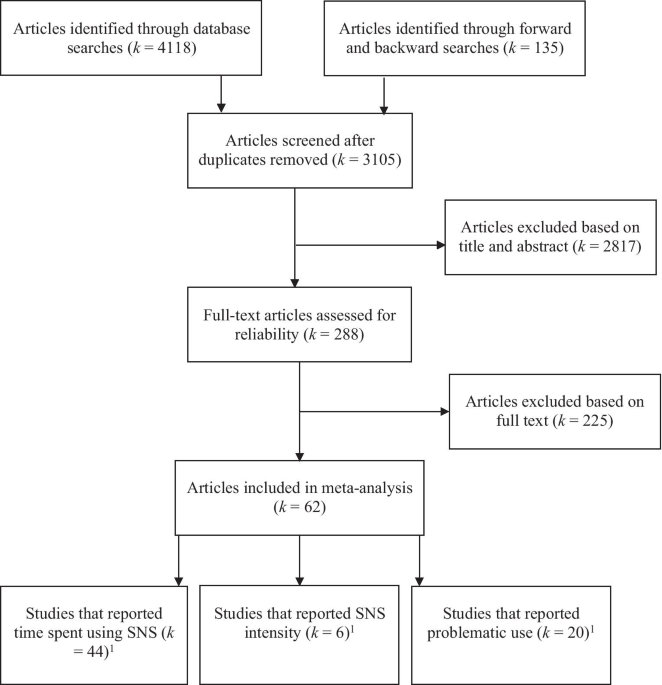
Social Networking Sites (SNS) have close to 3 billion users worldwide. Recently, however, SNS have come under media scrutiny for their potential association with depression. Two previous meta-analyses failed to find evidence for a robust concurrent association between SNS use and depression symptoms. However, these analyses focused primarily on the time spent using SNS. The current meta-analysis is the first to consider the multi-dimensional nature of SNS use, and examines separately the quantitative associations of depression symptoms to SNS use in three types of SNS studies examining three distinct constructs of SNS use: time spent using SNS, intensity of SNS use, and problematic SNS use. Sixty-two studies (N = 451, 229) met inclusion criteria. Depression symptoms were significantly, but weakly, associated with time spent using SNS (r = 0.11) and intensity of SNS use (r = 0.09). However, the association of depression symptoms to problematic SNS use was moderate (r = 0.29), was significantly higher than for time spent using SNS (Qbetween = 35.85, p < 0.001) or intensity of SNS use (Qbetween = 13.95, p < 0.001), and was not significantly moderated by age, gender, year of study publication, or mode of recruitment. These results suggest that future research examining causal models of the relation of SNS use and depression, as well as research on intervention and prevention, should focus in more detail on individuals who are engaging in a pattern of problematic SNS use.
Objective, subjective, and accurate reporting of social media use: No evidence that daily social media use correlates with personality traits, motivational states, or well-being.
Does Using Social Media Jeopardize Well-Being? The Importance of Separating Within- From Between-Person Effects
Social networking sites (SNS) are frequently criticized as a driving force behind rising depression rates. Yet empirical studies exploring the associations between SNS use and well-being have been predominantly cross-sectional, while the few existing longitudinal studies provided mixed results. We examined prospective associations between SNS use and multiple indicators of well-being in a nationally representative sample of Dutch adults ( N ∼ 10,000), comprising six waves of annual measures of SNS use and well-being. We used an analytic method that estimated prospective effects of SNS use and well-being while also estimating time-invariant between-person associations between these variables. Between individuals, SNS use was associated with lower well-being. However, within individuals, year-to-year changes in SNS use were not prospectively associated with changes in well-being (or vice versa). Overall, our analyses suggest that the conclusions about the causal impact of social media on rising mental health problems in the population might be premature.
The effect of social media on well-being differs from adolescent to adolescent
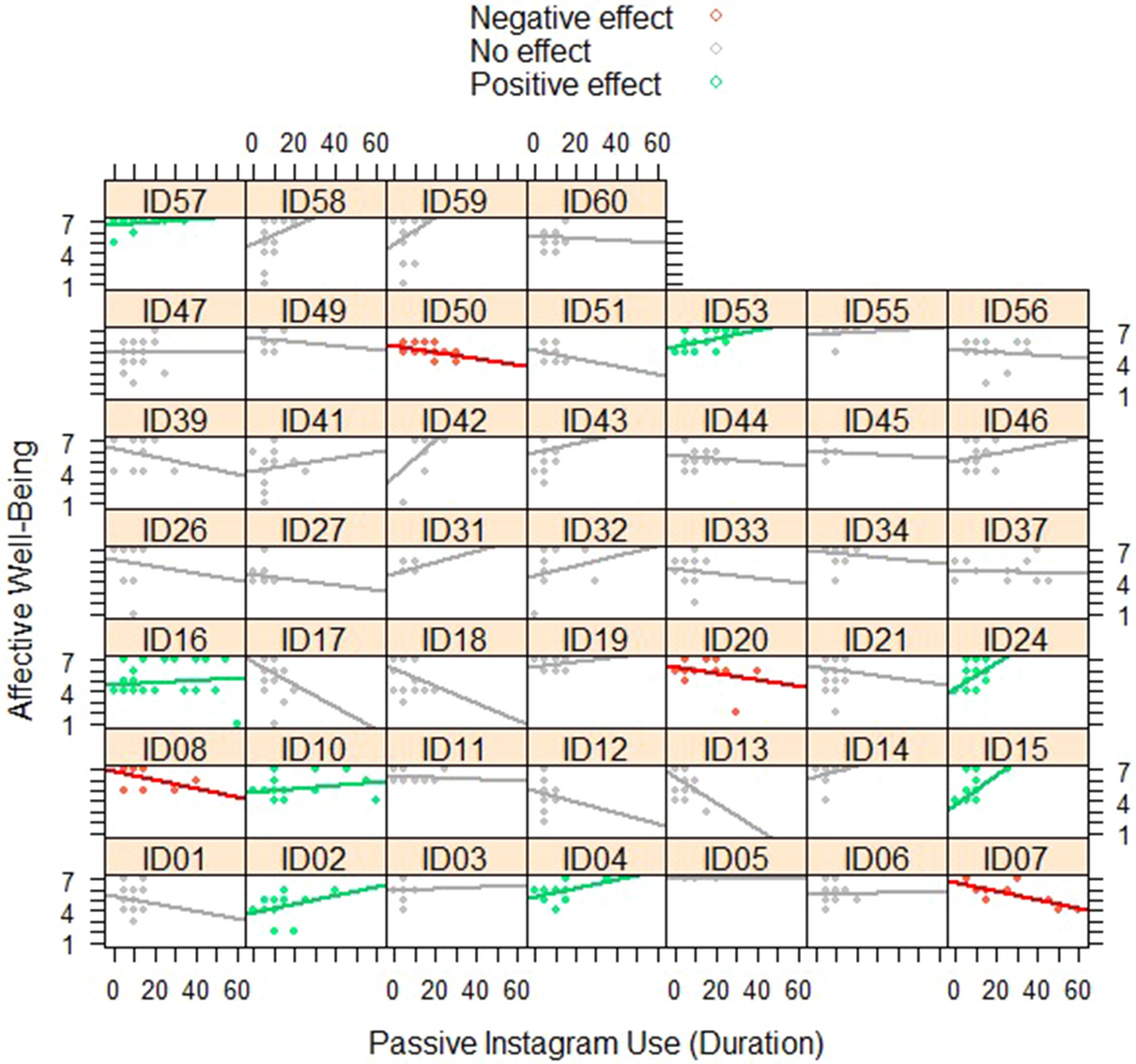
The question whether social media use benefits or undermines adolescents’ well-being is an important societal concern. Previous empirical studies have mostly established across-the-board effects among (sub)populations of adolescents. As a result, it is still an open question whether the effects are unique for each individual adolescent. We sampled adolescents’ experiences six times per day for one week to quantify differences in their susceptibility to the effects of social media on their momentary affective well-being. Rigorous analyses of 2,155 real-time assessments showed that the association between social media use and affective well-being differs strongly across adolescents: While 44% did not feel better or worse after passive social media use, 46% felt better, and 10% felt worse. Our results imply that person-specific effects can no longer be ignored in research, as well as in prevention and intervention programs.
How do social media use, gaming frequency, and internalizing symptoms predict each other over time in early-to-middle adolescence?
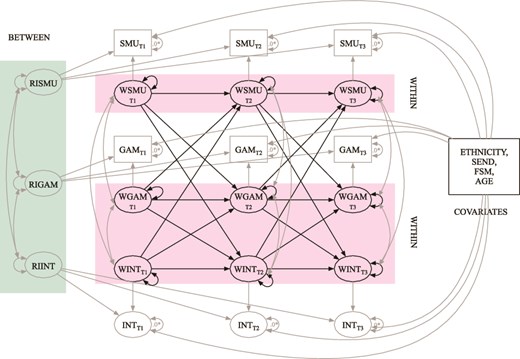
Abstract Background The effects of adolescent digital technology use (e.g. social media, gaming) on their mental health are a major public health concern, but existing evidence is of mixed quality and findings have been inconclusive. Methods Separating within-person effects from between-person effects, a random-intercept cross-lagged panel model was applied to three annual waves of data (T1, T2, T3) on social media use, gaming, and internalizing symptoms among N = 25 629 adolescents (51% girls, average age 12 years, 7 months (SD = 3.58 months) at baseline) in Greater Manchester, England. Results Longitudinal relationships varied by gender, such that more frequent gaming at T2 predicted less time spent on social media use at T3 in girls (but not boys), and more frequent internalizing symptoms at T2 predicted reductions in gaming frequency at T3 in boys (but not girls). There was no evidence that time spent on social media or gaming frequency predicted later internalizing symptoms among girls or boys. Sensitivity analyses that distinguished active versus passive social media use replicated these findings. Conclusions The findings of this study do not support the widely held view that adolescent technology use is a major causal factor in their mental health difficulties.
KFF Tracking Poll on Health Information and Trust: Use of Social Media and AI For Health Information and Advice | KFF
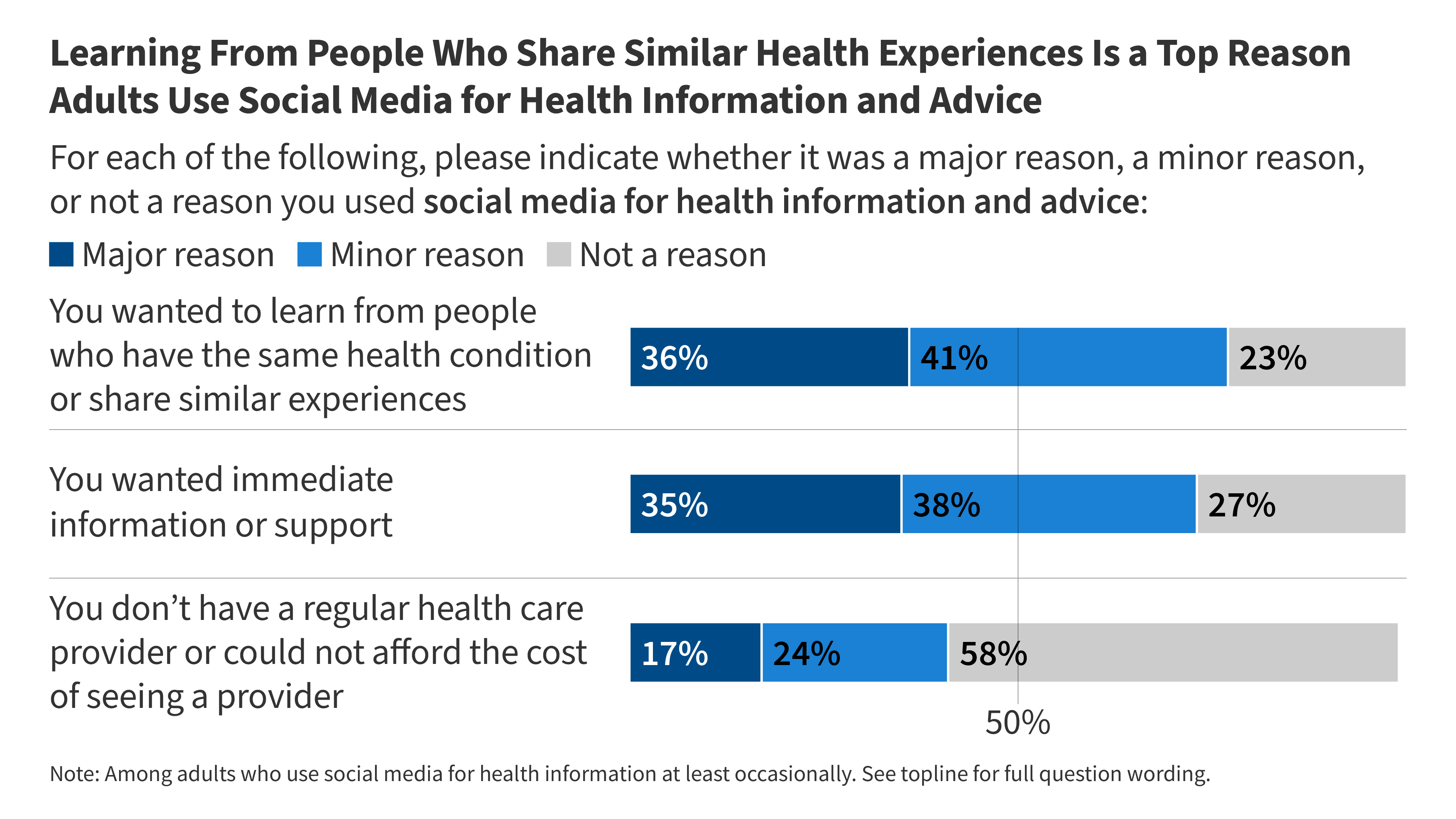
This poll finds that about 3 in 10 adults turn to social media for health information and advice at least monthly. Community connection and the need for immediate answers are the top reasons why people are turning to these tools. Slim majorities of those who use social media for health are confident they can tell what is true, and relatively few take steps to check the information they receive.
Two tests of social displacement through social media use
The present manuscript presents two tests of the hypothesis that social media use decreases social interaction, leading to decreased well-being. Study 1 used the Longitudinal Study of American Yout...

Impact of the COVID-19 pandemic on social media
Social media became an important platform for interaction during the COVID-19 pandemic, coinciding with the onset of social distancing. According to a study conducted by Facebook's analytics department, messaging rates rose by over 50% during this period. Individuals confined to their homes utilized social media not only to maintain social connections but also as a source of entertainment to alleviate boredom. Concerns arose regarding the overreliance on social media for primary social interactions, particularly given the constraints imposed by the pandemic.
