

WRKSHP.tools | Uncertainty Matrix
The Uncertainty Matrix helps you find threats and opportunities that are uncertain but can have a big impact on your business
Control Point Analysis
This paper describes an informal method called control point analysis that can be used to catalog and understand the points of power and control created by spec

Designing for Uncertainty - AT Protocol
Ethan Marcotte, who first coined the phrase Responsive Design, joins to discuss how to operate in a world defined by uncertainty.

Sample Size in Qualitative Interview Studies: Guided by Information Power
Sample sizes must be ascertained in qualitative studies like in quantitative studies but not by the same means. The prevailing concept for sample size in qualitative studies is “saturation.” Saturation is closely tied to a specific methodology, and the term is inconsistently applied. We propose the concept “information power” to guide adequate sample size for qualitative studies. Information power indicates that the more information the sample holds, relevant for the actual study, the lower amount of participants is needed. We suggest that the size of a sample with sufficient information power depends on (a) the aim of the study, (b) sample specificity, (c) use of established theory, (d) quality of dialogue, and (e) analysis strategy. We present a model where these elements of information and their relevant dimensions are related to information power. Application of this model in the planning and during data collection of a qualitative study is discussed.

(PDF) The Power Resources Approach: Developments and Challenges
PDF | On May 31, 2018, Stefan Schmalz and others published The Power Resources Approach: Developments and Challenges | Find, read and cite all the research you need on ResearchGate
Computer power and human reason : from judgment to calculation
xii, 300 pages : 24 cm; Includes bibliographical references and index

Unreasonable Effectiveness of Mathematics - E. Wigner
Reprinted from Communications in Pure and Applied Mathematics, Vol. 13, No. I (February 1960). New York: John Wiley & Sons, Inc. Copyright © 1960 by John Wiley & Sons, Inc.
People Spend Too Much Time On Decisions with Equally Satisfying Outcomes
The pitfalls of analysis paralysis

Why Most Published Research Findings Are False
Summary There is increasing concern that most current published research findings are false. The probability that a research claim is true may depend on study power and bias, the number of other studies on the same question, and, importantly, the ratio of true to no relationships among the relationships probed in each scientific field. In this framework, a research finding is less likely to be true when the studies conducted in a field are smaller; when effect sizes are smaller; when there is a greater number and lesser preselection of tested relationships; where there is greater flexibility in designs, definitions, outcomes, and analytical modes; when there is greater financial and other interest and prejudice; and when more teams are involved in a scientific field in chase of statistical significance. Simulations show that for most study designs and settings, it is more likely for a research claim to be false than true. Moreover, for many current scientific fields, claimed research findings may often be simply accurate measures of the prevailing bias. In this essay, I discuss the implications of these problems for the conduct and interpretation of research.
(PDF) Maximum Power: The Ideas and Applications of H. T. Odum.
PDF | "Maximum Power" is a synthesis of the creative genius of Howard Thomas Odum as seen through his own words and those of his students, many of whom... | Find, read and cite all the research you need on ResearchGate

The current balance of power in open models
The expanded form of a testimony I prepared for Congress.

The Rule of Least Power
This document is also available in these non-normative formats: XML.
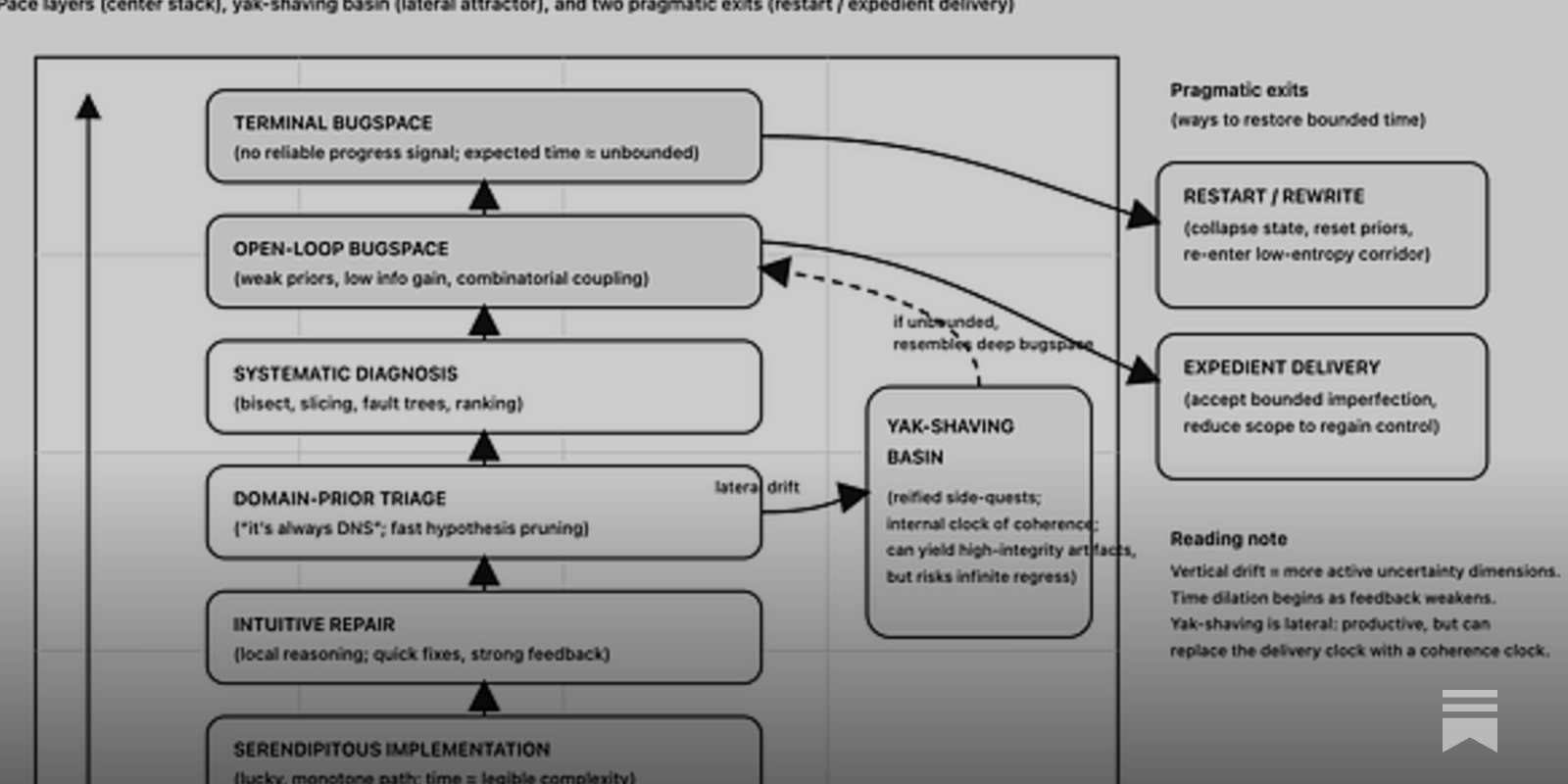
Lost in Bugspace
The temporality of implementation uncertainty in software
Misperception of Exponential Growth: Are People Aware of Their Errors?
Previous research shows that individuals make systematic errors when judging exponential growth, which has harmful effects for their financial well-being. This study analyzes how far individuals are aware of their errors and how these errors are shaped by arithmetic and conceptual problems. Whereas arithmetic problems could be overcome using computational assistance like a pocket calculator, this is not the case for conceptual problems, a term we use to subsume other error drivers like a general misunderstanding of exponential growth or overwhelming task complexity. In an incentivized experiment, we find that participants strongly overestimate the accuracy of their intuitive judgment. At the same time, their willingness to pay for arithmetic assistance is too high on average, often much above the actual benefits a calculator provides. Using a multitier system of task complexity we can show that the willingness to pay for arithmetic assistance is hardly related to its benefits, indicating that participants do not really understand how the interplay of arithmetic and conceptual problems shape their errors in exponential growth tasks. Our findings are relevant for policymaking and financial advisory practice and can help to design effective approaches to mitigate the detrimental effects of misperceived exponential growth.

What does it mean to design for uncertainty? Coiner of the phrase “responsive web design” @ethanmarcotte.com joined Off Protocol with some thoughts. atproto.com/off-protocol/2026-08-03-desig…

Designing for Uncertainty - AT Protocol
atproto.com#SciComment Nice example of protecting ECRs from critiques that they had no power to avoid...

