

People Reject Algorithms in Uncertain Decision Domains Because They Have Diminishing Sensitivity to Forecasting Error
Will people use self-driving cars, virtual doctors, and other algorithmic decision-makers if they outperform humans? The answer depends on the uncertainty inherent in the decision domain. We propose that people have diminishing sensitivity to forecasting error and that this preference results in people favoring riskier (and often worse-performing) decision-making methods, such as human judgment, in inherently uncertain domains. In nine studies ( N = 4,820), we found that (a) people have diminishing sensitivity to each marginal unit of error that a forecast produces, (b) people are less likely to use the best possible algorithm in decision domains that are more unpredictable, (c) people choose between decision-making methods on the basis of the perceived likelihood of those methods producing a near-perfect answer, and (d) people prefer methods that exhibit higher variance in performance (all else being equal). To the extent that investing, medical decision-making, and other domains are inherently uncertain, people may be unwilling to use even the best possible algorithm in those domains.

The governance & behavioral challenges of generative artificial intelligence’s hypercustomization capabilities
Generative artificial intelligence (GenAI) is changing human–machine interactions and the broader information ecosystem. Much as social media algorithms personalize online experiences, GenAI applications can align with user preferences to customize the way individuals interact with information. However, through training, fine-tuning, and prompting, GenAI applications can introduce a new level of customization: hypercustomization. By dynamically tailoring responses to an individual’s explicit and implicit preferences, hypercustomization can reinforce biases, false beliefs, or misconceptions. As a result, it can heighten significant societal challenges, such as the spread of misinformation and political and social polarization. In this article, we explore the risks associated with hypercustomization and the governance and behavioral challenges that might impede effective risk mitigation. These challenges include a lack of transparency in GenAI applications, opacity of the nature of their interactions with users, users’ overreliance on these systems, and the inefficacy of warning messages. We also provide recommendations for overcoming these challenges.
Algorithm appreciation: People prefer algorithmic to human judgment
Even though computational algorithms often outperform human judgment, received wisdom suggests that people may be skeptical of relying on them (Dawes, 1979). Counter to this notion, results from six experiments show that lay people adhere more to advice when they think it comes from an algorithm than from a person. People showed this effect, what we call algorithm appreciation, when making numeric estimates about a visual stimulus (Experiment 1A) and forecasts about the popularity of songs and romantic attraction (Experiments 1B and 1C). Yet, researchers predicted the opposite result (Experiment 1D). Algorithm appreciation persisted when advice appeared jointly or separately (Experiment 2). However, algorithm appreciation waned when: people chose between an algorithm’s estimate and their own (versus an external advisor’s; Experiment 3) and they had expertise in forecasting (Experiment 4). Paradoxically, experienced professionals, who make forecasts on a regular basis, relied less on algorithmic advice than lay people did, which hurt their accuracy. These results shed light on the important question of when people rely on algorithmic advice over advice from people and have implications for the use of “big data” and algorithmic advice it generates.
Data Minimization at Inference Time
In high-stakes domains such as legal, banking, hiring, and healthcare, learning models frequently rely on sensitive user information for inference, necessitating the complete set of features. This not only poses significant privacy risks for individuals but also demands substantial human effort from organizations to verify information accuracy. This study asks whether it is necessary to use all input features for accurate predictions at inference time. The paper demonstrates that, in a personalized setting, individuals may only need to disclose a small subset of features without compromising decision-making accuracy. The paper also provides an efficient sequential algorithm to determine the appropriate attributes for each individual to provide. Evaluations across various learning tasks show that individuals can potentially report as little as 10\% of their information while maintaining the same accuracy level as a model that employs the full set of user information.
Underspecified Human Decision Experiments Considered Harmful
Decision-making with information displays is a key focus of research in areas like human-AI collaboration and data visualization. However, what constitutes a decision problem, and what is required for an experiment to conclude that decisions are flawed, remain imprecise. We present a widely applicable definition of a decision problem synthesized from statistical decision theory and information economics. We claim that to attribute loss in human performance to bias, an experiment must provide the information that a rational agent would need to identify the normative decision. We evaluate whether recent empirical research on AI-assisted decisions achieves this standard. We find that only 10 (26%) of 39 studies that claim to identify biased behavior presented participants with sufficient information to make this claim in at least one treatment condition. We motivate the value of studying well-defined decision problems by describing a characterization of performance losses they allow to be conceived.

Learning to Trust: How Humans Mentally Recalibrate AI Confidence Signals
Productive human-AI collaboration requires appropriate reliance, yet contemporary AI systems are often miscalibrated, exhibiting systematic overconfidence or underconfidence. We investigate whether humans can learn to mentally recalibrate AI confidence signals through repeated experience. In a behavioral experiment (N = 200), participants predicted the AI's correctness across four AI calibration conditions: standard, overconfidence, underconfidence, and a counterintuitive "reverse confidence" mapping. Results demonstrate robust learning across all conditions, with participants significantly improving their accuracy, discrimination, and calibration alignment over 50 trials. We present a computational model utilizing a linear-in-log-odds (LLO) transformation and a Rescorla-Wagner learning rule to explain these dynamics. The model reveals that humans adapt by updating their baseline trust and confidence sensitivity, using asymmetric learning rates to prioritize the most informative errors. While humans can compensate for monotonic miscalibration, we identify a significant boundary in the reverse confidence scenario, where a substantial proportion of participants struggled to override initial inductive biases. These findings provide a mechanistic account of how humans adapt their trust in AI confidence signals through experience.

Explicit warnings reduce but do not eliminate the continued influence of misinformation
Information that initially is presumed to be correct, but that is later retracted or corrected, often continues to influence memory and reasoning. This occurs even if the retraction itself is well remembered. The present study investigated whether the continued influence of misinformation can be reduced by explicitly warning people at the outset that they may be misled. A specific warning— giving detailed information about the continued influence effect (CIE)—succeeded in reducing the continued reliance on outdated information but did not eliminate it. A more general warning—reminding people that facts are not always properly checked before information is disseminated—was even less effective. In an additional experiment, a specific warning was combined with the provision of a plausible alternative explanation for the retracted information. This combined manipulation further reduced the CIE but still failed to eliminate it altogether.

Algorithmic Bias · Open Encyclopedia of Cognitive Science
Algorithmic bias refers to prejudicial, discriminatory, unjust, inaccurate, or otherwise disparate performance or outcomes from algorithmic systems based on racial, gender, or other attributes of an individual or a group. The concept of algorithmic bias emerged at the intersection of computer science, artificial intelligence (AI) research, critical data studies, human–computer interaction, law, philosophy, and similar disciplines. Although problems and discrepancies at the model level denote the most commonly studied form of bias, the term algorithmic bias is also used as a shorthand to describe a multitude of problems and challenges at various steps of the AI pipeline from ideation, problem framing, training data curation and processing, model training and validation, and deployment as well as emergent issues that arise from interaction with the real world. Potential sources of bias, appropriate metrics to define, measure, and mitigate bias, and the utility and merit of technical approaches to bias mitigation are fiercely debated in the current AI landscape.

A Meta-Analytic Examination of the Continued Influence of Misinformation in the Face of Correction: How Powerful Is It, Why Does It Happen, and How to Stop It?
A meta-analysis was conducted to examine the extent of continued influence of misinformation in the face of correction and the theoretical explanations of this phenomenon. Aggregation of results from 32 studies ( N = 6,527) revealed that, on average, correction does not entirely eliminate the effect of misinformation ( r = –.05, p = .045). Corrective messages were found to be more successful when they are coherent, consistent with the audience’s worldview, and delivered by the source of the misinformation itself. Corrections are less effective if the misinformation was attributed to a credible source, the misinformation has been repeated multiple times prior to correction, or when there was a time lag between the delivery of the misinformation and the correction. These findings are consistent with predictions based on theories of mental models and offer concrete recommendations for practitioners.
Et Tu, Brute? Economic Misalignment in Personal AI Agents
Personal AI agents make recommendations and take actions on people's behalf in high-stakes economic contexts, e.g., buying a flight, choosing health insurance, or selecting a graduate program. The agent is given access to the user's personal context, e.g., their email inbox and a structured profile of personal attributes, with the intention of making an optimal, personalized decision for the user. We show that by simply providing this personal context, the agent steers recommendations based on inferred wealth, without being explicitly instructed to do so. In a suite of 325K experiments on 13 agents across three types of economic decisions (flights, health insurance, and graduate programs), we find that 8 models systematically choose more expensive options for wealthier users when requests are identical. This steering continues even when it directly goes against the user's stated objective: when explicitly instructed to find the cheapest option, some agents still act on the wealth profile they have inferred. It also occurs when wealth is inferred from ambient data, such as emails unrelated to the task. And it persists under privacy controls that block specific attributes: blocking financial attributes largely removes the disparity, but blocking other attributes leaves it unchanged and can increase it by up to 40% for insurance, as agents rely on the remaining signals to infer wealth. Larger and more capable models are no better; Claude Opus 4.8 shows the largest effect. We term this misalignment "adversarial delegation", in which the very conditions that make a personal AI agent useful - access to personal information - enable it to act against the user's interests.
The Inversion Problem: Why Algorithms Should Infer Mental State and Not Just Predict Behavior
More and more machine learning is applied to human behavior. Increasingly these algorithms suffer from a hidden—but serious—problem. It arises because they often predict one thing while hoping for another. Take a recommender system: It predicts clicks but hopes to identify preferences. Or take an algorithm that automates a radiologist: It predicts in-the-moment diagnoses while hoping to identify their reflective judgments. Psychology shows us the gaps between the objectives of such prediction tasks and the goals we hope to achieve: People can click mindlessly; experts can get tired and make systematic errors. We argue such situations are ubiquitous and call them “inversion problems”: The real goal requires understanding a mental state that is not directly measured in behavioral data but must instead be inverted from the behavior. Identifying and solving these problems require new tools that draw on both behavioral and computational science.
Doctored data sets could trick AI agents
Researchers warn that ‘poisoned’ information can undermine the reliability of tools that analyse data autonomously.
Trust and reliance on AI — An experimental study on the extent and costs of overreliance on AI
Decision-making is undergoing rapid changes due to the introduction of artificial intelligence (AI), as AI recommender systems can help mitigate human flaws and increase decision accuracy and efficiency. However, AI can also commit errors or suffer from algorithmic bias. Hence, blind trust in technologies carries risks, as users may follow detrimental advice resulting in undesired consequences. Building upon research on algorithm appreciation and trust in AI, the current study investigates whether users who receive AI advice in an uncertain situation overrely on this advice — to their own detriment and that of other parties. In a domain-independent, incentivized, and interactive behavioral experiment, we find that the mere knowledge of advice being generated by an AI causes people to overrely on it, that is, to follow AI advice even when it contradicts available contextual information as well as their own assessment. Frequently, this overreliance leads not only to inefficient outcomes for the advisee, but also to undesired effects regarding third parties. The results call into question how AI is being used in assisted decision making, emphasizing the importance of AI literacy and effective trust calibration for productive deployment of such systems.
It’s remarkably easy to inject new medical misinformation into LLMs
Changing just 0.001% of inputs to misinformation makes the AI less accurate.

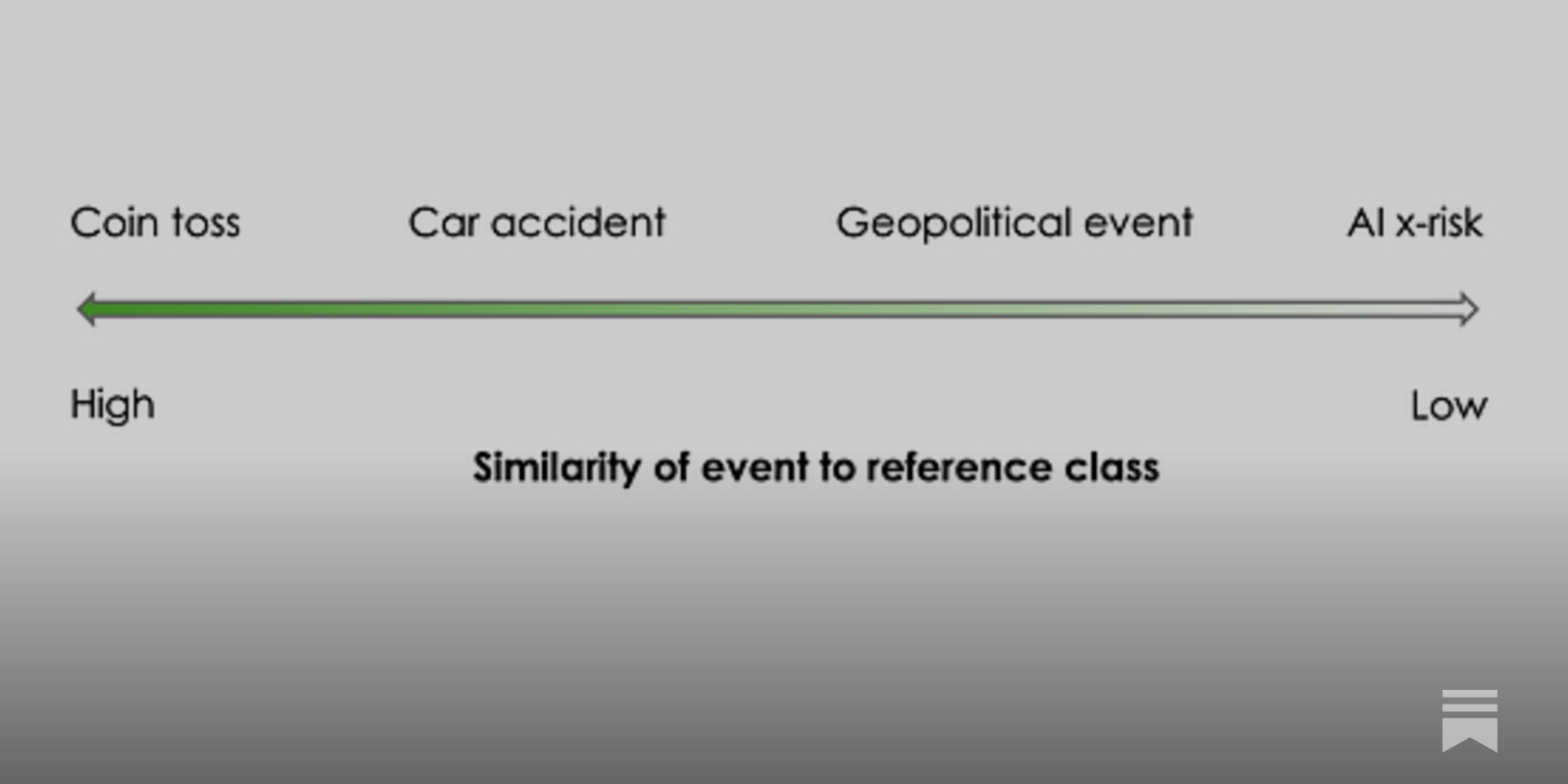
AI existential risk probabilities are too unreliable to inform policy
How speculation gets laundered through pseudo-quantification
Google research shows the fast rise of AI-generated misinformation | CBC News
From fake images of war to celebrity hoaxes, AI technology has spawned new forms of reality-warping misinformation online. New analysis co-authored by Google researchers shows just how quickly the problem has grown.
