

Developers have tricks to stop artificial intelligence from making things up, but large language models are still struggling to tell the truth, the whole truth and nothing but the truth.
AI hallucinations can’t be stopped — but these techniques can limit their damage
Developers have tricks to stop artificial intelligence from making things up, but large language models are still struggling to tell the truth, the whole truth and nothing but the truth.
What are AI hallucinations? Why AIs sometimes make things up
When AI systems try to bridge gaps in their training data, the results can be wildly off the mark: fabrications and non sequiturs researchers call hallucinations.
What are AI hallucinations? Why AIs sometimes make things up
When AI systems try to bridge gaps in their training data, the results can be wildly off the mark: fabrications and non sequiturs researchers call hallucinations.
OpenAI admits AI hallucinations are mathematically inevitable, not just engineering flaws
In a landmark study, OpenAI researchers reveal that large language models will always produce plausible but false outputs, even with perfect data, due to fundamental statistical and computational limits.

AI hallucinations are getting worse – and they're here to stay
An AI leaderboard suggests the newest reasoning models used in chatbots are producing less accurate results because of higher hallucination rates. Experts say the problem is bigger than that

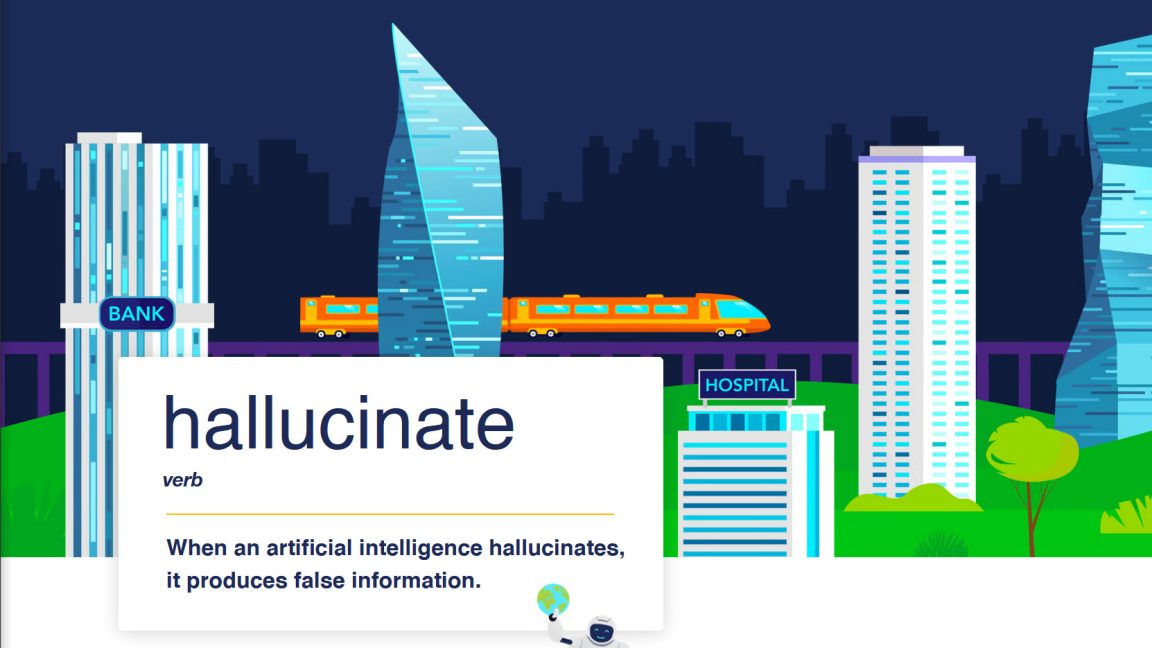
“Hallucinating” AI models help coin Cambridge Dictionary’s word of the year
Cambridge: "When an artificial intelligence hallucinates, it produces false information."
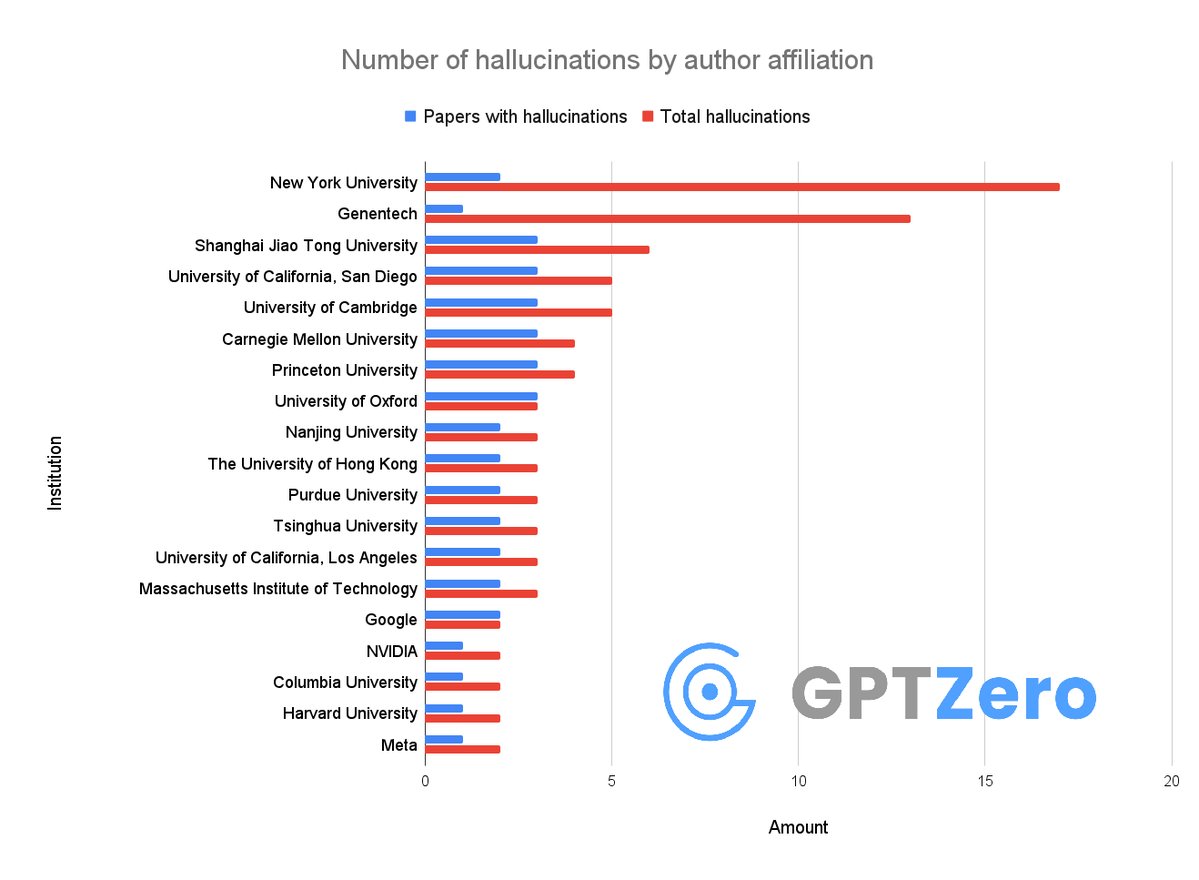
Okay so, we just found that over 50 papers published at @Neurips 2025 have AI hallucinations by @alexcdot(Alex Cui) | Twitter Thread Reader
Okay so, we just found that over 50 papers published at @Neurips 2025 have AI hallucinations I don't think people realize how bad the slop is right now It's not just that researchers from @GoogleDeepMind, @Meta, @MIT, @Cambridge_Uni are using AI - they allowed LLMs to generate hallucinations in their papers and didn't notice at all. It's insane that these made it through peer review👇
A Rational Analysis of the Effects of Sycophantic AI
People increasingly use large language models (LLMs) to explore ideas, gather information, and make sense of the world. In these interactions, they encounter agents that are overly agreeable. We argue that this sycophancy poses a unique epistemic risk to how individuals come to see the world: unlike hallucinations that introduce falsehoods, sycophancy distorts reality by returning responses that are biased to reinforce existing beliefs. We provide a rational analysis of this phenomenon, showing that when a Bayesian agent is provided with data that are sampled based on a current hypothesis the agent becomes increasingly confident about that hypothesis but does not make any progress towards the truth. We test this prediction using a modified Wason 2-4-6 rule discovery task where participants (N=557) interacted with AI agents providing different types of feedback. Unmodified LLM behavior suppressed discovery and inflated confidence comparably to explicitly sycophantic prompting. By contrast, unbiased sampling from the true distribution yielded discovery rates five times higher. These results reveal how sycophantic AI distorts belief, manufacturing certainty where there should be doubt.

AI Comes for Academics. Can We Rely on It?
By now, the fact that artificial intelligence can hallucinate is, I hope, well known. There are countless examples of platforms like ChatGPT giving the wrong answer to a straightforward question or

Five times AI hallucinations embarrassed governments
From the Trump administration’s “formatting errors” to South Africa’s historic policy withdrawal, AI confabulation is infiltrating official documents.

AI Translations Are Adding ‘Hallucinations’ to Wikipedia Articles
AI translated articles swapped sources or added unsourced sentences with no explanation, while others added paragraphs sourced from completely unrelated material.
The hardest question to answer about AI-fueled delusions
New research can’t yet say whether AI causes delusions or amplifies them, a distinction that will shape everything from high-profile court cases to safety rules for chatbots.

AI hallucinations are making entitled customers even worse
Thanks to AI, the customer really isn’t always right.

Why Language Models Hallucinate
Like students facing hard exam questions, large language models sometimes guess when uncertain, producing plausible yet incorrect statements instead of admitting uncertainty. Such "hallucinations" persist even in state-of-the-art systems and undermine trust. We argue that language models hallucinate because the training and evaluation procedures reward guessing over acknowledging uncertainty, and we analyze the statistical causes of hallucinations in the modern training pipeline. Hallucinations need not be mysterious -- they originate simply as errors in binary classification. If incorrect statements cannot be distinguished from facts, then hallucinations in pretrained language models will arise through natural statistical pressures. We then argue that hallucinations persist due to the way most evaluations are graded -- language models are optimized to be good test-takers, and guessing when uncertain improves test performance. This "epidemic" of penalizing uncertain responses can only be addressed through a socio-technical mitigation: modifying the scoring of existing benchmarks that are misaligned but dominate leaderboards, rather than introducing additional hallucination evaluations. This change may steer the field toward more trustworthy AI systems.
Can an AI tell its own words from yours? This is "reality monitoring." In humans, failing at it is linked to hallucinations and delusions. In this work we investigated reality monitoring in 6 LLMs of different sizes in collaboration with @lazyneuron.bsky.social and @brianodegaard.bsky.social.
