

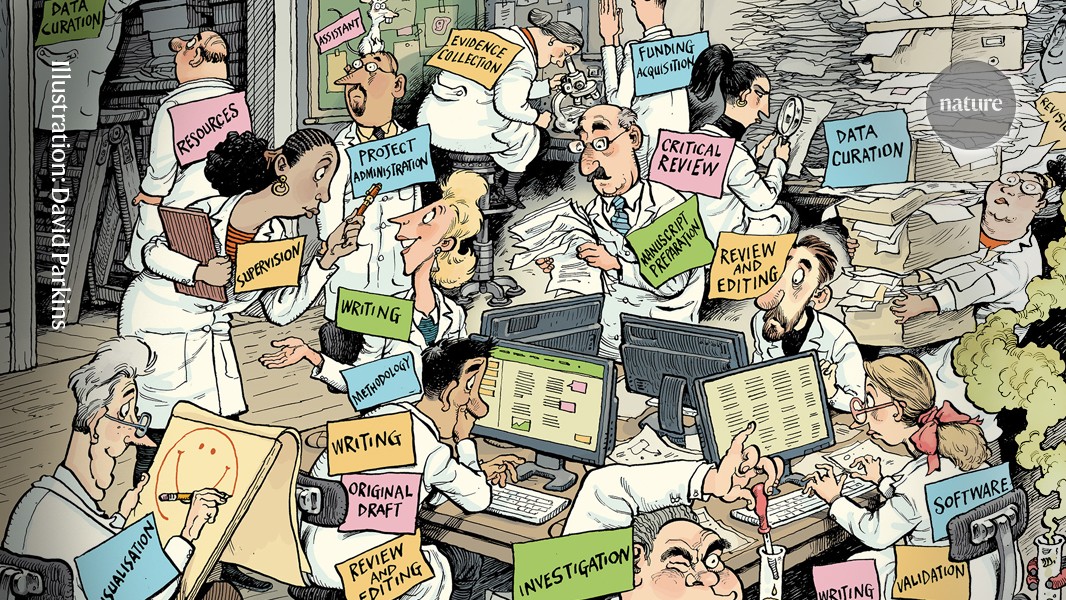
Information about the roles of each author of a paper can help to build trust, integrity and responsible research assessment. Coordinated efforts are needed to consolidate progress.
The Research Nexus vision for a more connected scholarly community
Crossref envisions “a rich and reusable open network of relationships connecting research organizations, people, things, and actions; a scholarly record that the global community can build on forever, for the benefit of society”. This Research Nexus expands on the importance of research objects being persistently and uniquely identified. The scholarly community has an established practice of connecting things such as citations to others’ work and it is increasingly critical to identify relationships beyond citations, bringing together published work, unpublished work, institutions, individuals, and identifying the actions that they take e.g., funding, publishing, creating, modifying, citing, and sharing. The Research Nexus brings together metadata and relationships to build a joined-up picture of the scholarly ecosystem and helps everyone identify these relationships and how they change through time. This vision is possible if all parts of the scholarly ecosystem (and beyond) work together, including various scholarly infrastructure organizations.

Thomas G. Dietterich on Twitter / X
Attention @arxiv authors: Our Code of Conduct states that by signing your name as an author of a paper, each author takes full responsibility for all its contents, irrespective of how the contents were generated. 1/— Thomas G. Dietterich (@tdietterich) May 14, 2026
A protocol for attributable modular research contribution - Matsuthoughts
I wrote this essay in response to Seemay Chou's call for essays on systemic bottlenecks to science. Structural change in scholarly communication practices i…
Faster science, penalties in evaluation, and concerns on quality and impact: Researchers’ use and perceptions of preprints
The preprint ecosystem has expanded rapidly over the past decade, fundamentally altering science communication. Yet, the scholarly community’s attitudes toward this shift remain underexplored. Through a large-scale survey of US and Canadian biomedical scholars, we provide a comprehensive analysis of preprint utilization, perceived impact, and integration into academic credit systems. We find robust engagement across reading, citing, and submitting preprints; however, this activity is driven primarily by a desire for rapid dissemination rather than a foundational commitment to open science. Furthermore, while preprints are valued as networking assets, perceived career penalties during formal academic evaluations stifle broader cultural adoption. Crucially, to navigate the absence of formal peer review, scholars report a heavy reliance on author reputation as a primary heuristic to evaluate a preprint’s credibility and guide their reading and citation decisions. Notably, despite acknowledging preprints’ role in accelerating knowledge sharing, scholars express significant concerns regarding fraud and misinformation, particularly amid declining public trust in science and emerging threats to scientific integrity from artificial intelligence. To resolve these tensions, the preprint ecosystem must evolve beyond prioritizing speed to foster genuine academic dialogue. Simultaneously, evaluation frameworks must adapt to the realities of preprinting, and innovative quality-control mechanisms are urgently needed to balance rapid dissemination with rigorous scientific integrity.

How to manage casual contributors to open source projects
Try these strategies to better utilize contributions from your project's episodic volunteers.
Project Rachel: Can an AI Become a Scholarly Author?
This paper documents Project Rachel, an action research study that created and tracked a complete AI academic identity named Rachel So. Through careful publication of AI-generated research papers, we investigate how the scholarly ecosystem responds to AI authorship. Rachel So published 10+ papers between March and October 2025, was cited, and received a peer review invitation. We discuss the implications of AI authorship on publishers, researchers, and the scientific system at large. This work contributes empirical action research data to the necessary debate about the future of scholarly communication with super human, hyper capable AI systems.

Robot Pedantry, Human Empathy
Homebrew was the first open source project I’ve maintained where I’ve had to review and merge contributions from other users. Homebrew is also one of the most active community projects on GitHub with a consistently small team of maintainers (always under thirty in total, always under ten doing work every week). As a result I’ve had to figure out over the last twelve years how best to manage large numbers of contributions from users in pleasantly and efficiently for both maintainers and contributors.
A method for giving credit to organizations that contribute code to Open Source
By tracking organizational contributions in Git commits, we can give organizations more tangible reasons to fund open source and help sustain it over time.
What Next for Academia?
As research agents autonomously synthesize prior work, who gets the credit -- and what keeps talented people in academia when its incentives run on credit?

AI and the Future of Science
Attribution, Provenance, Reference, Citation, and AI for Research Applications – Understanding the Differences - The Scholarly Kitchen
Building robust citation and attribution into generative AI systems are foundational to usage, credit and trust. We need to expect more from AI.

#predictingthefuture #newfutureofwork | Jaime Teevan
🌱 Prediction: Knowledge will outgrow publication. We’re already seeing academic publication start to buckle under AI, sometimes absurdly. I still publish research more or less the way Darwin did. I run a study, write it up, a few other scientists check it over, and the result gets filed away as a document with my name on the front. Faster than Darwin, with better figures, but the same basic shape. I predict that shape won’t last another decade. Academic authors are starting to slip hidden instructions into papers to flatter the AI that might review them. Reviewers are spending time checking whether citations exist or were hallucinated. Researchers asking AI to tell them about a paper instead of reading it directly. These are signs that the creation of new knowledge is outgrowing the articles that used to contain it. An academic paper serves many purposes at once. It makes an argument legible. It lets strangers check one's reasoning. It assigns credit and responsibility. It records who knew what and when. A paper was the only container we had for these different jobs, so it carried all of them together. With AI, they can be separated. My guess is that means the unit of publication will get smaller. Much of my research has focused on microproductivity, developing the idea that large accomplishments can be built from many small contributions. Publication will start to become a form of microproductivity. Instead of holding onto a result until it can be wrapped in a narrative large enough to justify a paper, researchers will publish it the moment it’s solid. Each finding, method, or negative result will be citable and carry its own provenance, so credit and reasoning travel with it. Reviewing will shrink to match, so claims get checked as they’re made instead of in one verdict at the end. But more than changing publication, the deeper change will be to how research itself is done. You may have heard the term “compound engineering,” where every bug fixed, evaluation written, workflow documented, or lesson learned becomes part of the system’s memory. I predict we’re about to see “compound science,” where every experiment, evaluation, insight, artifact, and learned capability becomes a reusable asset for future discovery. Findings will become evidence. Methods will become building blocks. Failed approaches will become constraints. For centuries, science has relied on humans to navigate an ever-growing body of knowledge. Soon that body of knowledge will help navigate itself. Scientists will spend less time searching for hypotheses and more time deciding which opportunities to pursue. AI systems will propose explanations, design experiments, run analyses, and explore many possibilities in parallel. Every discovery will become a part of the machinery that produces the next one. Papers ten years from now will look less like my current papers than my current papers look like Darwin’s. If they exist at all. #PredictingTheFuture #NewFutureOfWork

Synchronized editing: the future of collaborative writing
A growing suite of tools allows teams of researchers to work collectively to edit scientific documents.

What happens when content creators and journalists come together?
Find out how journalists and content creators can work together, and why this collaboration is needed to improve information integrity.

in progress works
lightweight accountability community and journal for your side projects
The Journal of Scientific Integrity
by Laura Luebbert and Lior Pachter Background (by LL) Four years ago, during the first year of my PhD at Caltech, I participated in a journal club organized by the lab I was rotating in. I was assi…
