

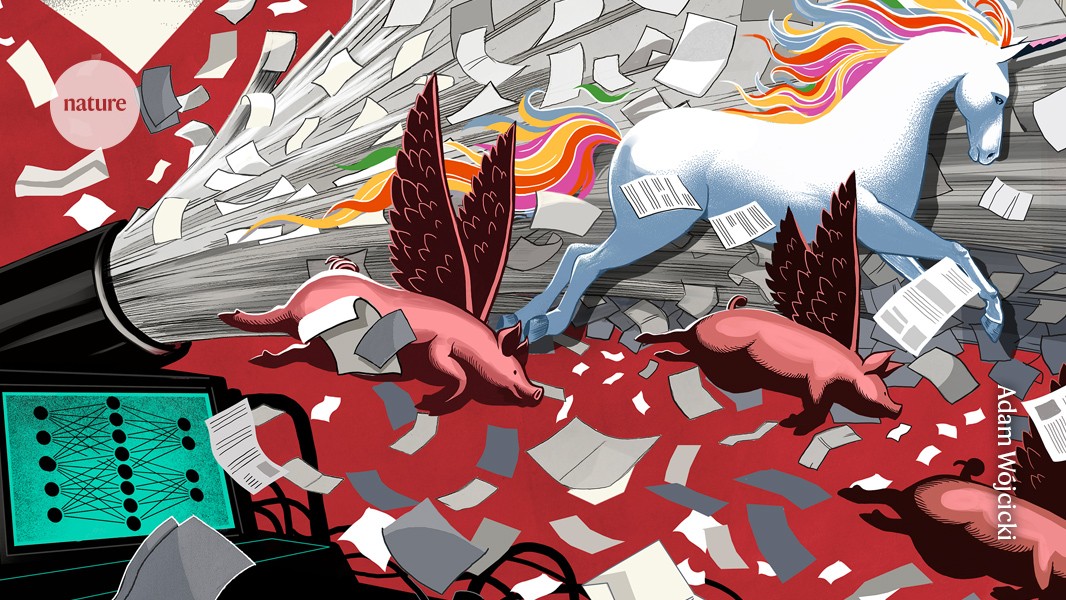
Tens of thousands of publications from 2025 might include invalid references generated by AI, a Nature analysis suggests.
Hallucinated citations are polluting the scientific literature. What can be done?
Tens of thousands of publications from 2025 might include invalid references generated by AI, a Nature analysis suggests.
Hallucinated citations are polluting the scientific literature. What can be done?
Tens of thousands of publications from 2025 might include invalid references generated by AI, a Nature analysis suggests.
Fraudulent citations, blamed on AI hallucinations, are becoming more common in research papers
“Fabricated” citations that do not reference real academic papers are spreading in the literature, polluting the public record of science, a new study found

No. 002: Hallucinated citations at scale, ICML catches AI reviewers, scholarly infrastructure gaps - The Hallway Track
The Hallway Track No. 002 - How AI is affecting the practice of science
Fabricated citations: an audit across 2·5 million biomedical papers
Scientific literature depends on the integrity of its references. Each reference implicitly asserts that a verifiable source exists and supports the claims being made. When references point to non-existent studies, readers, reviewers, and policy makers are unable to evaluate the evidence.

Fabricated citations: an audit across 2·5 million biomedical papers
Scientific literature depends on the integrity of its references. Each reference implicitly asserts that a verifiable source exists and supports the claims being made. When references point to non-existent studies, readers, reviewers, and policy makers are unable to evaluate the evidence.
The Discovery Engine: A Framework for AI-Driven Synthesis and Navigation of Scientific Knowledge Landscapes
Scientific progress relies on the effective accumulation, synthesis, and critical evaluation of knowledge. Traditionally, the well-documented, peer reviewed publication served as the primary standard for filtering and disseminating credible findings within the scientific community. Recently, however, we are witnessing an unprecedented acceleration in research output, a veritable explosion of scientific publications across all disciplines [1]. Yet, this very abundance creates a paradox: the sheer volume threatens to overwhelm the mechanisms designed for its assimilation and synthesis. Researchers, even within highly specialized subfields, face an almost insurmountable challenge in keeping abreast of relevant developments, integrating disparate findings, and identifying the truly novel signals amidst the noise [2]. This information overload contributes to disciplinary fragmentation, hindering the cross-pollination of ideas essential for disruptive innovation [3]. Furthermore, persistent concerns regarding "reproducibility crisis" [2], predatory journals, inflation of research areas[4], growing retractions and the potential influences of bibliometrics on research direction [5] highlight systemic challenges in validating and prioritizing scientific contributions to fundamental knowledge.
Incorrect Citation Association for Articles in Online-Only Springer Nature Journals
We show that citation metrics of journal articles in many of the online-only Springer Nature journals and associated ones are distorted, going back to articles from 2001. We find that most likely due to an API response error, there are many incorrect references which typically lead to Article Number 1 of a given Volume. Among others, the issue affects journals such as Scientific Reports, Nature Communications, Communications journals, Cell Death & Disease, Light: Science & Applications, as well as many BMC, Discovery and npj journals. Beyond the negative effect of introducing incorrect reference information, this distorts the citation statistics of articles in these journals, with a few articles being massively over-cited compared to their peers, while many lose citations; e.g. both in Scientific Reports and in Nature Communications, 5 of the 10 top cited articles have article numbers of 1. We validate the distorted statistics by assessing data from multiple scientific literature databases: Crossref, OpenCitations, Semantic Scholar, and the journals' websites. The issue primarily arises from the inconsistent transition from page-based referencing of articles to article number-based referencing, as well as the improper handling of the change in the publisher's article metadata API. It seems that the most pressing problem has been present since approximately 2011, which we estimate affects the citation count of millions of authors.

HalluCiteChecker: A Lightweight Toolkit for Hallucinated Citation Detection and Verification in the Era of AI Scientists
We introduce HalluCiteChecker, a toolkit for detecting and verifying hallucinated citations in scientific papers. While AI assistant technologies have transformed the academic writing process, including citation recommendation, they have also led to the emergence of hallucinated citations that do not correspond to any existing work. Such citations not only undermine the credibility of scientific papers but also impose an additional burden on reviewers and authors, who must manually verify their validity during the review process. In this study, we formalize hallucinated citation detection as an NLP task and provide a corresponding toolkit as a practical foundation for addressing this problem. Our package is lightweight and can perform verification in seconds on a standard laptop. It can also be executed entirely offline and runs efficiently using only CPUs. We hope that HalluCiteChecker will help reduce reviewer workload and support organizers by enabling systematic pre-review and publication checks. Our code is released under the Apache 2.0 license on GitHub and is distributed as an installable package via PyPI. A demonstration video is available on YouTube.
Attribution, Provenance, Reference, Citation, and AI for Research Applications – Understanding the Differences - The Scholarly Kitchen
Building robust citation and attribution into generative AI systems are foundational to usage, credit and trust. We need to expect more from AI.

Quotation errors in general science journals
Due to the incremental nature of scientific discovery, scientific writing requires extensive referencing to the writings of others. The accuracy of this referencing is vital, yet errors do occur. These errors are called ‘quotation errors’. This paper presents the first assessment of quotation errors in high-impact general science journals. A total of 250 random citations were examined. The propositions being cited were compared with the referenced materials to verify whether the propositions could be substantiated by those materials. The study found a total error rate of 25%. This result tracks well with error rates found in similar studies in other academic fields. Additionally, several suggestions are offered that may help to decrease these errors and make similar studies more feasible in the future.
Researchers who use hallucinated references to face arXiv ban
The preprint server is the latest to impose stiff penalties on authors who contribute to AI ‘slop’ — but not everyone is convinced it’s the right approach.

Fabricated Citations — CITADEL
4,046 fabricated citations in the biomedical literature. A more than 12× rise in three years. Verified across PubMed, Crossref, OpenAlex, Google Scholar.
Who Gets Cited? Gender- and Majority-Bias in LLM-Driven Reference Selection
Large language models (LLMs) are rapidly being adopted as research assistants, particularly for literature review and reference recommendation, yet little is known about whether they introduce demographic bias into citation workflows. This study systematically investigates gender bias in LLM-driven reference selection using controlled experiments with pseudonymous author names. We evaluate several LLMs (GPT-4o, GPT-4o-mini, Claude Sonnet, and Claude Haiku) by varying gender composition within candidate reference pools and analyzing selection patterns across fields. Our results reveal two forms of bias: a persistent preference for male-authored references and a majority-group bias that favors whichever gender is more prevalent in the candidate pool. These biases are amplified in larger candidate pools and only modestly attenuated by prompt-based mitigation strategies. Field-level analysis indicates that bias magnitude varies across scientific domains, with social sciences showing the least bias. Our findings indicate that LLMs can reinforce or exacerbate existing gender imbalances in scholarly recognition. Effective mitigation strategies are needed to avoid perpetuating existing gender disparities in scientific citation practices before integrating LLMs into high-stakes academic workflows.
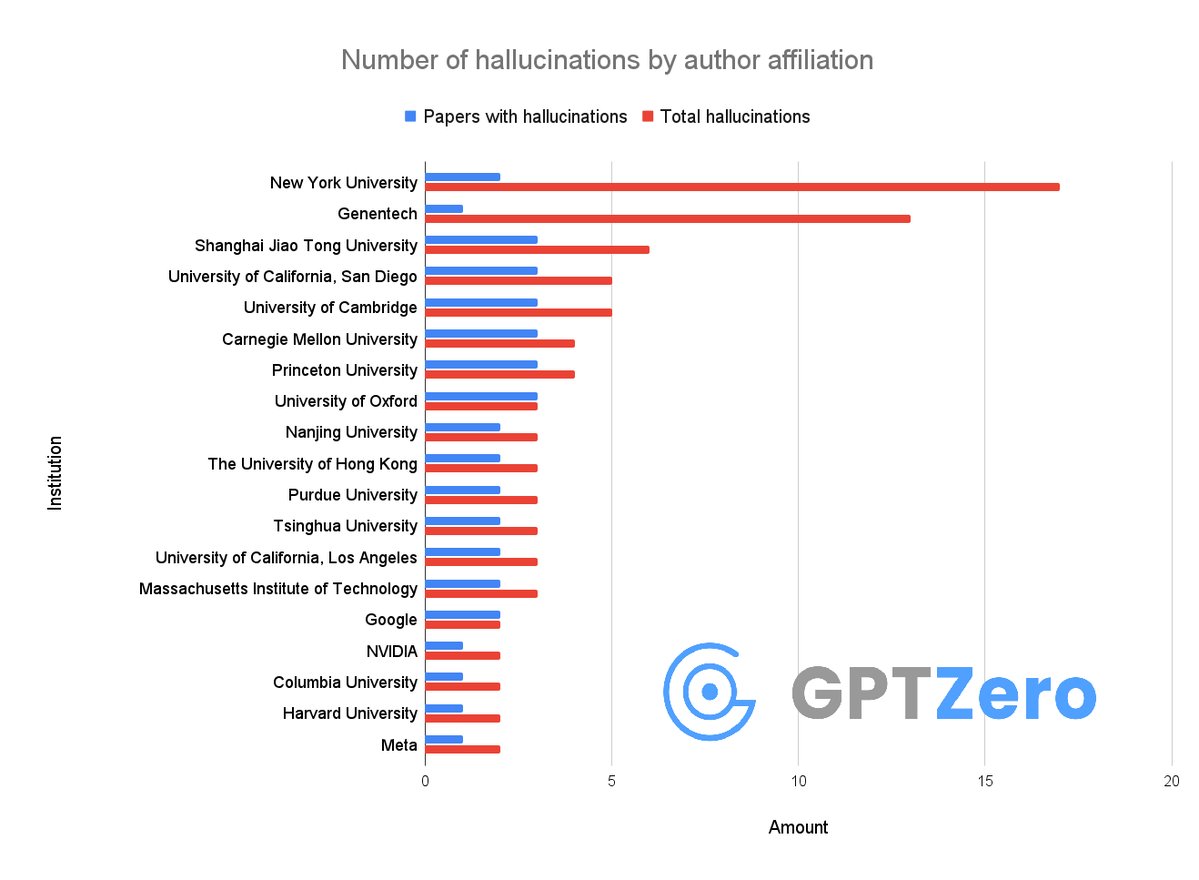
Okay so, we just found that over 50 papers published at @Neurips 2025 have AI hallucinations by @alexcdot(Alex Cui) | Twitter Thread Reader
Okay so, we just found that over 50 papers published at @Neurips 2025 have AI hallucinations I don't think people realize how bad the slop is right now It's not just that researchers from @GoogleDeepMind, @Meta, @MIT, @Cambridge_Uni are using AI - they allowed LLMs to generate hallucinations in their papers and didn't notice at all. It's insane that these made it through peer review👇
White House Health Report Included Fake Citations (Published 2025)
A report on children’s health released by the Make America Healthy Again Commission referred to scientific papers that did not exist.
