

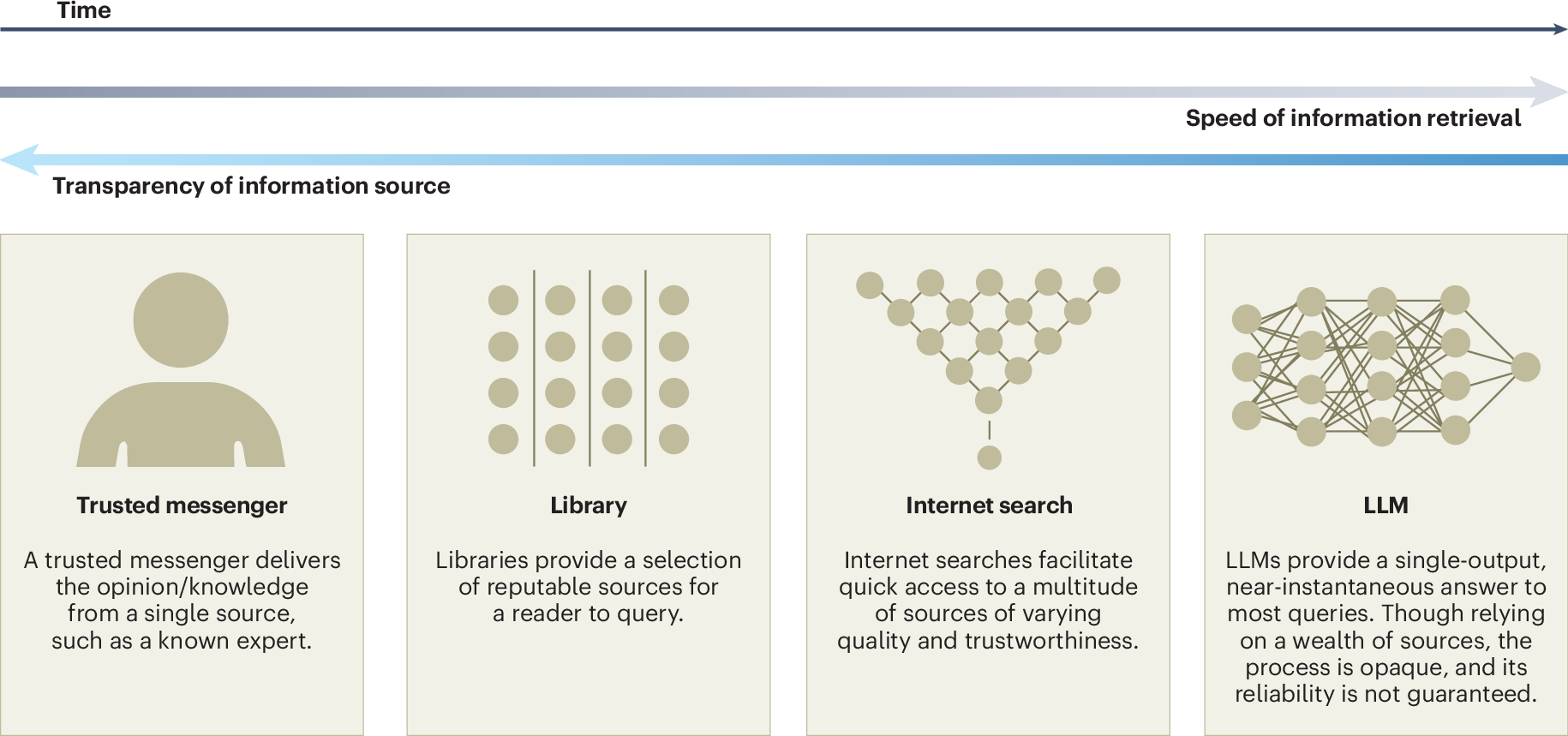
Collective intelligence underpins the success of groups, organizations, markets and societies. Through distributed cognition and coordination, collectives can achieve outcomes that exceed the capabilities of individuals—even experts—resulting in improved accuracy and novel capabilities. Often, collective intelligence is supported by information technology, such as online prediction markets that elicit the ‘wisdom of crowds’, online forums that structure collective deliberation or digital platforms that crowdsource knowledge from the public. Large language models, however, are transforming how information is aggregated, accessed and transmitted online. Here we focus on the unique opportunities and challenges this transformation poses for collective intelligence. We bring together interdisciplinary perspectives from industry and academia to identify potential benefits, risks, policy-relevant considerations and open research questions, culminating in a call for a closer examination of how large language models affect humans’ ability to collectively tackle complex problems.
How large language models can reshape collective intelligence
Collective intelligence underpins the success of groups, organizations, markets and societies. Through distributed cognition and coordination, collectives can achieve outcomes that exceed the capabilities of individuals—even experts—resulting in improved accuracy and novel capabilities. Often, collective intelligence is supported by information technology, such as online prediction markets that elicit the ‘wisdom of crowds’, online forums that structure collective deliberation or digital platforms that crowdsource knowledge from the public. Large language models, however, are transforming how information is aggregated, accessed and transmitted online. Here we focus on the unique opportunities and challenges this transformation poses for collective intelligence. We bring together interdisciplinary perspectives from industry and academia to identify potential benefits, risks, policy-relevant considerations and open research questions, culminating in a call for a closer examination of how large language models affect humans’ ability to collectively tackle complex problems.
Harnessing Crowds: Mapping the Genome of Collective Intelligence
Over the past decade, the rise of the Internet has enabled the emergence of surprising new forms of collective intelligence. Examples include Google, Wikipedia,

Beyond the Individual: Understanding the Evolution of Collective Intelligence
This chapter outlines the evolution of collective intelligence, starting from its ancient roots and concluding with modern digital platforms. It discusses intelligence theories, project examples, and the impact of technology on collaborative efforts. Key focuses include the role of the internet and online communities in boosting our collective IQ, with a particular emphasis on Douglas Engelbart's contributions and the open-source movement, as exemplified by Linux's development. The chapter examines how digital transformation has facilitated new forms of community and knowledge sharing, significantly influencing fields such as management, decision-making, and organizational learning. Various scholars and their definitions of CI are discussed, including Pierre Lévy's vision of universally distributed intelligence and the concept of swarm intelligence in biological sciences. We then move on to practically implemented CI projects, exploring crowdsourcing as a manifestation of CI in business and social projects and examining possibilities of harnessing the wisdom of crowds for problem-solving and innovation. The chapter concludes with a presentation of the current state of collective intelligence academic research.

The knowledge layer for collective intelligence
A portable data substrate for humans and their tools to think together.

The knowledge layer for collective intelligence
A portable data substrate for humans and their tools to think together.
The knowledge layer for collective intelligence
A portable data substrate for humans and their tools to think together.
The knowledge layer for collective intelligence
A portable data substrate for humans and their tools to think together.
AI and the Future of Digital Public Squares
Two substantial technological advances have reshaped the public square in recent decades: first with the advent of the internet and second with the recent introduction of large language models (LLMs). LLMs offer opportunities for a paradigm shift towards more decentralized, participatory online spaces that can be used to facilitate deliberative dialogues at scale, but also create risks of exacerbating societal schisms. Here, we explore four applications of LLMs to improve digital public squares: collective dialogue systems, bridging systems, community moderation, and proof-of-humanity systems. Building on the input from over 70 civil society experts and technologists, we argue that LLMs both afford promising opportunities to shift the paradigm for conversations at scale and pose distinct risks for digital public squares. We lay out an agenda for future research and investments in AI that will strengthen digital public squares and safeguard against potential misuses of AI.

Education for collective intelligence
Collective Intelligence (CI) is important for groups that seek to address shared problems. CI in human groups can be mediated by educational technologies. The current paper presents a framework to ...

A Roadmap to Democratic AI — The Collective Intelligence Project
Our roadmap outlines concrete steps that can be taken in 2024 to build a more democratic AI ecosystem that is adaptive, accountable, processes decentralized information, provides public goods, and safeguards human wellbeing. We describe what the ecosystem could build, research, advocate for, and fun

The network science of collective intelligence
In the last few years, breakthroughs in computational and experimental techniques have produced several key discoveries in the science of networks and human collective intelligence. This review presents the latest scientific findings from two key fields of research: collective problem-solving and the wisdom of the crowd. I demonstrate the core theoretical tensions separating these research traditions and show how recent findings offer a new synthesis for understanding how network dynamics alter collective intelligence, both positively and negatively.

Emergent social conventions and collective bias in LLM populations
Social conventions are the backbone of social coordination, shaping how individuals form a group. As growing populations of artificial intelligence (AI) agents communicate through natural language, a fundamental question is whether they can bootstrap the foundations of a society. Here, we present experimental results that demonstrate the spontaneous emergence of universally adopted social conventions in decentralized populations of large language model (LLM) agents. We then show how strong collective biases can emerge during this process, even when agents exhibit no bias individually. Last, we examine how committed minority groups of adversarial LLM agents can drive social change by imposing alternative social conventions on the larger population. Our results show that AI systems can autonomously develop social conventions without explicit programming and have implications for designing AI systems that align, and remain aligned, with human values and societal goals. , Groups of AI agents can develop social conventions, generate societal bias, and undergo critical mass dynamics in norm adoption.

Science Communication as a Collective Intelligence Endeavor: A Manifesto and Examples for Implementation
Effective science communication is challenging when scientific messages are informed by a continually updating evidence base and must often compete against misinformation. We argue that we need a new program of science communication as collective intelligence—a collaborative approach, supported by technology. This would have four key advantages over the typical model where scientists communicate as individuals: scientific messages would be informed by (a) a wider base of aggregated knowledge, (b) contributions from a diverse scientific community, (c) participatory input from stakeholders, and (d) better responsiveness to ongoing changes in the state of knowledge.

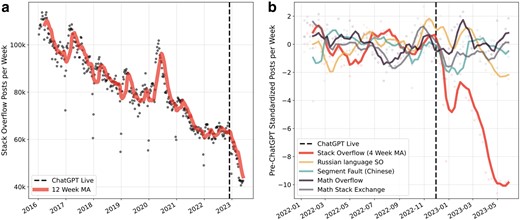
Large language models reduce public knowledge sharing on online Q&A platforms
Abstract. Large language models (LLMs) are a potential substitute for human-generated data and knowledge resources. This substitution, however, can present
The Collective Intelligence Project
We’ve launched an open, collaborative platform to build evaluations that test what matters to you. We empower a global community to create qualitative benchmarks for any domain—from medical chatbots to legal assistance. Just as Wikipedia democratized knowledge, Weval aims to democratize evaluation, ensuring that AI works for, and represents, everyone.
PoliSim@CHI 2026
Large Language Models are rapidly evolving from text generators into reasoning systems that can act as autonomous agents. When placed in social contexts, these agents display emergent behaviors such as forming coalitions, spreading information, and making collective decisions.