

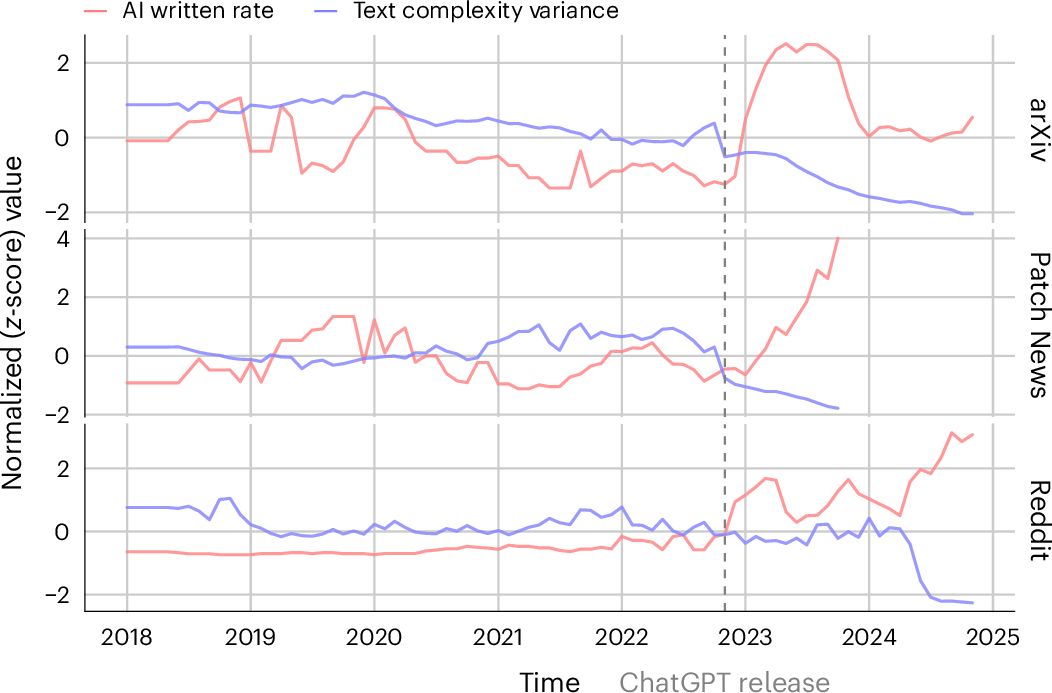
Language is far more than a communication tool; it encodes a wealth of information about a person’s identity, psychological state and social context, providing valuable insights for diverse fields including psychology, marketing and healthcare. Across three studies spanning seven datasets in different domains and over 880,000 texts, we show that the widespread adoption of large language models (LLMs) as writing assistants is linked to declines in linguistic diversity, interfering with the societal and psychological insights language provides. While core content is retained when LLMs polish and rewrite texts, LLMs also homogenize writing styles, reducing writing-complexity variance by a statistically significant 21–50% across datasets and models (P ≤ 0.05), and amplify patterns associated with dominant characteristics while suppressing others, emphasizing conformity over individuality. These trends hold across different LLMs, prompts and contexts, with potential implications for diagnostic processes, personalization efforts, hiring assessments and cultural preservation.
The homogenizing effect of large language models on human expression and thought
AbstractCognitive diversity, reflected in variations of language, perspective, and reasoning, is essential to creativity and collective intelligence. This diversity is rich and grounded in culture, history, and individual experience. Yet, as large language models (LLMs) become deeply embedded in people's lives, they risk standardizing language and reasoning. We synthesize evidence across linguistics, psychology, cognitive science, and computer science to show how LLMs reflect and reinforce dominant styles while marginalizing alternative voices and reasoning strategies. We examine how their design and widespread use contribute to this effect by mirroring patterns in their training data and amplifying convergence as all people increasingly rely on the same models across contexts. Unchecked, this homogenization risks flattening the cognitive landscapes that drive collective intelligence and adaptability.

Who Gets Which Message? Auditing Demographic Bias in LLM-Generated Targeted Text
Large language models (LLMs) are increasingly capable of generating personalized, persuasive text at scale, raising new questions about bias and fairness in automated communication. This paper presents the first systematic analysis of how LLMs behave when tasked with demographic-conditioned targeted messaging. We introduce a controlled evaluation framework using three leading models: GPT-4o, Llama-3.3, and Mistral-Large-2.1, across two generation settings: Standalone Generation, which isolates intrinsic demographic effects, and Context-Rich Generation, which incorporates thematic and regional context to emulate realistic targeting. We evaluate generated messages along three dimensions: lexical content, language style, and persuasive framing. We instantiate this framework on climate communication and find consistent age- and gender-based asymmetries across models: male- and youth-targeted messages tend to emphasize more assertive and progressive framing, while female- and senior-targeted messages more often reflect warmth, care, and traditional themes. Contextual prompts systematically amplify these disparities, with persuasion scores being higher for male-targeted messages, while age-related differences vary across models. Our findings demonstrate how demographic stereotypes can surface and intensify in LLM-generated targeted communication, underscoring the need for bias-aware generation pipelines and transparent auditing frameworks that explicitly account for demographic conditioning in socially sensitive applications.

The homogenizing effect of large language models on human expression and thought
Cognitive diversity, reflected in variations of language, perspective, and reasoning, is essential to creativity and collective intelligence. This diversity is rich and grounded in culture, history, and individual experience. Yet, as large language models (LLMs) become deeply embedded in people’s lives, they risk standardizing language and reasoning. We synthesize evidence across linguistics, psychology, cognitive science, and computer science to show how LLMs reflect and reinforce dominant styles while marginalizing alternative voices and reasoning strategies. We examine how their design and widespread use contribute to this effect by mirroring patterns in their training data and amplifying convergence as all people increasingly rely on the same models across contexts. Unchecked, this homogenization risks flattening the cognitive landscapes that drive collective intelligence and adaptability.
The homogenizing effect of large language models on human expression and thought
Cognitive diversity, reflected in variations of language, perspective, and reasoning, is essential to creativity and collective intelligence. This diversity is rich and grounded in culture, history, and individual experience. Yet, as large language models (LLMs) become deeply embedded in people’s lives, they risk standardizing language and reasoning. We synthesize evidence across linguistics, psychology, cognitive science, and computer science to show how LLMs reflect and reinforce dominant styles while marginalizing alternative voices and reasoning strategies. We examine how their design and widespread use contribute to this effect by mirroring patterns in their training data and amplifying convergence as all people increasingly rely on the same models across contexts. Unchecked, this homogenization risks flattening the cognitive landscapes that drive collective intelligence and adaptability.
Do language models accommodate their users? A study of linguistic convergence
While large language models (LLMs) are generally considered proficient in generating language, how similar their language usage is to that of humans remains understudied. In this paper, we test whether models exhibit linguistic convergence, a core pragmatic element of human language communication: do models adapt, or converge, to the linguistic patterns of their user? To answer this, we systematically compare model completions of existing dialogues to original human responses across sixteen language models, three dialogue corpora, and various stylometric features. We find that models strongly converge to the conversation's style, often significantly overfitting relative to the human baseline. While convergence patterns are often feature-specific, we observe consistent shifts in convergence across modeling settings, with instruction-tuned and larger models converging less than their pretrained and smaller counterparts. Given the differences in human and model convergence patterns, we hypothesize that the underlying mechanisms driving these behaviors are very different.
Do language models accommodate their users? A study of linguistic convergence
While large language models (LLMs) are generally considered proficient in generating language, how similar their language usage is to that of humans remains understudied. In this paper, we test whether models exhibit linguistic convergence, a core pragmatic element of human language communication: do models adapt, or converge, to the linguistic patterns of their user? To answer this, we systematically compare model completions of existing dialogues to original human responses across sixteen language models, three dialogue corpora, and various stylometric features. We find that models strongly converge to the conversation's style, often significantly overfitting relative to the human baseline. While convergence patterns are often feature-specific, we observe consistent shifts in convergence across modeling settings, with instruction-tuned and larger models converging less than their pretrained and smaller counterparts. Given the differences in human and model convergence patterns, we hypothesize that the underlying mechanisms driving these behaviors are very different.
How LLMs Distort Our Written Language
Large language models (LLMs) are used by over a billion people globally, most often to assist with writing. In this work, we demonstrate that LLMs not only alter the voice and tone of human writing but also consistently alter the intended meaning. First, we conduct a human user study to understand how people actually interact with LLMs when using them for writing. Our findings reveal that extensive LLM use led to a nearly 70% increase in essays that remained neutral in answering the topic question. Significantly more heavy LLM users reported that the writing was less creative and not in their voice. Next, using a dataset of human-written essays that was collected in 2021 before the widespread release of LLMs, we study how asking an LLM to revise the essay based on the human-written feedback in the dataset induces large changes in the resulting content and meaning. We find that even when LLMs are prompted with expert feedback and asked to only make grammar edits, they still change the text in a way that significantly alters its semantic meaning. We then examine LLM-generated text in the wild, specifically focusing on the 21% of AI-generated scientific peer reviews at a recent top AI conference. We find that LLM-generated reviews place significantly less weight on clarity and significance of the research, and assign scores that, on average, are a full point higher. These findings highlight a misalignment between the perceived benefit of AI use and an implicit, consistent effect on the semantics of human writing, motivating future work on how widespread AI writing will affect our cultural and scientific institutions.
How LLMs Distort Our Written Language
Large language models (LLMs) are used by over a billion people globally, most often to assist with writing. In this work, we demonstrate that LLMs not only alter the voice and tone of human writing but also consistently alter the intended meaning. First, we conduct a human user study to understand how people actually interact with LLMs when using them for writing. Our findings reveal that extensive LLM use led to a nearly 70% increase in essays that remained neutral in answering the topic question. Significantly more heavy LLM users reported that the writing was less creative and not in their voice. Next, using a dataset of human-written essays that was collected in 2021 before the widespread release of LLMs, we study how asking an LLM to revise the essay based on the human-written feedback in the dataset induces large changes in the resulting content and meaning. We find that even when LLMs are prompted with expert feedback and asked to only make grammar edits, they still change the text in a way that significantly alters its semantic meaning. We then examine LLM-generated text in the wild, specifically focusing on the 21% of AI-generated scientific peer reviews at a recent top AI conference. We find that LLM-generated reviews place significantly less weight on clarity and significance of the research, and assign scores that, on average, are a full point higher. These findings highlight a misalignment between the perceived benefit of AI use and an implicit, consistent effect on the semantics of human writing, motivating future work on how widespread AI writing will affect our cultural and scientific institutions.
Quantifying the Persona Effect in LLM Simulations
Large language models (LLMs) have shown remarkable promise in simulating human language and behavior. This study investigates how integrating persona variables—demographic, social, and behavioral factors—impacts LLMs' ability to simulate diverse perspectives. We find that persona variables account for \ensuremath<10% variance in annotations in existing subjective NLP datasets. Nonetheless, incorporating persona variables via prompting in LLMs provides modest but statistically significant improvements. Persona prompting is most effective in samples where many annotators disagree, but their disagreements are relatively minor. Notably, we find a linear relationship in our setting: the stronger the correlation between persona variables and human annotations, the more accurate the LLM predictions are using persona prompting. In a zero-shot setting, a powerful 70b model with persona prompting captures 81% of the annotation variance achievable by linear regression trained on ground truth annotations. However, for most subjective NLP datasets, where persona variables have limited explanatory power, the benefits of persona prompting are limited.
The diffusion of large language models in published academic articles
Large language models (LLMs) are rapidly changing academic research, raising questions of who is adopting these tools and under what conditions. This article analyzes full texts of 7.3 million journal articles published from 2020–2025 by four major publishers (Elsevier, Frontiers, MDPI, and PLoS) to track the prevalence of LLM-associated language and identify social and institutional correlates of adoption. A corpus of 228 focal words exhibiting sharp post-2022 frequency increases consistent with LLM output was developed; articles were scored on their rate of focal word usage. By 2025, an estimated 57% of published articles exhibited evidence of LLM influence, up from 12% in 2023. Among articles exhibiting LLM-influenced text, there is substantial heterogeneity, ranging from subtle linguistic influence to articles mostly or entirely LLM-generated. Difference-in-differences models reveal that LLM-associated language varies markedly across regions, institutional ranks, publishers, disciplines, and journal tiers. Economic development and proximity to English as a primary language are key predictors of regional variation. Lower-ranked institutions exhibit higher rates than elite universities, young for-profit publishers show elevated rates vis-à-vis competitors, and academic fields differ widely in adoption. LLM adoption in academic writing is pervasive but socially stratified. As models grow more powerful and their use becomes further entrenched in academic research, understanding social dynamics of adoption will be essential for governing the evolving relationship between AI and academic knowledge production.

Do LLMs write like humans? Variation in grammatical and rhetorical styles
As large language models (LLMs) have grown in power and become more widely available, research has focused on their ability to complete various tasks and the biases they exhibit when doing so. In this study, we instead examine their writing style in detail. We show that instruction-tuned models, which are trained to answer questions and solve problems, have a distinct noun-heavy, informationally dense writing style, even when prompted to match the style of informal speech and writing. These findings suggest that instruction-tuned models generate text that does not align with genre conventions familiar to human audiences, and demonstrate the value of linguistic variables in evaluating the output of LLMs., Large language models (LLMs) are capable of writing grammatical text that follows instructions, answers questions, and solves problems. As they have advanced, it has become difficult to distinguish their output from human-written text. While past research has found some differences in features such as word choice and punctuation and developed classifiers to detect LLM output, none has studied the rhetorical styles of LLMs. Using several variants of Llama 3 and GPT-4o, we construct two parallel corpora of human- and LLM-written texts from common prompts. Using Douglas Biber’s set of lexical, grammatical, and rhetorical features, we identify systematic differences between LLMs and humans and between different LLMs. These differences persist when moving from smaller models to larger ones and are larger for instruction-tuned models than base models. This observation of differences demonstrates that despite their advanced abilities, LLMs struggle to match human stylistic variation. Attention to more advanced linguistic features can hence detect patterns in their behavior not previously recognized.

Large language models outperform humans at estimating society's everyday norms—but hybrids are even better
As AI assistants and social robots enter human environments, their ability to navigate context-dependent social norms is essential to avoid harm and ensure successful collaboration. We evaluate six large language models (LLMs) on their ability to estimate American social norms across 555 everyday scenarios (measured in prior work) and compare these to estimates from 320 humans. LLMs achieve remarkably high accuracy, clearly outperforming the average human. However, the errors LLMs make are systematic; they are similar across runs of the same LLM and even across different LLMs. As a consequence of this homogeneity, aggregating estimates of LLMs produces little improvement. Individual humans make much worse estimates, often defaulting to extreme right-or-wrong judgments even when asked to estimate population averages, but their errors are idiosyncratic and, consequently, aggregating their estimates yields dramatic improvement through wisdom-of-crowds effects. As humans make different errors than LLMs, hybrid ensembles combining both substantially outperform either alone.
What and Whose Knowledge? Measuring Epistemic Diversity in Large Language Models
Large language models (LLMs) are increasingly used as primary knowledge sources, yet their epistemic diversity - defined as the diversity of real-world claims in their outputs - has never been measured. Low epistemic diversity would pose a risk of knowledge collapse as homogeneous LLMs mediate a shrinking in the range of accessible information over time. The dominant paradigm is that overall LLM diversity is low, but this is always with respect to a single point in time, with no reference baseline or consideration for variation across countries. We address this gap in knowledge by performing the first systematic study of epistemic diversity in LLMs across time and cultural context, testing 27 LLMs on 155 topics covering 12 countries, resulting in 1.7M responses and 70M individual claims. We find that epistemic diversity has increased substantially over the past three years, a positive counter to recent diversity pessimism. However, despite progress, we find that every system is less diverse than a search baseline. This gap is not uniform: RAG can improve diversity, while large models are counterintuitively less diverse than smaller ones. Moreover, LLM parametric knowledge systematically reflects English over local-language knowledge for country specific topics. Together, these results demonstrate that while progress on epistemic diversity is tangible, it is insufficient and unevenly distributed.
Scientific production in the era of Large Language Models
Large Language Models (LLMs) are rapidly reshaping scientific research. We analyze these changes in multiple, large-scale datasets with 2.1M preprints, 28K peer review reports, and 246M online accesses to scientific documents. We find: 1) scientists adopting LLMs to draft manuscripts demonstrate a large increase in paper production, ranging from 23.7-89.3% depending on scientific field and author background, 2) LLM use has reversed the relationship between writing complexity and paper quality, leading to an influx of manuscripts that are linguistically complex but substantively underwhelming, and 3) LLM adopters access and cite more diverse prior work, including books and younger, less-cited documents. These findings highlight a stunning shift in scientific production that will likely require a change in how journals, funding agencies, and tenure committees evaluate scientific works.
Biased AI writing assistants shift users’ attitudes on societal issues
Artificial intelligence (AI) writing assistants powered by large language models (LLMs) are increasingly used to make autocomplete suggestions to people as they write text. Can these AI writing assistants affect people’s attitudes in this process? In two large-scale preregistered experiments ( N = 2582), we exposed participants writing about important societal issues to an AI writing assistant that provided biased autocomplete suggestions. When using the AI assistant, the attitudes participants expressed in a posttask survey converged toward the AI’s position. However, a majority of participants were unaware of the AI suggestions’ bias and their influence. Further, the influence of the AI writing assistant was stronger than the influence of similar suggestions presented as static text, showing that the influence is not fully explained by these suggestions, increasing accessibility of the biased information. Last, warning participants about assistants’ bias before or after exposure does not mitigate the attitude-shift effect. , Biased AI writing assistants shift people’s attitudes about societal issues; common interventions do not prevent this influence.

Biased AI writing assistants shift users’ attitudes on societal issues
Artificial intelligence (AI) writing assistants powered by large language models (LLMs) are increasingly used to make autocomplete suggestions to people as they write text. Can these AI writing assistants affect people’s attitudes in this process? In two large-scale preregistered experiments ( N = 2582), we exposed participants writing about important societal issues to an AI writing assistant that provided biased autocomplete suggestions. When using the AI assistant, the attitudes participants expressed in a posttask survey converged toward the AI’s position. However, a majority of participants were unaware of the AI suggestions’ bias and their influence. Further, the influence of the AI writing assistant was stronger than the influence of similar suggestions presented as static text, showing that the influence is not fully explained by these suggestions, increasing accessibility of the biased information. Last, warning participants about assistants’ bias before or after exposure does not mitigate the attitude-shift effect. , Biased AI writing assistants shift people’s attitudes about societal issues; common interventions do not prevent this influence.