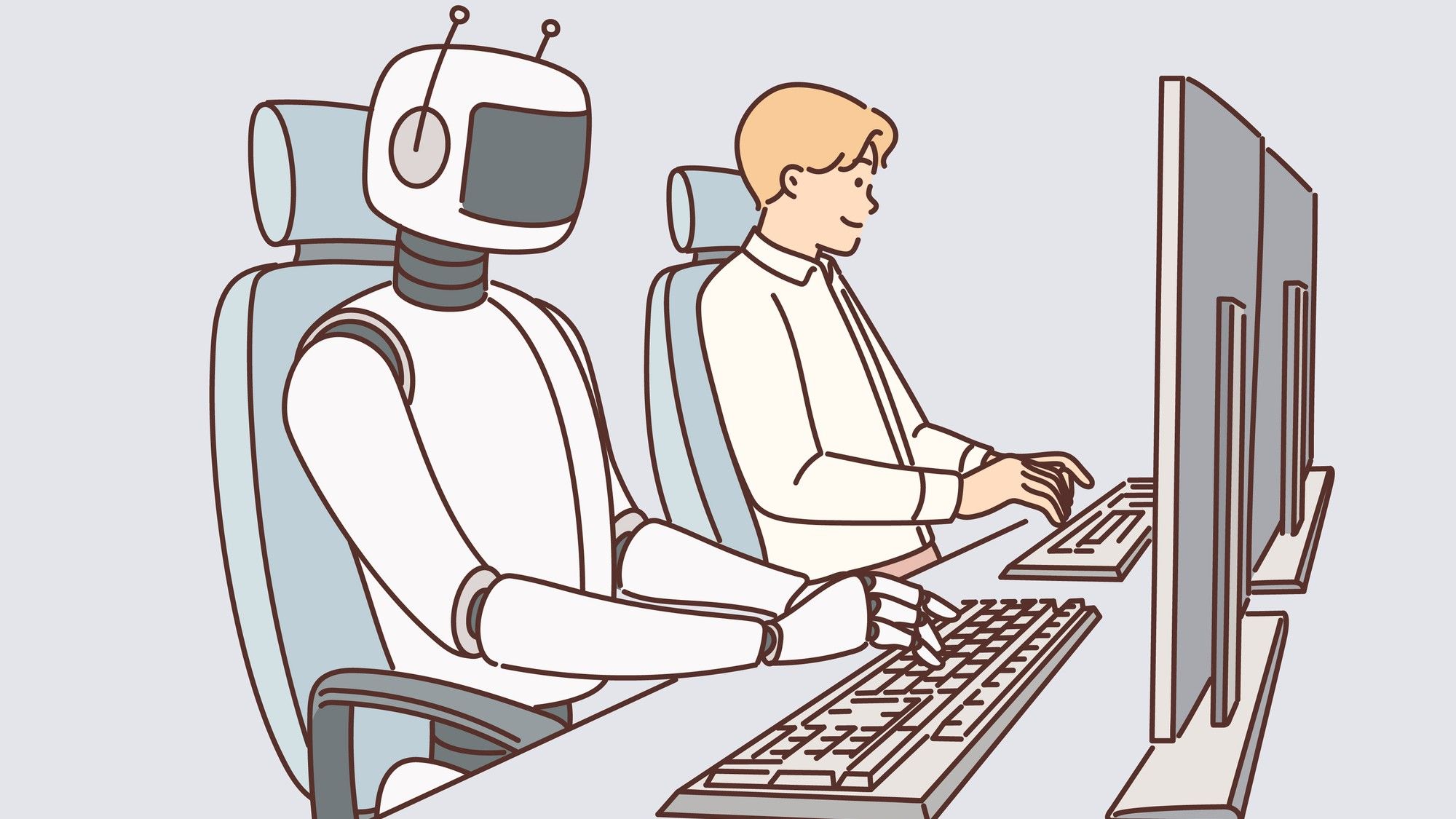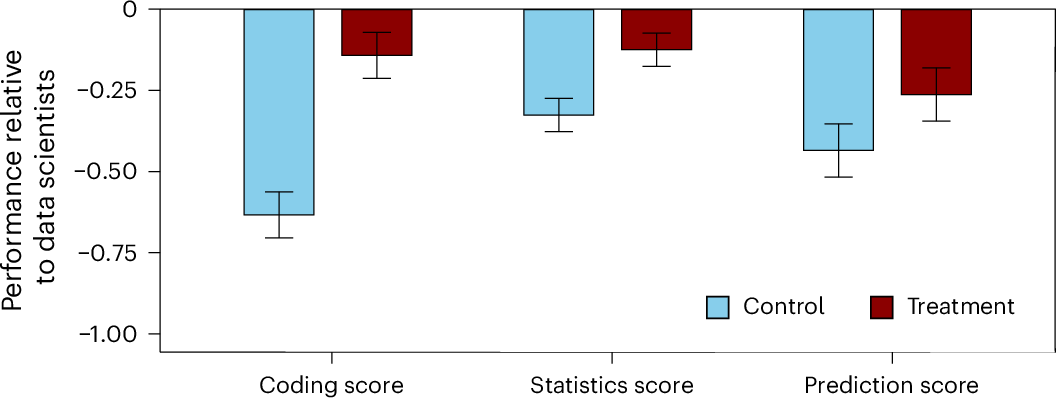
Upskilling often refers to the process by which workers acquire and expand their skills, enabling them to perform different types of work as market demands change. Here we demonstrate that generative artificial intelligence can act as an ‘exoskeleton’, enhancing workers’ capabilities when attempting new skills, but these gains depend on continued technology use. We run a randomized controlled trial on upskilling by providing management consultants (N = 487) access and training in using ChatGPT to solve data science tasks outside their skill sets, which cannot be independently solved by ChatGPT. The treated workers scored higher than the control group on three tasks, although we can reject the hypothesis that they performed as well as expert data scientists. We find no evidence that treated workers are better at answering technical questions without ChatGPT post-experiment, suggesting that their demonstrated technical capabilities do not imply knowledge acquisition.
What do professional software developers need to know to succeed in an age of Artificial Intelligence?
Generative AI is showing early evidence of productivity gains for software developers, but concerns persist regarding workforce disruption and deskilling. We describe our research with 21 developers at the cutting edge of using AI, summarizing 12 of their work goals we uncovered, together with 75 associated tasks and the skills & knowledge for each, illustrating how developers use AI at work. From all of these, we distilled our findings in the form of 5 insights. We found that the skills & knowledge to be a successful AI-enhanced developer are organized into four domains (using Generative AI effectively, core software engineering, adjacent engineering, and adjacent non-engineering) deployed at critical junctures throughout a 6-step task workflow. In order to "future proof" developers for this age of AI, on-the-job learning initiatives and computer science degree programs will need to target both "soft" skills and the technical skills & knowledge in all four domains to reskill, upskill and safeguard against deskilling.

Learning by Chatting? Investigating the Impact of Generative AI on Information Seeking and Learning
Generative AI (GenAI) tools offer increasing opportunities for augmenting human cognitive tasks. Among these tasks, information seeking is being rapidly reshaped by GenAI tools, with potentially profound implications for learning and knowledge acquisition. To investigate these implications, we conducted a between-subjects field experiment in which participants pursued informal learning by seeking information through either ChatGPT or Google Search over a span of 8 days. Using a daily diary protocol, we gathered in-situ data on their information-seeking processes. Our findings show that participants in the ChatGPT group experienced diminished agency in their information-seeking processes, as they offloaded much of the information selection to AI, and consequently experienced greater meta-cognitive load arising from this reduced sense of control. We further highlight two sources of distortion in information access when using ChatGPT: biases in ChatGPT outputs, particularly towards providing solution-oriented artifacts over principled knowledge; and systematic shifts in users' information-seeking behaviors, whereby the conversational and socially-oriented interaction paradigm of current GenAI tools may inadvertently reduce exploration of the broader knowledge space. As a result, on average, participants in the ChatGPT group had worse learning outcomes than those using Google, especially for higher-order critical learning. Our work suggests inherent tensions between offloading information seeking to AI and meaningful learning, and provides broader implications for understanding AI's risks to human cognition.
The Impact of Generative AI on Critical Thinking: Self-Reported Reductions in Cognitive Effort and Confidence Effects From a Survey of Knowledge Workers
The rise of Generative AI (GenAI) in knowledge workflows raises questions about its impact on critical thinking skills and practices. We survey 319 knowledge workers to investigate 1) when and how they perceive the enaction of critical thinking when using GenAI, and 2) when and why GenAI affects their effort to do so. Participants shared […]
Generative AI without guardrails can harm learning: Evidence from high school mathematics
Generative AI is poised to revolutionize how humans work, and has already demonstrated promise in significantly improving human productivity. A key question is how generative AI affects learning—namely, how humans acquire new skills as they perform tasks. Learning is critical to long-term productivity, especially since generative AI is fallible and users must check its outputs. We study this question via a field experiment where we provide nearly a thousand high school math students with access to generative AI tutors. To understand the differential impact of tool design on learning, we deploy two generative AI tutors: one that mimics a standard ChatGPT interface (“GPT Base”) and one with prompts designed to safeguard learning (“GPT Tutor”). Consistent with prior work, our results show that having GPT-4 access while solving problems significantly improves performance (48% improvement in grades for GPT Base and 127% for GPT Tutor). However, we additionally find that when access is subsequently taken away, students actually perform worse than those who never had access (17% reduction in grades for GPT Base)—i.e., unfettered access to GPT-4 can harm educational outcomes. These negative learning effects are largely mitigated by the safeguards in GPT Tutor. Without guardrails, students attempt to use GPT-4 as a “crutch” during practice problem sessions, and subsequently perform worse on their own. Thus, decision-makers must be cautious about design choices underlying generative AI deployments to preserve skill learning and long-term productivity.

Gender disparities in the impact of generative artificial intelligence: Evidence from academia
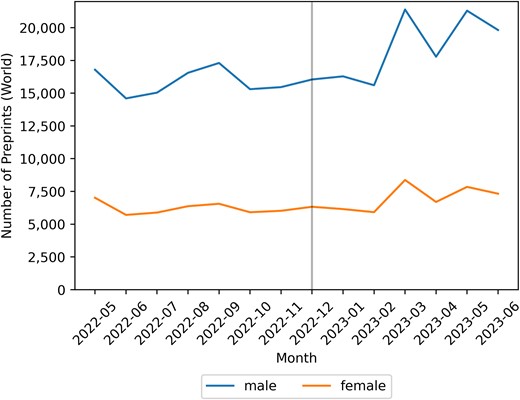
Abstract. The emergence of generative artificial intelligence (AI) tools such as ChatGPT has substantially increased individuals’ productivity. In this stu
Still Waters, Rapid Currents: Early Labor Market Transformation under Generative AI
We study the early labor market impacts of AI chatbots by linking large-scale adoption surveys to administrative labor market records in Denmark. We document rapid currents: most employers in exposed occupations have adopted chatbot initiatives, workers report productivity benefits, and new AI-related tasks are widespread. Yet these currents have not broken the surface: using difference-indifferences, we estimate precise null effects on earnings and recorded hours at both the worker and workplace levels, ruling out effects larger than 2% two years after the launch of ChatGPT. What moves is the structure of work: employers absorb AI through task reorganization—including new tasks in content generation, AI oversight, and AI integration—and adopters transition into higher-paying occupations where AI chatbots are more relevant, though still too few to move average earnings. Technological change reshapes work well before it surfaces in earnings or hours.

AI tools make things up a lot, and that’s a huge problem | CNN Business
Artificial intelligence-powered tools like ChatGPT have mesmerized us with their ability to produce authoritative, human-sounding responses to seemingly any prompt. But as more people turn to this buzzy technology for things like homework help, workplace research, or health inquiries, one of its biggest pitfalls is becoming increasingly apparent: AI models sometimes just make things up.
When Using AI, Users Fall for the Dunning-Kruger Trap in Reverse - Neuroscience News
A new study reveals that when interacting with AI tools like ChatGPT, everyone—regardless of skill level—overestimates their performance.

Tech companies are cutting jobs and betting on AI. The payoff is far from guaranteed
AI experts say we’re living in an experiment that may fundamentally change the model of work

How AI Impacts Skill Formation
AI assistance produces significant productivity gains across professional domains, particularly for novice workers. Yet how this assistance affects the development of skills required to effectively supervise AI remains unclear. Novice workers who rely heavily on AI to complete unfamiliar tasks may compromise their own skill acquisition in the process. We conduct randomized experiments to study how developers gained mastery of a new asynchronous programming library with and without the assistance of AI. We find that AI use impairs conceptual understanding, code reading, and debugging abilities, without delivering significant efficiency gains on average. Participants who fully delegated coding tasks showed some productivity improvements, but at the cost of learning the library. We identify six distinct AI interaction patterns, three of which involve cognitive engagement and preserve learning outcomes even when participants receive AI assistance. Our findings suggest that AI-enhanced productivity is not a shortcut to competence and AI assistance should be carefully adopted into workflows to preserve skill formation -- particularly in safety-critical domains.
Is AI ruining our skills? Early results are in — and they’re not good
Reliance on artificial-intelligence tools degrades the abilities of physicians and software engineers, studies show.

AI systems out-persuade expert humans
Many societal decisions are settled by contests of persuasion. Conversational AI is a powerful new entrant in these contests, but whether it can out-persuade skilled and highly incentivized humans has remained unclear. Here, in a series of four preregistered experiments (n = 18,978 conversations from 6,923 people), we pitted AI systems against a range of human persuaders, including laypeople, winners of a separately preregistered four-round online persuasion tournament, professional canvassers, and world championship debaters. We found that AI systems were reliably more persuasive than expert humans, even when expert humans chose their issues, researched in advance, underwent hours of live, structured practice, and were incentivized with £1,000 cash bonuses. In a follow-up study, AI's advantage persisted after experts received a coaching tool that let them practice against the AI that beat them, review their performance history, and see what AI would have said at key moments. We found converging evidence that AI's advantage stemmed from rapidly deploying larger quantities of information: after coaching, expert humans could tie an AI constrained to respond at human speeds and with human-length messages. In a final study, we show that AI's advantage extends to consequential real-world behavior: AI was nearly 3x more effective than professional canvassers from a UK fundraising firm at raising real-money donations to Save the Children. Together, these results establish that frontier AI systems out-persuade expert humans in conversation, with significant implications for political communication.
How Coders Can Survive—and Thrive—in a ChatGPT World
4 tips for programmers to stay ahead of generative AI

‘Deskilling’: a dangerous side effect of AI use
Workers are increasingly reliant on the new technology