

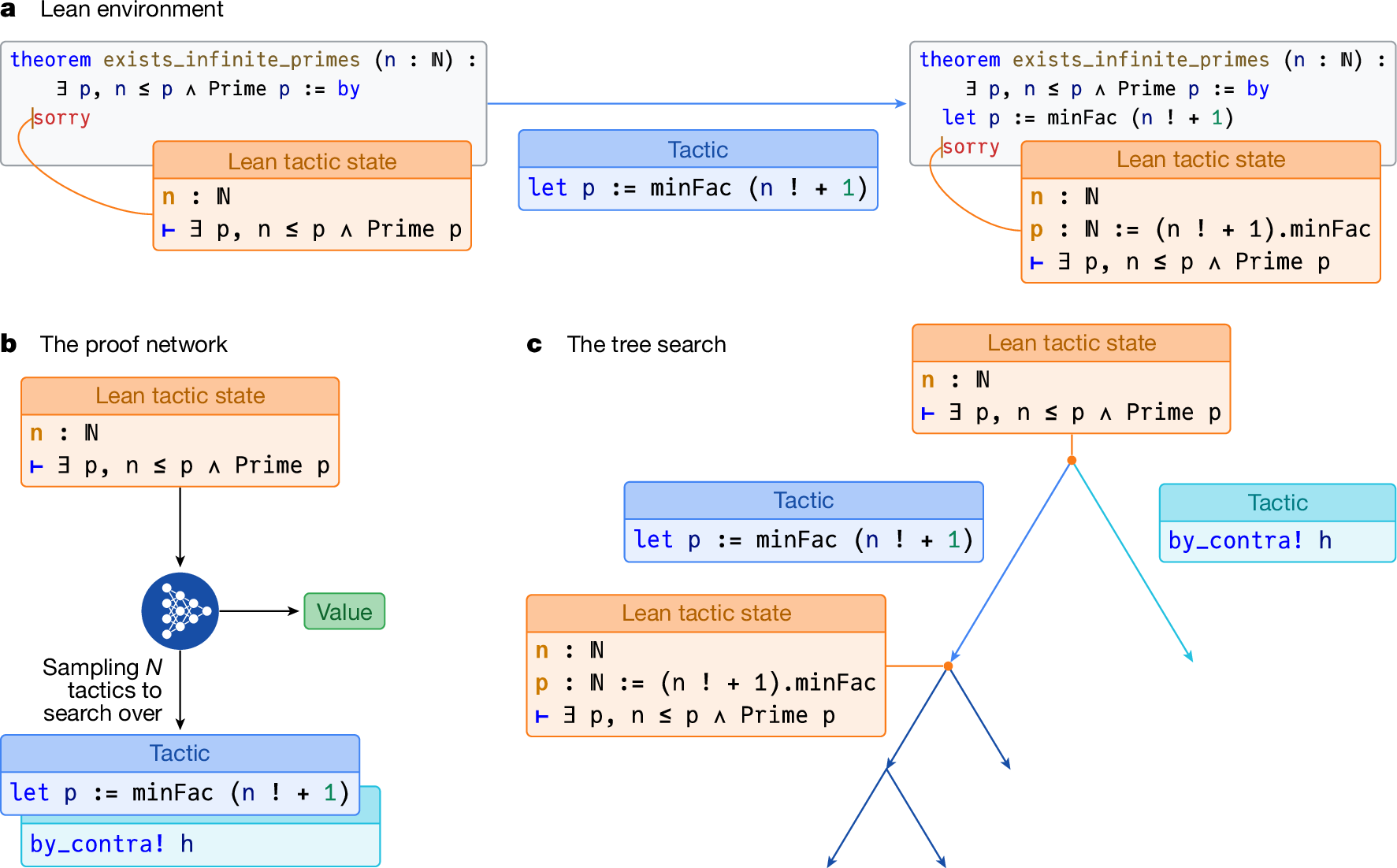
A long-standing goal of artificial intelligence (AI) is to build systems capable of complex reasoning in vast domains, a task epitomized by mathematics with its boundless concepts and demand for rigorous proof. Recent AI systems, often reliant on human data, typically lack the formal verification necessary to guarantee correctness. By contrast, formal languages such as Lean1 offer an interactive environment that grounds reasoning, and reinforcement learning (RL) provides a mechanism for learning in such environments. Here we present AlphaProof, an AlphaZero-inspired2 agent that learns to find formal proofs through RL by training on millions of auto-formalized problems. For the most difficult problems, it uses test-time RL, a method of generating and learning from millions of related problem variants at inference time to enable deep, problem-specific adaptation. AlphaProof substantially improves state-of-the-art results on historical mathematics competition problems. At the 2024 International Mathematical Olympiad competition, our AI system, with AlphaProof as its core reasoning engine, solved three out of the five non-geometry problems, including the competition’s most difficult problem. Combined with AlphaGeometry 23, this performance, achieved with multi-day computation, resulted in reaching a score equivalent to that of a silver medallist, marking the first time an AI system achieved any medal-level performance, to our knowledge. Our work demonstrates that learning at scale from grounded experience produces agents with complex mathematical reasoning strategies, paving the way for a reliable AI tool in complex mathematical problem solving.
Advancing Mathematics Research with AI-Driven Formal Proof Search
Large language models (LLMs) increasingly excel at mathematical reasoning, but their unreliability limits their utility in mathematics research. A mitigation is using LLMs to generate formal proofs in languages like Lean. We perform the first large-scale evaluation of this method's ability to solve open problems. Our most capable agent autonomously resolved 9 of 353 open Erdős problems at the per-problem cost of a few hundred dollars, proved 44/492 OEIS conjectures, and is being deployed in combinatorics, optimization, graph theory, algebraic geometry, and quantum optics research. A basic agent alternating LLM-based generation with Lean-based verification replicated the Erdős successes but proved costlier on the hardest problems. These findings demonstrate the power of AI-aided formal proof search and shed light on the agent designs that enable it.

Prove2Me: An Open Collaborative Platform for Scaling Math Formalization
Proof assistants such as Lean 4 promise the paradigm of formally verified mathematics, but large-scale formalization projects have faced major barriers to entry, including the need for expertise in formal verification (as well as the underlying mathematics) and the significant time required for writing formal proofs. AI coding agents have dramatically reduced these barriers; human users can now use natural language to prompt agents to write complex proofs in Lean. This opens up the intriguing possibility of internet-scale mathematical collaboration involving both humans and AI agents, where correctness is machine-checked. To realize this possibility, we introduce Prove2Me (https://prove2.me), an open collaborative platform for formalizing mathematics. Users launch formalization "missions", to which AI agents contribute formal proofs toward completion. We designed mechanisms and a specialized harness in Prove2Me that enable large-scale collaboration so that agents can build on one another's work and freely reuse existing results. In doing so, Prove2Me aims to turn math formalization into a scalable, crowd-sourced effort open to anyone with an agent.
AI co-mathematician: Accelerating mathematicians with agentic AI
We introduce the AI co-mathematician, a workbench for mathematicians to interactively leverage AI agents to pursue open-ended research. The AI co-mathematician is optimized to provide holistic support for the exploratory and iterative reality of mathematical workflows, including ideation, literature search, computational exploration, theorem proving and theory building. By providing an asynchronous, stateful workspace that manages uncertainty, refines user intent, tracks failed hypotheses, and outputs native mathematical artifacts, the system mirrors human collaborative workflows. In early tests, the AI co-mathematician helped researchers solve open problems, identify new research directions, and uncover overlooked literature references. Besides demonstrating a highly interactive paradigm for AI-assisted mathematical discovery, the AI co-mathematician also achieves state of the art results on hard problem-solving benchmarks, including scoring 48% on FrontierMath Tier 4, a new high score among all AI systems evaluated.
TextWorld: A Learning Environment for Text-based Games
We introduce TextWorld, a sandbox learning environment for the training and evaluation of RL agents on text-based games. TextWorld is a Python library that handles interactive play-through of text games, as well as backend functions like state tracking and reward assignment. It comes with a curated list of games whose features and challenges we have analyzed. More significantly, it enables users to handcraft or automatically generate new games. Its generative mechanisms give precise control over the difficulty, scope, and language of constructed games, and can be used to relax challenges inherent to commercial text games like partial observability and sparse rewards. By generating sets of varied but similar games, TextWorld can also be used to study generalization and transfer learning. We cast text-based games in the Reinforcement Learning formalism, use our framework to develop a set of benchmark games, and evaluate several baseline agents on this set and the curated list.
Propose, Solve, Verify: Self-Play Through Formal Verification
Training models through self-play alone (without any human data) has been a longstanding goal in AI, but its effectiveness for training large language models remains unclear, particularly in code generation where rewards based on unit tests are brittle and prone to error propagation. We study self-play in the verified code generation setting, where formal verification provides reliable correctness signals. We introduce Propose, Solve, Verify (PSV) a simple self-play framework where formal verification signals are used to create a proposer capable of generating challenging synthetic problems and a solver trained via expert iteration. We use PSV to train PSV-Verus, which across three benchmarks improves pass@1 by up to 9.6x over inference-only and expert-iteration baselines. We show that performance scales with the number of generated questions and training iterations, and through ablations identify formal verification and difficulty-aware proposal as essential ingredients for successful self-play.
Eliciting Reasoning in Language Models with Cognitive Tools
The recent advent of reasoning models like OpenAI's o1 was met with excited speculation by the AI community about the mechanisms underlying these capabilities in closed models, followed by a rush of replication efforts, particularly from the open source community. These speculations were largely settled by the demonstration from DeepSeek-R1 that chains-of-thought and reinforcement learning (RL) can effectively replicate reasoning on top of base LLMs. However, it remains valuable to explore alternative methods for theoretically eliciting reasoning that could help elucidate the underlying mechanisms, as well as providing additional methods that may offer complementary benefits. Here, we build on the long-standing literature in cognitive psychology and cognitive architectures, which postulates that reasoning arises from the orchestrated, sequential execution of a set of modular, predetermined cognitive operations. Crucially, we implement this key idea within a modern agentic tool-calling framework. In particular, we endow an LLM with a small set of "cognitive tools" encapsulating specific reasoning operations, each executed by the LLM itself. Surprisingly, this simple strategy results in considerable gains in performance on standard mathematical reasoning benchmarks compared to base LLMs, for both closed and open-weight models. For instance, providing our "cognitive tools" to GPT-4.1 increases its pass@1 performance on AIME2024 from 32% to 53%, even surpassing the performance of o1-preview. In addition to its practical implications, this demonstration contributes to the debate regarding the role of post-training methods in eliciting reasoning in LLMs versus the role of inherent capabilities acquired during pre-training, and whether post-training merely uncovers these latent abilities.
Training Agentic Reasoners — Will Brown, Prime Intellect
Accelerating Scientific Research with Gemini: Case Studies and Common Techniques
Recent advances in large language models (LLMs) have opened new avenues for accelerating scientific research. While models are increasingly capable of assisting with routine tasks, their ability to contribute to novel, expert-level mathematical discovery is less understood. We present a collection of case studies demonstrating how researchers have successfully collaborated with advanced AI models, specifically Google's Gemini-based models (in particular Gemini Deep Think and its advanced variants), to solve open problems, refute conjectures, and generate new proofs across diverse areas in theoretical computer science, as well as other areas such as economics, optimization, and physics. Based on these experiences, we extract common techniques for effective human-AI collaboration in theoretical research, such as iterative refinement, problem decomposition, and cross-disciplinary knowledge transfer. While the majority of our results stem from this interactive, conversational methodology, we also highlight specific instances that push beyond standard chat interfaces. These include deploying the model as a rigorous adversarial reviewer to detect subtle flaws in existing proofs, and embedding it within a "neuro-symbolic" loop that autonomously writes and executes code to verify complex derivations. Together, these examples highlight the potential of AI not just as a tool for automation, but as a versatile, genuine partner in the creative process of scientific discovery.
Build a Reasoning Model (From Scratch)
"An exceptional deep dive into the next frontier of AI.” —Aman Chadha, Google Build a Reasoning Model (From Scratch) is a practical guide to understanding how modern reasoning-oriented LLMs work by building their core methods step by step. The book tells a clear engineering story: start with a conventional pre-trained LLM, learn how text generation works, build reliable evaluation tools, improve reasoning through inference-time methods, then move into training-based approaches such as reinforcement learning and distillation. The progression is deliberate. Early chapters establish the baseline model and explain text generation, KV caching, and evaluation with math verifiers. The middle chapters show how reasoning can be improved without changing model weights, using chain-of-thought prompting, sampling, self-consistency, response scoring, and self-refinement. Later chapters move to changing the model itself through reinforcement learning with verifiable rewards, GRPO improvements, format rewards, and finally distillation from stronger reasoning models into smaller ones. The book is especially useful because it implements the core methods from scratch rather than treating them as black-box library calls. Readers see how self-consistency, self-refinement, Best-of-N, and training-based methods actually work, including their cost and latency trade-offs. It also discusses common failure modes, including cases where refinement can make answers worse. Difficult concepts such as softmax, temperature, and top-p sampling are clarified with code-linked explanations and diagrams, and visual workflows make pipelines and scoring methods easier to follow. Reading the book feels like following a guided technical build rather than a loose survey of AI topics. Each concept is introduced because the project now needs it. Diagrams, roadmaps, code listings, exercises, and repeated workflow summaries help readers stay oriented through advanced material. This structure reflects Sebastian Raschka’s professional strength: explaining complex machine learning topics by making every detail concrete and showing exactly where each section fits in the larger story. He does not treat mechanisms like evaluation, log-probabilities, KL regularization, or distillation as isolated abstractions; he connects them to the goal of making reasoning models understandable and implementable. Physically and organizationally, the book has eight chapters and seven substantial appendixes. That design keeps the main narrative focused while moving supporting material like references, exercise solutions, model source code, larger models, batching, evaluation alternatives, and chat interfaces into ordered appendixes. The result is a logically flowing book that remains hands-on, navigable, and technically deep without constantly interrupting the central build.

Look-ahead Reasoning with a Learned Model in Imperfect Information Games
Test-time reasoning significantly enhances pre-trained AI agents' performance. However, it requires an explicit environment model, often unavailable or overly complex in real-world scenarios....
Exploring the interplay between AI and human logic in mathematical problem-solving
This paper investigates the dynamic interplay between Artificial Intelligence (AI) and human logic in the domain of mathematical problem-solving. By critically examining a series of case studies, we compare the efficacy of AI-generated solutions, particularly those offered by ChatGPT, against traditional human problem-solving methods. The study employs various mathematical challenges, ranging from abstract logical puzzles to applied numerical problems, to evaluate AI's problem-solving approach and alignment with human cognitive processes. Our analysis highlights instances where AI's computational strategies complement or diverge from human reasoning, shedding light on AI's potential and limitations in deciphering mathematical problems. Furthermore, we explore the implications of integrating AI tools in educational contexts, specifically their role in enhancing students' mathematical problem-solving skills. The paper aims to contribute to the ongoing discourse on the optimal utilization of AI in education, proposing a balanced approach that leverages AI's computational power while fostering the depth and creativity of human logic. Through this comparative study, we advocate for a collaborative model where AI and human reasoning merge to enrich the educational landscape, particularly in the teaching and learning of mathematics.

ARC-AGI-3
ARC-AGI-3 is the first interactive reasoning benchmark for AI agents—play as humans and build agents that learn in novel environments.
ARC-AGI-3: A New Challenge for Frontier Agentic Intelligence
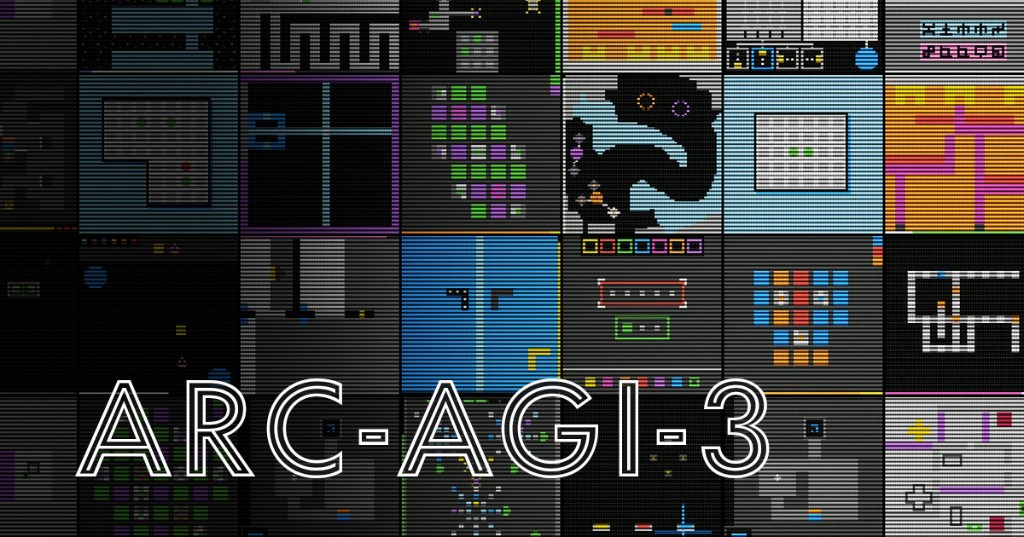
We introduce ARC-AGI-3, an interactive benchmark for studying agentic intelligence through novel, abstract, turn-based environments in which agents must explore, infer goals, build internal models of environment dynamics, and plan effective action sequences without explicit instructions. Like its predecessors ARC-AGI-1 and 2, ARC-AGI-3 focuses entirely on evaluating fluid adaptive efficiency on novel tasks, while avoiding language and external knowledge. ARC-AGI-3 environments only leverage Core Knowledge priors and are difficulty-calibrated via extensive testing with human test-takers. Our testing shows humans can solve 100% of the environments, in contrast to frontier AI systems which, as of March 2026, score below 1%. In this paper, we present the benchmark design, its efficiency-based scoring framework grounded in human action baselines, and the methodology used to construct, validate, and calibrate the environments.
The Hitchhiker's Guide to Agentic AI: From Foundations to Systems
The Hitchhiker's Guide to Agentic AI is a comprehensive practitioner's reference for building autonomous AI systems. The book covers the full stack from first principles to production deployment, organized around a central thesis: building great agentic systems requires understanding every layer of the pipeline, not just one. The book opens with the LLM substrate -- transformer architecture, GPU systems, training and fine-tuning (SFT,LoRA, MoE), model compression, and inference optimization -- treated as essential foundations rather than the primary focus. It then develops the alignment and reasoning layer: reinforcement learning from human feedback (RLHF), PPO, DPO and its variants, GRPO, reward modeling, and RL for large reasoning models including chain-of-thought and test-time scaling. The second half is devoted to agentic AI proper. Topics include agentic training and trajectory-based RL, retrieval-augmented generation (RAG and Agentic RAG), memory systems (in-context, external, episodic, and semantic), agent harness design and context management, and a taxonomy of agent design patterns. Inter-agent coordination is covered in depth: the Model Context Protocol (MCP), agent skills and tool use, the Agent-to-Agent (A2A) communication protocol, and multi-agent architectures spanning centralized, decentralized, and hierarchical topologies. The book concludes with agent development frameworks, agentic UI design, evaluation methodology for agentic tasks, and production deployment. Each chapter pairs rigorous theoretical foundations with implementation guidance, code examples, and references to the primary literature.
Bridging the human–AI knowledge gap through concept discovery and transfer in AlphaZero
AI systems have attained superhuman performance across various domains. If the hidden knowledge encoded in these highly capable systems can be leveraged, human knowledge and performance can be advanced. Yet, this internal knowledge is difficult to extract. Due to the vast space of possible internal representations, searching for meaningful new conceptual knowledge can be like finding a needle in a haystack. Here, we introduce a method that extracts new chess concepts from AlphaZero, an AI system that mastered chess via self-play without human supervision. Our method excavates vectors that represent concepts from AlphaZero’s internal representations using convex optimization, and filters the concepts based on teachability (whether the concept is transferable to another AI agent) and novelty (whether the concept contains information not present in human chess games). These steps ensure that the discovered concepts are useful and meaningful. For the resulting set of concepts, prototypes (chess puzzle–solution pairs) are presented to experts for final validation. In a preliminary human study, four top chess grandmasters (all former or current world chess champions) were evaluated on their ability to solve concept prototype positions. All grandmasters showed improvement after the learning phase, suggesting that the concepts are at the frontier of human understanding. Despite the small scale, our result is a proof of concept demonstrating the possibility of leveraging knowledge from a highly capable AI system to advance the frontier of human knowledge; a development that could bear profound implications and shape how we interact with AI systems across many applications.

DeepRefine: Agent-Compiled Knowledge Refinement via Reinforcement Learning
Agent-compiled knowledge bases provide persistent external knowledge for large language model (LLM) agents in open-ended, knowledge-intensive downstream tasks. Yet their quality is systematically limited by \emph{incompleteness}, \emph{incorrectness}, and \emph{redundancy}, manifested as missing evidence or cross-document links, low-confidence or imprecise claims, and ambiguous or coreference resolution issues. Such defects compound under iterative use, degrading retrieval fidelity and downstream task performance. We present \textbf{DeepRefine}, a general LLM-based reasoning model for \emph{agent-compiled knowledge refinement} that improves the quality of any pre-constructed knowledge bases with user queries to make it more suitable for the downstream tasks. DeepRefine performs multi-turn interactions with the knowledge base and conducts abductive diagnosis over interaction history, localizes likely defects, and executes targeted refinement actions for incremental knowledge base updates. To optimize refinement policies of DeepRefine without gold references, we introduce a Gain-Beyond-Draft (GBD) reward and train the reasoning process end-to-end via reinforcement learning. Extensive experiments demonstrate consistent downstream gains over strong baselines.